
You’ll find six wild deer species roaming the UK: red, roe, fallow, sika, muntjac, and Chinese water deer. From the hefty, impressive red deer to the pint-sized muntjac and water deer, each species has its own quirks and features you can actually spot if you know what to look for.
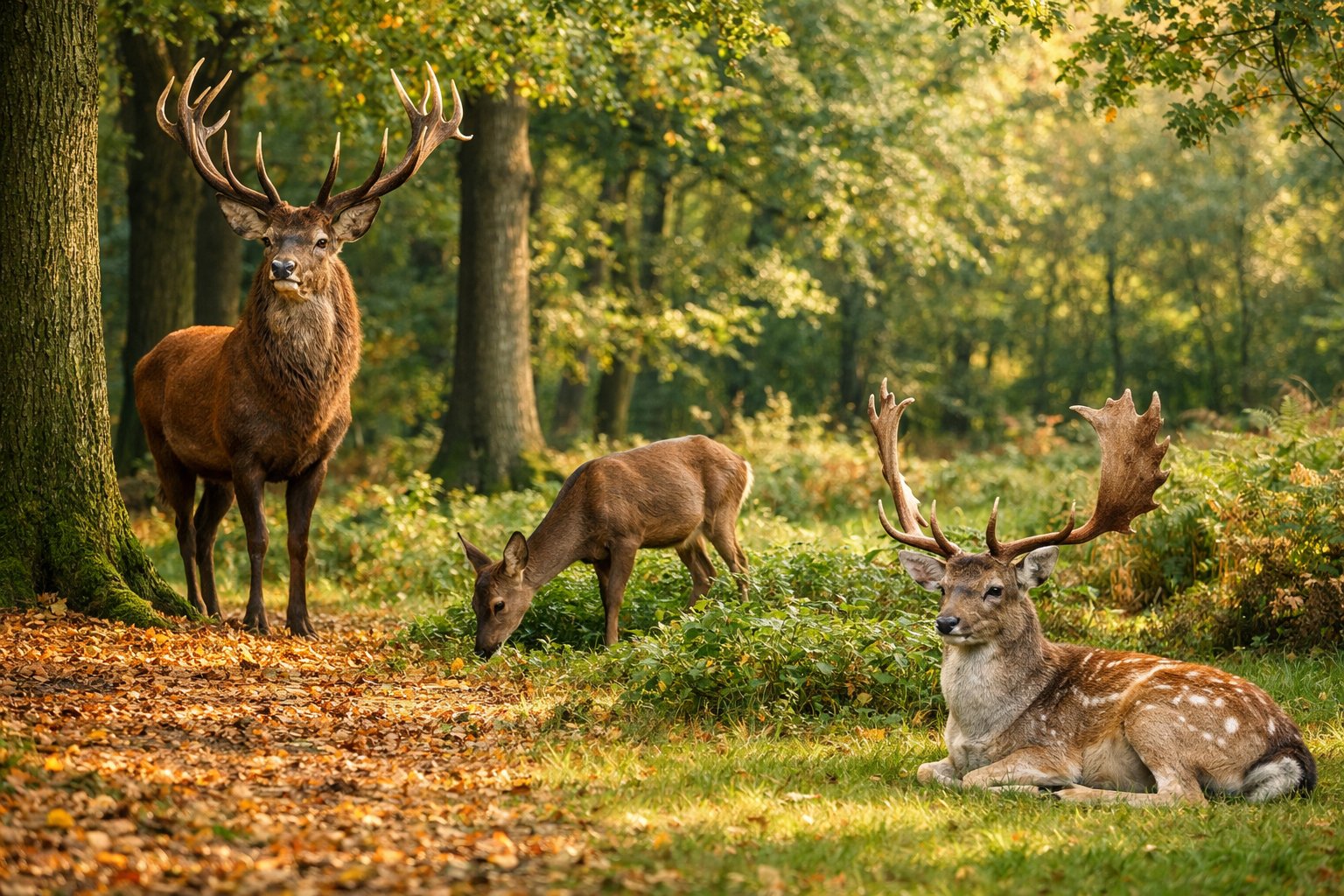
Step into a woodland, park, or even a patch of fenland, and you’ll probably notice the different body shapes, sizes, and behaviors. These clues can help you figure out which species you’re looking at.
The next bits will show you where to find each one, what stands out, and why muntjac and Chinese water deer are a bit odd compared to the rest.
The Six Main Types of Deer in the UK

You’ll get a sense of which large and medium deer you might bump into in woods, fields, or moorland. It’s not too hard to spot the difference between males and females once you know what to look for.
Plus, you’ll see where each species likes to live in the UK.
Red Deer (Cervus elaphus)
Red deer are the UK’s biggest wild deer. Adult stags can tip the scales at over 200 kg and grow branched antlers every autumn.
You’ll usually find them in Scotland’s Highlands, some parts of England, and out on moorland where they graze and browse.
When autumn rolls around, stags roar and clash antlers to win over hinds. Hinds give birth to a single calf in late spring.
Their coats go reddish-brown in summer, then turn greyer in winter. The British Deer Society lists red deer as a key UK species.
Key ID points:
- Large, tall-legged build
- Stags grow branched antlers
- Reddish coat in summer, greyer in winter
Roe Deer (Capreolus capreolus)
Roe deer are much smaller and honestly, you’ll see them pretty often across England, Wales, and Scotland. They seem to love woodland edges, hedgerows, and farmland.
Roe bucks grow short, upright antlers, but the does don’t have antlers at all.
Roe are nimble and usually keep to themselves or stick with a small family group. They give birth to one to three fawns in late spring.
Their coats are chestnut in summer and fade to grey-brown in winter. If you spot a small, white rump patch and a tiny tail as they leap away, you’ve probably seen a roe.
Key ID points:
- Small, compact body
- Bucks have short antlers
- White rump patch; quick, springy escape
Fallow Deer (Dama dama)
Fallow deer fall into the medium-sized category and you’ll spot them in parks, big estates, and patches of woodland across England and Wales.
People probably introduced them centuries ago, and now they’re settled in nicely. Bucks grow palm-shaped antlers that look pretty wide and flat.
Their coats can really vary. The most common is chestnut with white spots in summer, but you might see darker or almost black ones too.
During the autumn rut, bucks call out and defend their patch. Hinds usually have a single fawn in late spring.
Fallow deer seem to prefer mixed woodland and open grassland.
Key ID points:
- Bucks sport palm-shaped antlers
- Spotted coats in summer (usually)
- Often seen in parkland and mixed woods
Sika Deer (Cervus nippon)
Sika deer originally came from East Asia, but now you’ll find them mostly in western Scotland, parts of northern England, and Ireland.
They’re about the same size as red deer, but usually darker and often keep their spots all year. Sika stags grow narrower, spike-like antlers.
Sika like coniferous woods, heath, and moorland. They sometimes hybridise with red deer where their ranges overlap, which is a bit of a headache for conservation.
During the rut, sika stags let out high, piercing calls. Hinds have one calf each year.
The British Deer Society keeps an eye on their expanding range in the UK.
Key ID points:
- Medium-large, usually dark or spotted
- Stags have narrow antlers
- Found in conifer woods and moorland
Distinctive Characteristics of Muntjac and Chinese Water Deer

Let’s talk about these two small Asian deer—muntjac and Chinese water deer. They really don’t look or act like the others.
One has short antlers and makes a weird bark-like call. The other doesn’t have antlers at all but flashes long, tusk-like teeth.
Muntjac Deer (Muntiacus reevesi)
You’ll usually find muntjac alone, hiding out in dense woodland and thick hedgerows. They stand about 50–65 cm tall at the shoulder and weigh between 7–18 kg.
Males grow short, single-point antlers and have a little crest of hair on their forehead. Both males and females have scent glands on their face and throat, and the males use these a lot during the rut.
If you hear a sharp, barking call at night, that’s probably a muntjac. Look for small, round tracks and heavy browsing on young shoots and saplings.
They mark their territory with scrapes and droppings. Their Latin name is Muntiacus reevesi, and they’re part of the deer family Cervidae.
Chinese Water Deer (Hydropotes inermis)
You’ll probably spot Chinese water deer hanging around wet ground or tucked into thick cover. They look a lot like muntjac in size, but you won’t find any antlers on them.
Instead, the males grow these long upper canine teeth—basically tusks—that stick out and come in handy for fighting or just showing off. Their faces look longer, and their ears seem pretty big compared to other deer.
Sometimes you’ll come across narrow, cloven tracks or patches where they’ve grazed the low vegetation right down to the ground. Chinese water deer tend to get active at dusk and dawn.
They usually stay quieter than muntjac, not making much noise. The scientific name is Hydropotes inermis. When they browse, they can really change how young trees regenerate.


