
Alright, here’s the quick answer you probably want: you just can’t outrun a deer in a short sprint—deer hit much higher top speeds and leave us in the dust when it comes to acceleration. But if you’re talking about long distances, well, things get a bit more interesting. Stamina, terrain, and even the deer’s age or health can tip the scales.
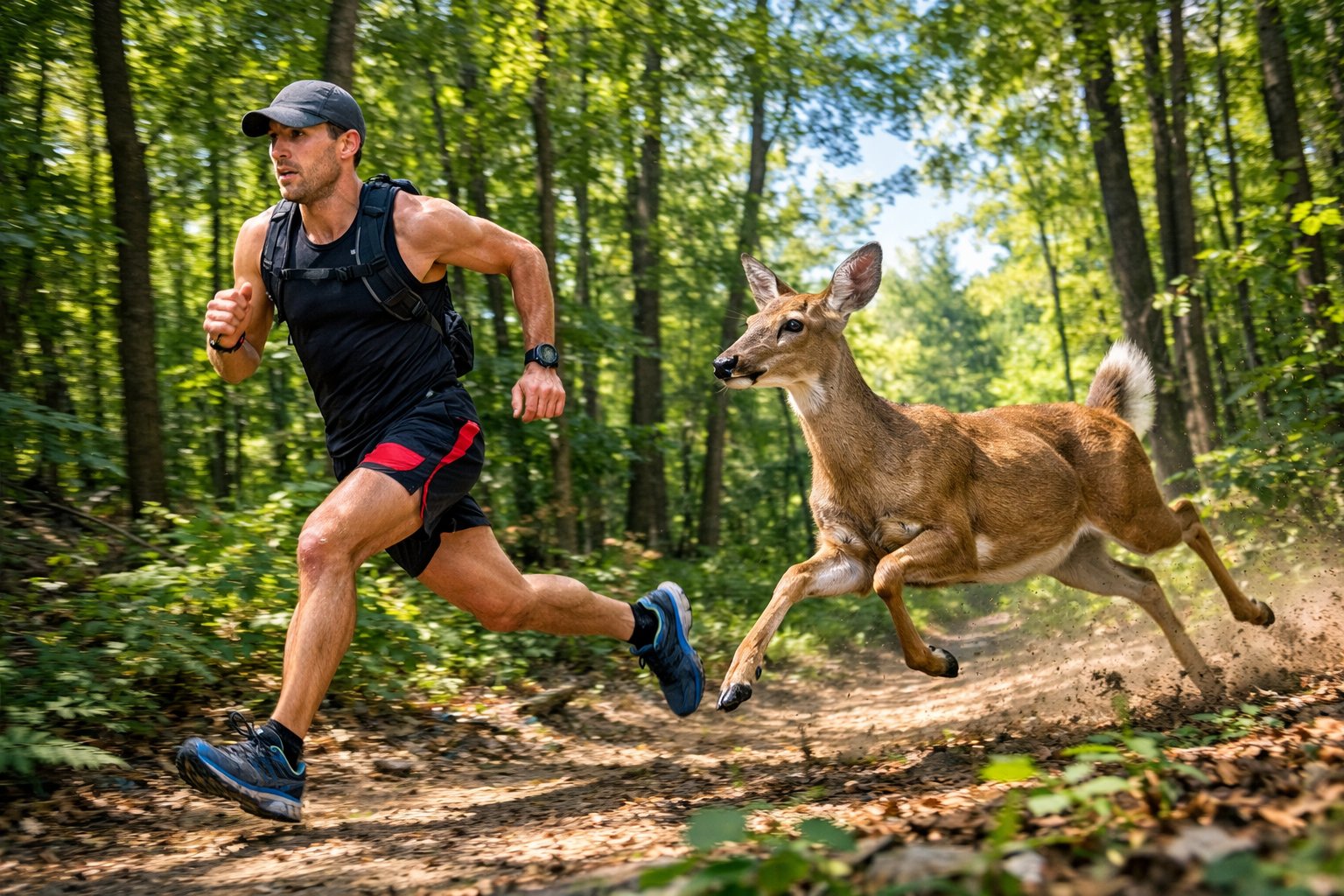
Picture this: you’re hiking and suddenly a deer bolts across your path. What happens if you try to keep up?
Let’s dig into how humans and deer run, and what really decides who “wins”—speed, endurance, terrain, and motivation all play a part.
Curious about when you might have a shot, or what to do if you actually meet a deer on the trail? Stick around.
Comparing Human and Deer Running Capabilities

Deer hit way higher top speeds for short bursts, while you can keep moving at a steady pace for much longer.
The advantage shifts depending on the ground, the weather, and honestly, how much you’ve trained.
Deer Speed and Agility
Deer sprint like pros. A white-tailed deer can hit 30–40 mph in a burst, and mule deer aren’t far behind.
Their powerful hind legs launch them forward, letting them make sharp turns and dodge through rough forests.
They don’t keep that speed up for long, especially if it’s hot out.
Deer rely on quick, explosive sprints and zig-zagging, not long, steady runs.
Their bodies are built for power and bursts, not marathon distances.
That’s just how nature set them up.
Average Human Running Speed
Most people jog at 4–6 mph. If you run a lot, maybe you keep up 7–10 mph for miles.
Elite marathoners? They average around 12–13 mph, which is honestly wild.
Sprinters can briefly hit 20–28 mph, but only for a few seconds.
We just can’t hold that kind of speed.
Sweating keeps us cool, so we can go longer in the heat.
With good pacing and training, you might run 6–8 mph for hours—a big edge over deer if the ground is flat.
Your speed changes a ton depending on fitness, age, and where you’re running.
No surprise there.
Sprint Versus Endurance Running
A deer will always win a short sprint. Their top speed and quick takeoff are just on another level.
But you can take the lead in a long, steady chase—especially if you’re on open ground and the weather’s warm.
Deer dodge and weave using bursts and agility.
You rely on aerobic endurance and your body’s cooling system to keep going.
If you actually try to outrun a deer, the distance and terrain matter a lot.
A trained runner could outlast a deer by holding 6–8 mph for hours on flat ground, but in the woods, the deer’s agility rules.
Limitations of Outrunning a Deer
There’s just no way around it: even the fittest human can’t match a deer’s sprint.
And honestly, chasing wild animals is both unethical and often illegal, so it’s not a great idea.
Steep hills, thick forest, or deep snow make it even harder for you.
Hot weather can wear out both you and the deer, but deer overheat faster since they can’t sweat like we do.
You’ve got to think about your own fitness, shoes, and risk of injury, too.
Most of the time, trying to outrun a deer is risky for you and stressful for the animal.
Want to see more about deer speeds and behavior? Check out how fast deer can run in typical conditions (https://www.fieldandstream.com/stories/conservation/wildlife-conservation/how-fast-can-a-deer-run).
Factors That Influence the Possibility of Outrunning a Deer

A few big things decide if you could ever catch or escape a deer: your own fitness, how you run, how long the run lasts, the deer’s sprinting chops, and how the terrain and weather affect both of you.
Evolutionary Advantages of Human Endurance
Humans evolved more for distance than speed.
We got long legs, springy tendons, and a cooling system that lets us keep moving for miles.
A fit runner can hold 6–8 mph for a long time, and push faster for shorter stretches.
That’s a real advantage over some animals, but not over a deer in a short dash.
Deer, like white-tailed or mule deer, can hit 35–40 mph in a burst.
They leap over obstacles like it’s nothing.
So your endurance only really helps if the chase goes on for minutes or hours—not in a sudden race across a field.
Persistence Hunting and Historical Practices
If you think about early humans, persistence hunting was a big deal.
Hunters would run down prey at a steady pace, forcing animals to stop and pant.
Over hours, the animals would overheat and slow down, while humans could trot and walk, taking turns to rest.
It took heat management and planning, though—you had to keep a steady pace, switch between running and walking, and track the animal.
This worked better on animals that couldn’t handle heat, not the fastest sprinters.
Still, it shows where humans have a unique edge.
Biomechanics: Achilles Tendon and Sweat Glands
Your Achilles tendon and the way your feet work store and return energy every step.
That springiness makes you efficient over long distances.
Strong calves and long tendons help you keep going on long runs.
You also sweat—a lot.
Sweating cools you down so you can keep moving, even in the heat.
Deer don’t sweat much; their fur and short bursts mean they overheat faster if they run for too long.
That’s why a fit human endurance runner can outlast a lot of mammals, even if you’ll never match a deer’s top speed.
Comparisons with Other Fast Animals
A pronghorn antelope can outrun most predators. It hits speeds around 55 mph, which is way faster than any deer.
Dogs are a mixed bag—some breeds sprint fast but run out of steam before a trained human would in a long race. If you pace yourself well and the dog isn’t bred for endurance, you might actually outlast it on a long hunt.
When you stack up different species, you really have to look at two things: top sprint speed and how long they can keep going. Deer take the crown for short sprints.
Pronghorns and cheetahs? They blow past everyone in pure speed. But over long, hot chases, when it’s all about endurance and staying cool, you might just come out on top.


