
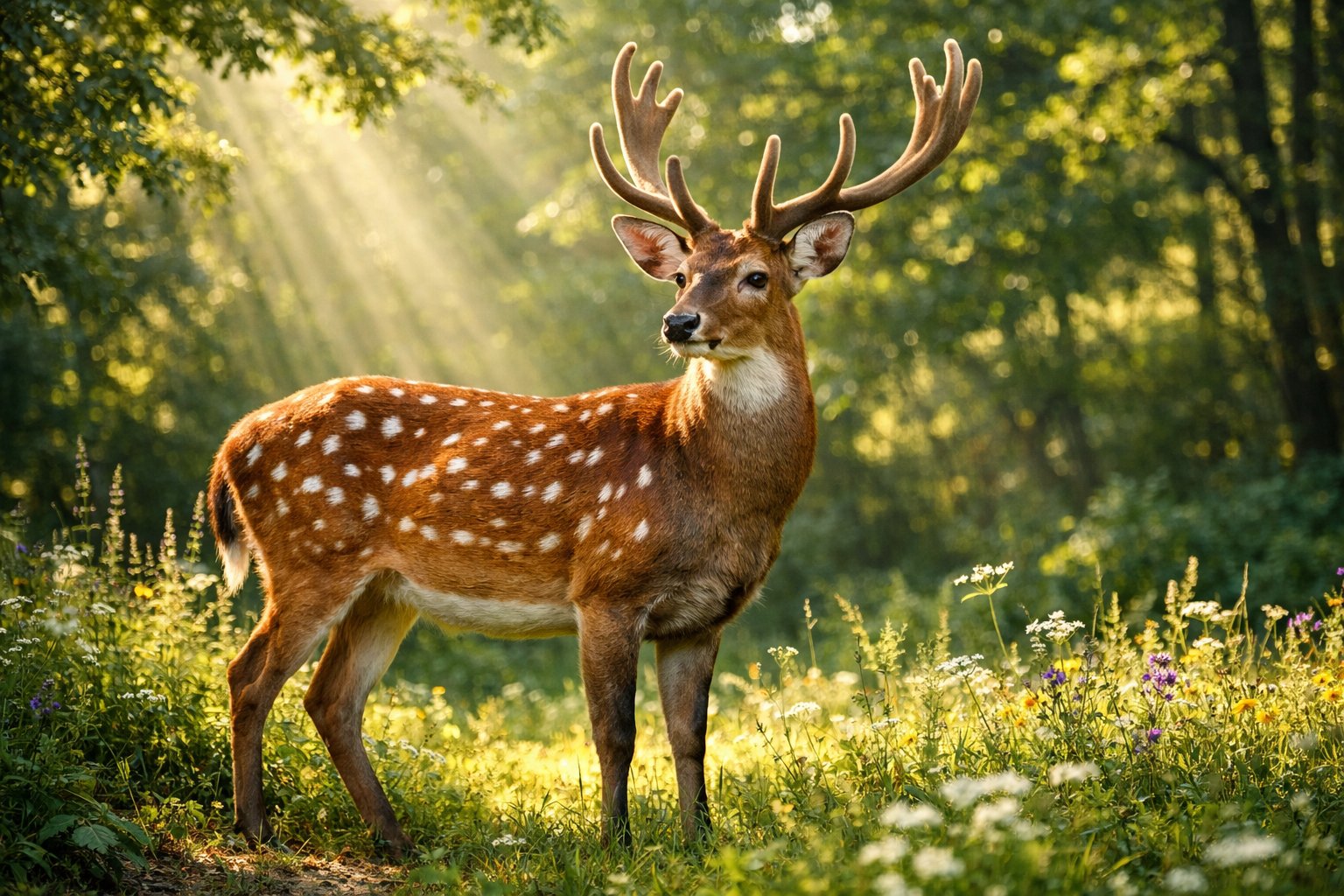
You’ll probably spot the Axis deer before any other—it’s hard to miss that reddish coat and those white spots. Most people rank the Axis deer (chital) as the most beautiful deer in the world, thanks to its vivid coloring, graceful shape, and that steady, elegant way it moves.
As you wander through the Cervidae family, you’ll meet plenty of striking species, each with its own charm. Some have grand antlers, others delicate markings, but the Axis really pops.
Let’s see what makes the Axis stand out, and then we’ll check out other deer species that deserve a little love from around the world.
Axis Deer: The World’s Most Beautiful Deer

You’ll meet a deer with a golden-brown coat and bright white spots, plus those impressive three-tined antlers on the males. Axis deer eat a flexible diet, so they manage to live in a bunch of different places.
Let’s break down how they look, where they live, and how they stack up against other deer.
Distinctive Physical Characteristics
You’ll spot the axis deer (or chital) by its rich cinnamon coat, covered with rows of white spots that never really fade. Males grow lyre-shaped antlers, usually with three tines per antler, and those racks can get pretty long—they drop them and regrow every year.
Females don’t have antlers and look lighter and more slender. There’s a dark stripe running down the back, and the throat, belly, and inside of the legs are all pale.
Their eyes and nose are dark, which stands out sharply against that coat. Axis deer are medium to large for the deer family, and their “perpetual fawn” look is just plain striking—honestly, it’s hard to look away.
Natural Range and Habitats
Axis deer come from India, Nepal, and Sri Lanka, where they stick to mixed forests, grasslands, and anywhere near water. They eat leaves, twigs, and grasses, so they do well in places with both open space and tree cover.
People brought axis deer to Texas and Hawaii for hunting and ranching, and those herds are still around. In their tropical home, they can breed all year; usually, a female gives birth to one fawn after about 220 days.
Their knack for adapting to different habitats and foods lets them thrive just about anywhere. That’s also why they sometimes set up shop as non-native species after being released or escaping.
Comparison With Other Deer Species
When you line up axis deer next to whitetail or red deer, the spots are the first thing you’ll notice. Whitetails lose their fawn spots, but axis deer keep theirs for life.
Antler shape is different too—axis males have those three-tined, lyre-shaped racks, while other species go for more tines or totally different branching. Axis deer are smaller than big red deer but bigger than most forest-dwelling species.
They’re crepuscular and social, often hanging out in mixed groups, which isn’t the case for every deer. If you care about looks, adaptability, and year-round breeding, it’s tough to beat the axis deer’s combination of spots, coat, and antlers.
Other Strikingly Beautiful Deer Around the Globe

You’ll find deer with all sorts of coats, antlers, and sizes—each with something special. Some species wow you with their movement or adaptability, while others just look wild with their markings or tiny size.
White-Tailed Deer and Their Grace
The white-tailed deer roams across North and Central America, and it’s not picky—forests, fields, even suburbs work. You’ll see the white underside of its tail flash up as an alarm, and bucks grow branched antlers each year, with size showing off age and nutrition.
Their summer coat is reddish-brown, but turns grayish in winter, which helps them blend in. Western cousins like mule deer and black-tailed deer have bigger ears and different antler shapes, so you can tell them apart if you look closely.
- Key ID: white tail flash, coat changes with the seasons, branched antlers.
- Related: mule deer, black-tailed deer, whitetail adaptability.
Red Deer: Majestic and Regal
Red deer live across Europe, Asia, and parts of North Africa, and they’re among the biggest deer you’ll see. Stags sport large, multi-branched antlers during the autumn rut, and their coats go from reddish-brown to grayish-brown depending on the time of year.
Sambar deer and Thorold’s deer share the big size and presence, but their coats and habitats are different. Reindeer (caribou) also have huge antlers, but they stick to the tundra and boreal forests and have their own cold-weather tricks.
When you watch red deer, you’ll notice antler size, body mass, and even their calls all play into social status during mating.
- Key ID: large body, heavy build, complex antlers.
- Related: sambar deer, Thorold’s deer, reindeer/caribou.
Fallow Deer and Their Unique Spots
Fallow deer stand out thanks to their coat patterns—some are spotted, some menil, and some even melanistic. Adults are medium to large, and males have palmate antlers that look almost like open hands.
You’ll find them in parks and woods across Europe, and people have introduced them elsewhere too. Roe deer and muntjac are smaller cousins that you might mix up with fallow deer at first, but roe deer don’t have palmate antlers and muntjac are much tinier, with simple tusk-like canines.
Fallow deer form loose groups and their coats change tone and thickness with the seasons, which is pretty neat to see.
- Key ID: palmate antlers, spotted or varied coat, parkland sightings.
- Related: roe deer, muntjac.
Unusual Beauty: Pudu, Sika, and More
Some species just have a kind of beauty you don’t expect—sometimes it’s their tiny size, sometimes it’s a quirky feature. The northern pudu, for example, is the world’s smallest deer. It stands under 17 inches tall, with a compact little body and a face that’s almost delicate.
You’ll find pudu wandering the forests of South America. Sika deer, on the other hand, keep their spots all year and make these surprising, high-pitched calls.
They live mostly in East Asia, though people have introduced them to other parts of the world too.
There are other fascinating types worth mentioning, like the hog deer and the red brocket. Water deer—especially the Korean water deer—skip the big antlers and have these odd, tusk-like canines instead.
You might even come across the so-called vampire deer (that’s just another name for musk deer). They’ve got those dramatic, fang-like teeth.
All these differences really highlight just how wildly diverse artiodactyls can get, depending on where they live.
- Key ID: tiny pudu size, sika spots and calls, water deer tusks.
- Related: red brocket, hog deer, Korean water deer, muntjac, types of deer.


