
Ever wondered if frogs can actually see in total darkness? Turns out, frogs really can see colors even when it’s almost pitch black—something most animals, including us, just can’t do.
This wild ability helps them find food and stay out of trouble during the night.
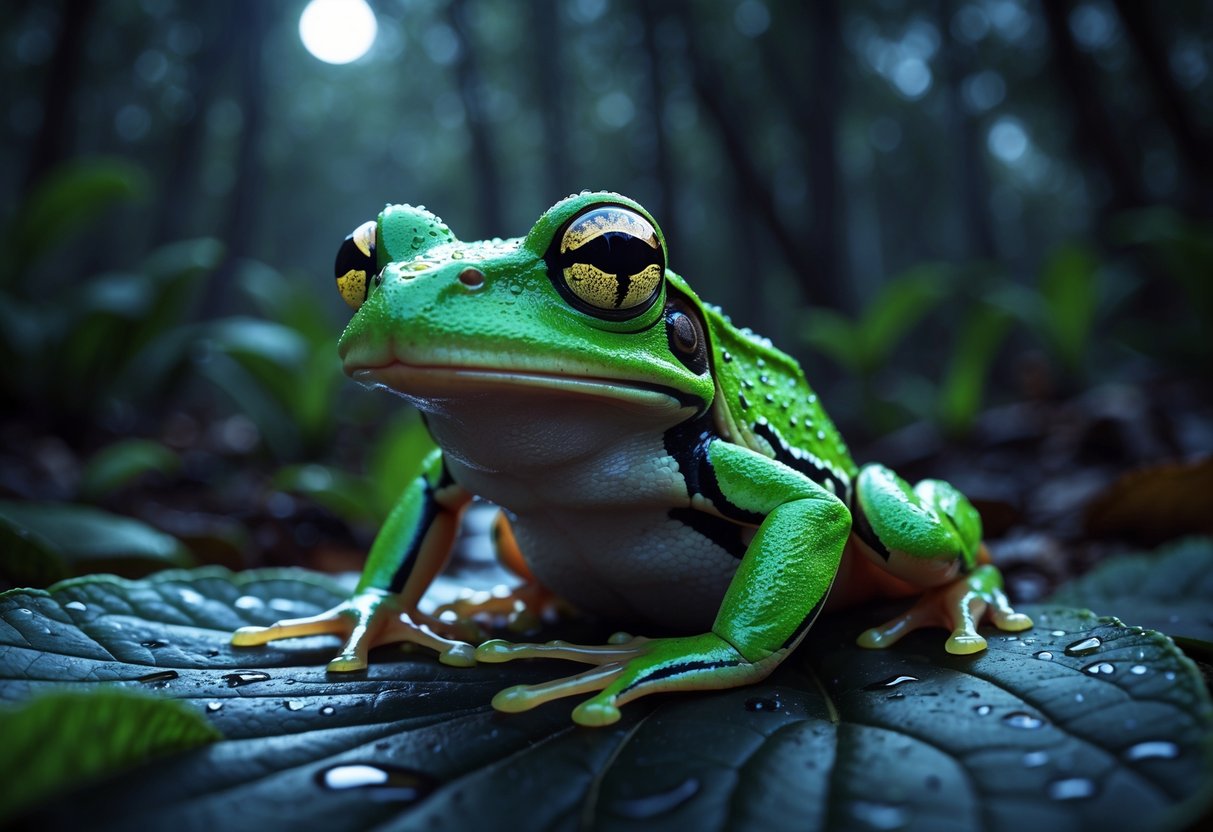
Frogs have eyes that work in a pretty unique way. Special cells in their eyes let them spot shapes and even colors in really low light.
So when you hear frogs croaking after dark, they aren’t just listening—they’re actually using their night vision to move around and hunt.
Let’s get into how their eyes pull this off, and why frogs totally outshine most other animals when it comes to seeing in the dark. Nature’s pretty clever, isn’t it?
Can Frogs See in Total Darkness?

Frogs have eyes that let them see better in the dark than most animals can. They even manage to spot colors when it’s nearly pitch black.
Their eyes work differently from yours, with special cells that help them get around and hunt at night.
Scientific Studies on Frog Night Vision
Researchers, especially those at Lund University, have dug into how frogs see in very low light. Their findings? Frogs can see color in darkness that’s way too dim for humans to see anything.
Frogs have two kinds of rod cells in their eyes, each with its own light sensitivity. These rods let them pick up colors even when light is almost gone.
Professor Almut Kelber’s team ran experiments in total darkness, watching frogs move or search for food. The results were pretty clear—frogs use their sight to get around, even when there’s barely any light.
Comparison to Other Vertebrates
Most vertebrates, like us and other mammals, lose color vision at night. Our rod cells can’t tell colors apart, and our cones just stop working in low light.
Frogs break the rules here. They keep some color vision thanks to their two rod cell types.
Other animals don’t have this “dual rod” setup, so frogs and toads really have an edge once the sun goes down.
If you ever notice how your own eyes lose color in the dark, just remember—frogs don’t have that problem.
Color Vision in Low Light
You might assume color vision vanishes in the dark, but frogs still see colors when it’s super dim. Their rods kind of act like cones, letting them spot prey or dodge danger.
Studies show frogs can pick up blue and green light at levels where we’d just see shades of gray. When frogs go looking for food, they rely on this special color vision, even in near darkness.
It’s a big reason why frogs stay active and manage to survive when there’s hardly any light. Their night vision is just on another level.
The Role of Tapetum Lucidum
A lot of animals with good night vision have a reflective layer behind their eyes called the tapetum lucidum. This layer bounces light back through the retina, giving eyes another shot at catching every bit of light.
Frogs and toads have this too, which helps them squeeze the most out of whatever light is around. It teams up with their rods to boost their vision in pitch black or almost total darkness.
That’s why you sometimes see their eyes shining if you point a light at them at night. The tapetum lucidum makes sure frogs can see when other animals just can’t.
If you want to geek out more, check out this study by Lund University.
How Frogs Adapt to See in the Dark

Frogs have all sorts of neat features in their eyes that help them see when it’s super dark. These features work together to make the most of even tiny bits of light.
Their eyes aren’t like ours, and that helps them survive at night.
Retina Structure and Rod Cells
The retina is the part of your frog’s eye that picks up light. Frogs have two types of rod cells in their retina.
These rods are super sensitive, so frogs can see when it’s almost dark out.
Our eyes mostly use rods for seeing at night, but frogs’ rods let them see some colors too, even in the dark.
Their retina works along with the tapetum lucidum, that shiny layer behind the retina. This layer reflects light back, giving rods a second try at catching it.
It’s kind of like having a built-in mirror that boosts their night vision.
Visual Adaptations in Amphibians
Frogs belong to the amphibian crew, animals that split their time between water and land. Their eyes have changed over time to help them see in dim places, like murky water or nighttime forests.
You’ve probably noticed frogs have big, bulging eyes. That shape helps them grab more light.
Some frogs even have eyes on top of their heads, so they can see almost everywhere without turning.
Other amphibians might have some of the same tricks, but frogs really stand out for their night vision. Their special rods and the tapetum lucidum make them champs at spotting prey or dodging predators after dark.
Differences Among Frog Species
Not all frogs see in the dark the same way.
Some, like the African dwarf frog or the PacMan frog, have really strong night vision. They spend their lives in places where light barely shows up.
Red-eyed tree frogs? They’re also pretty amazing at seeing at night. They hunt and search for mates when it’s dark, so they count on their night vision to get by.
On the other hand, frogs that hang out in brighter places don’t need night vision as much. Their eyes usually have a smaller tapetum lucidum, and their rod cells aren’t quite as sensitive.
So honestly, how well a frog sees in the dark just comes down to where it lives and how much it does after sunset.


