
Most people expect females to give birth, but seahorses totally flip that script. Male seahorses actually carry and hatch the eggs in a special pouch, so female seahorses don’t give birth at all. That unusual swap changes how both parents behave, how many young they can produce, and the way they protect their babies.
Curious about how that pouch really works? Or why evolution landed on this wild arrangement? This post breaks down each step. Nature definitely rewrote the usual parenting playbook here, and it’s honestly pretty clever.
Why Male Seahorses Give Birth Instead of Females

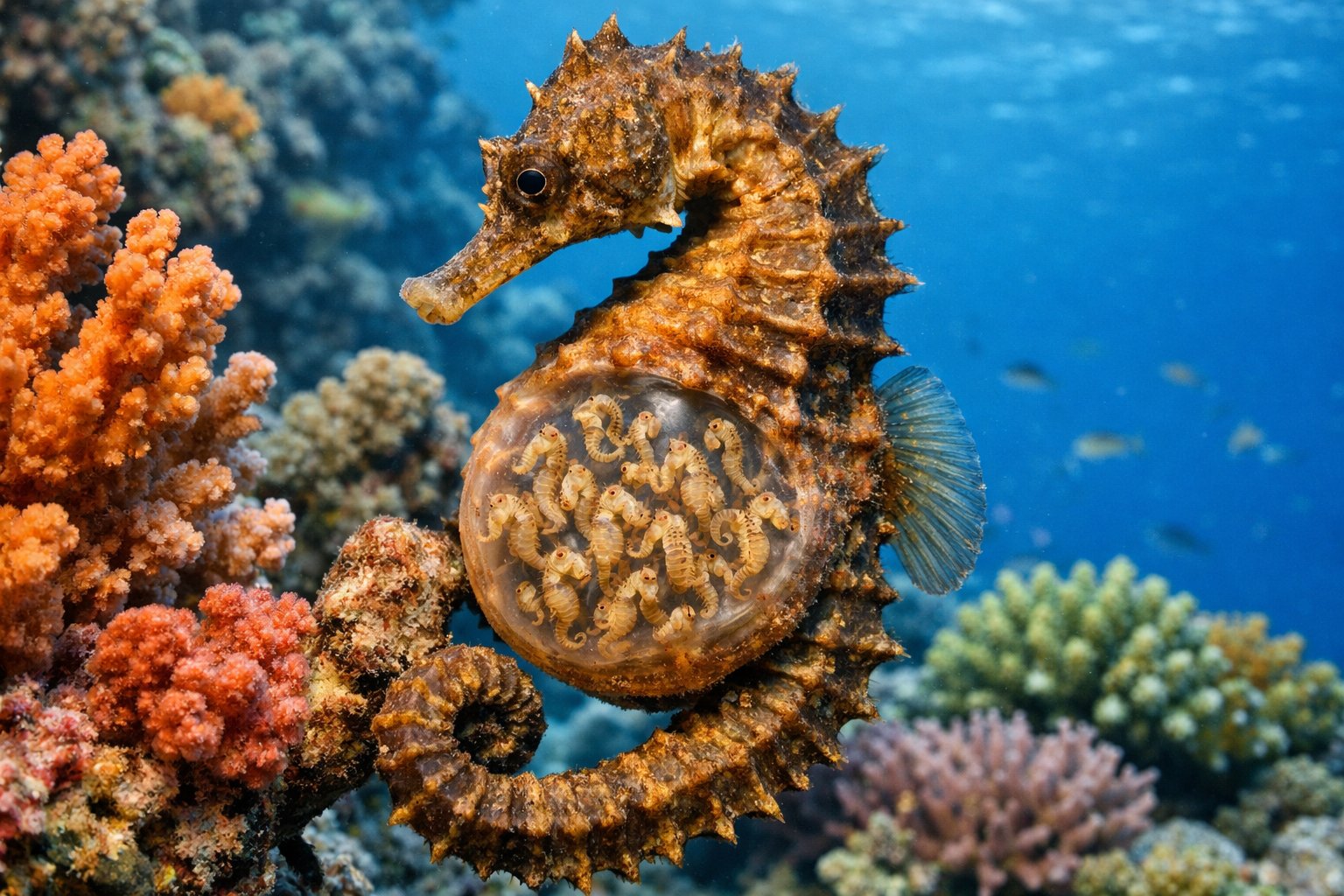
Male seahorses take on the job of carrying embryos in a protected pouch. The female transfers her eggs directly into this pouch, and the male provides oxygen and a bit of nutrition while the eggs develop.
This switch shifts the heavy work of gestation from female to male, and it really changes how both parents invest in their young.
Seahorse Brood Pouch and Its Role
The brood pouch sits right on the front of the male’s tail and opens at his trunk. Inside, a spongy lining holds the eggs against the wall so embryos can stay put and grow.
The pouch maintains stable water salinity and blood flow, which keeps things safe for the developing babies. It acts like a mobile nursery, honestly.
Blood flows close to the embryos, supplying them with oxygen. The male’s body moves ions and small nutrients into the pouch fluid, too.
This pouch also protects eggs from hungry predators and rough currents. That’s a big deal when you’re a tiny seahorse embryo.
Different seahorse species have pouches of all shapes and sizes. A bigger pouch lets males carry more embryos—sometimes hundreds at once.
That capacity actually affects how many eggs a female will transfer during mating. It’s all pretty coordinated.
The Egg Transfer Process: Ovipositor Function
When the female’s ready, she uses her ovipositor—a narrow tube near her tail—to deposit eggs right into the male’s pouch. The two often perform a courtship dance, timing the transfer so the eggs enter at just the right moment.
The male fertilizes the eggs inside the pouch after receiving them. The ovipositor makes the egg transfer quick and accurate, which is honestly pretty efficient.
It keeps the eggs together in the pouch’s spongy tissue and prevents them from drifting away. That boosts the odds that more embryos survive those early days.
Once the eggs are inside, they embed in the pouch lining. The male then supplies water, oxygen, and some nutrients.
It’s a coordinated handoff: the female provides the egg, the ovipositor guides it, and the male takes over from there.
Evolutionary Advantages of Paternal Incubation
Giving the male a brood pouch comes with some real evolutionary perks. Females recover faster after laying their eggs because they don’t have to carry developing embryos.
That means they can produce more egg batches each breeding season and boost their total number of offspring. Male pregnancy also puts all the parental care in one place.
The male can guard his “nursery” and lower the risk of eggs getting eaten—way better than just letting eggs float around in the open water. Paternal incubation lets pairs synchronize their mating, so both parents invest in well-timed, protected broods.
The system even changes the dating scene: females sometimes compete for males with empty pouch space. It’s a twist that keeps things interesting and helps seahorse populations in crowded or risky habitats.
- Key structures: brood pouch, ovipositor
- Main functions: protection, oxygen supply, nutrient exchange
How Seahorse Reproduction Works
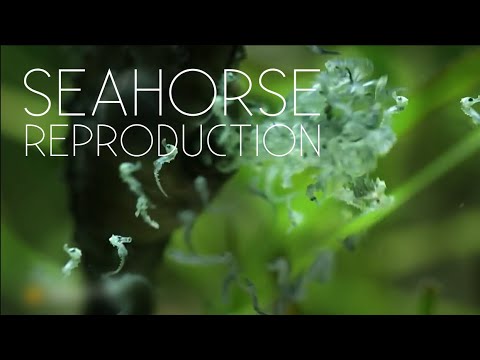
Seahorse reproduction really turns things upside down. Males carry and give birth, while females focus on making and transferring eggs.
You’ll notice a careful courtship, internal fertilization inside the male’s pouch, and some traits that set seahorses apart from other fish.
Courtship and Mating Rituals
Seahorse pairs perform daily dances that can last anywhere from a few minutes to a few days. They’ll change color, swim side by side, and even lock tails.
These rituals build trust and sync up their bodies for the egg transfer. Before mating, the female prepares a batch of eggs in her ovary.
The male inflates and opens his brood pouch, getting ready. During a quick transfer, the female slips her ovipositor into the pouch and pushes the eggs in.
The male releases sperm right then, fertilizing the eggs inside. Some species stick with the same partner and repeat this ritual each breeding cycle.
Others play the field and mate with several partners in a season. Seahorses aren’t always as loyal as you might think.
Fertilization and Embryo Development
Fertilization happens inside the male’s pouch, which works like a little incubator. The pouch supplies oxygen and a bit of nutrition through a network of blood vessels.
It’s a pretty safe chamber, keeping embryos at a steady salinity and temperature. Gestation usually lasts about 2–4 weeks, depending on the species and water temperature.
Warmer water speeds up development. When the embryos are ready, the male strains his pouch muscles and gives birth to dozens, sometimes hundreds, or even thousands of tiny fry.
Once released, the newborns are totally independent. They have to hunt down tiny food like zooplankton right away, since their parents don’t feed or protect them after birth.
Comparison to Other Marine Life
Most fish just release eggs into the water and let external fertilization do its thing. Seahorses, though, really flip the script—they use internal fertilization, and it actually happens inside the male.
Pipefish and seadragons, which are pretty close relatives, also have males that brood the young. But honestly, the pouch structure and how they handle care can be all over the place depending on the species.
Marine mammals and a lot of birds? They stick with internal gestation, but always in females—not the guys. Seahorses are the real oddballs here since the male’s pouch creates this controlled environment, kind of like a mammal’s placenta. Still, the embryos mostly live off yolk, not anything like milk.
This whole system changes up who does the work. Females get to produce more eggs, while males spend their time and energy growing the babies in their pouch.
If you want to dig deeper into male brooding or how the brood pouch works, The Institute for Environmental Research has some solid explanations.


