
Ever seen a wild canine and couldn’t quite tell if it was a fox or a coyote? You’re definitely not the only one. These two look similar at first glance, but they’re actually pretty different.
The main differences between a fox and a coyote are size, body shape, color, and behavior. Coyotes are bigger and more muscular, with shorter tails. Foxes stay smaller, sport bushier tails, and come in a bunch of colors.
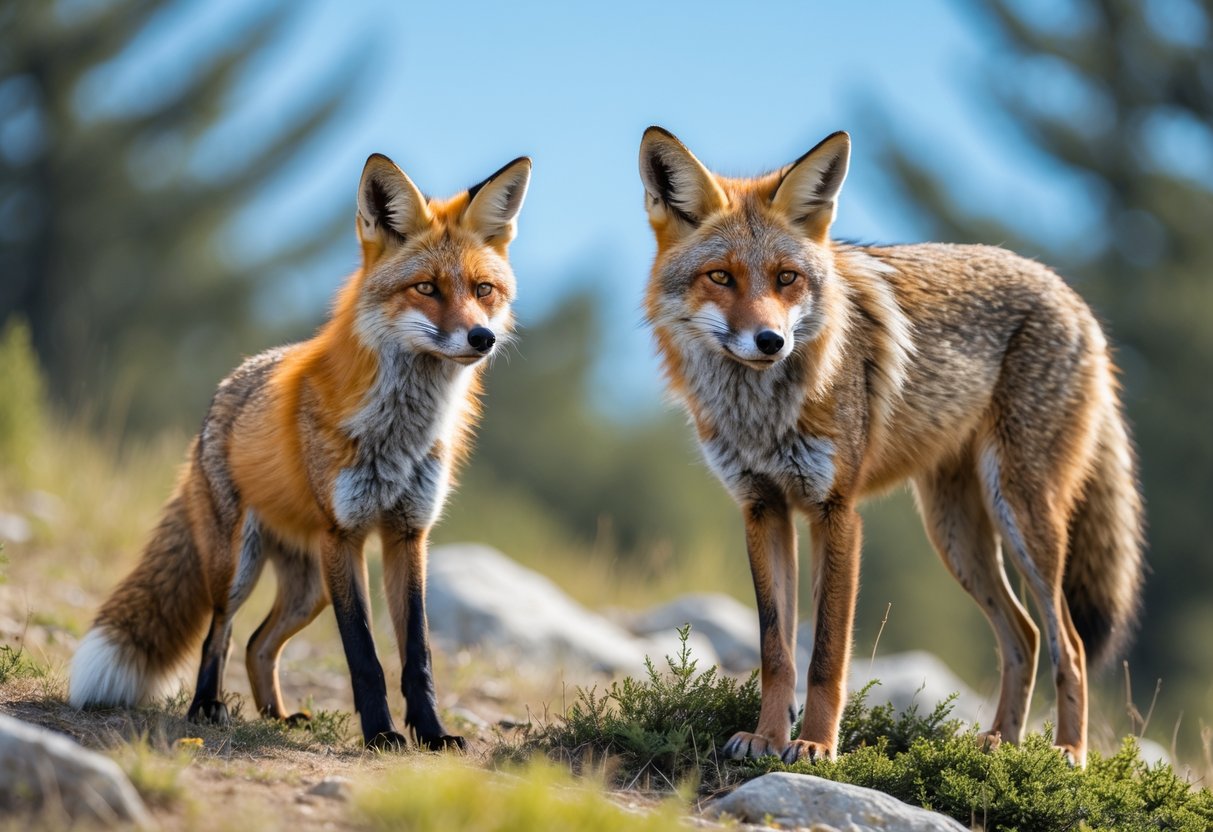
If you know these differences, you can quickly figure out what you’re seeing—whether that’s in your yard or out on a hike. Learning how foxes and coyotes live and act can also make you appreciate these clever wild animals more.
Let’s look at what sets foxes and coyotes apart.
Key Differences Between Foxes and Coyotes

Foxes and coyotes both belong to the Canidae family, but they show some obvious differences in size, appearance, behavior, and where they live.
Physical Characteristics
Coyotes have bigger, more muscular bodies than foxes. They usually measure between 3 and 4.5 feet long, tail included, and weigh anywhere from 15 to 50 pounds.
Foxes, on the other hand, are smaller. Most are just 1 to 3 feet long, with tails almost as long as their bodies, and weigh between 2 and 30 pounds.
Their body shapes set them apart too. Coyotes look robust and wolf-like, with shorter legs. Foxes have lean, tube-shaped bodies, longer legs, and big ears—especially those desert types like the Fennec fox.
Both have sharp claws, but foxes often seem more delicate because of their size.
Identifying Features by Species
Foxes come in a bunch of species and colors. The red fox, for example, might be red, gray, black, or even silver. Gray foxes tend to have a more uniform gray coat.
Coyotes usually have gray or reddish-brown fur, sometimes with black mixed in.
If you’re unsure, check the tail. Fox tails are fluffy and often tipped in white or black. When foxes run, they hold their tails high.
Coyotes’ tails are shorter, not as bushy, and hang low when they move. Their coats look more uniform in color compared to the wild variety you’ll find in foxes.
Behavioral Variations
Foxes mostly keep to themselves, except for breeding season or when raising young. They use dens or burrows for shelter.
You might catch a fox using clever hunting tricks, like pouncing through snow to catch prey. They’re pretty crafty.
Coyotes act more social. They live in family groups or small packs and make a lot of noise—howls, barks, and yips. They only use dens during mating season.
Coyotes often hunt bigger prey like rabbits and deer. Foxes stick to smaller animals and insects.
Habitat Preferences
If you’re outside North America, you’re almost always seeing a fox. Coyotes only live in North America.
Coyotes like open fields, deserts, and forests, but they adapt to cities pretty well.
Foxes live all over the world. You’ll find them in forests, grasslands, mountains, and even cities. They usually hide in dense brush or burrows.
Coyotes show up more often, and you might spot them during the day or night. Foxes are sneakier, more active at night, and harder to spot.
For more details, check the key differences between foxes and coyotes.
How to Identify Foxes Versus Coyotes in the Wild

When you spot a wild canid, pay attention to its size, color, and behavior. These clues can help you figure out if you’re looking at a fox or a coyote.
Notice their shape, markings, and even the sounds they make. It really helps.
Size, Shape, and Tracks
Coyotes are just bigger. Adults usually measure 32 to 37 inches long and weigh between 20 and 50 pounds.
Foxes are smaller—most are 18 to 33 inches long and weigh less than 15 pounds.
Foxes have slender bodies, shorter legs, and bushy tails tipped with white. Coyotes look sturdier, with longer legs and bushy tails that usually hang down.
Coyotes stand about 21 to 24 inches at the shoulder. Foxes are shorter, usually 12 to 16 inches tall.
If you find tracks, coyote prints are bigger and more oval. Fox tracks are smaller, rounder, and have shorter claw marks.
Color Patterns and Markings
Foxes show off more colors. You might see a red fox with reddish-orange fur and a white belly, or a gray fox with a grayish coat and black markings.
Fox tails often have white tips or bands.
Coyotes usually wear gray to brown fur, sometimes with tan or cream mixed in. Their fur looks more uniform, with less contrast.
You won’t see the bright red of a red fox on a coyote.
Some coyotes have a black stripe down the tail or a black tip. Foxes have smoother color changes and sometimes brighter patterns.
Sounds and Social Behavior
Coyotes are pretty social; they stick together in packs. You’ll probably hear their howls and yips echoing across the distance.
They use these calls to talk to each other and to send out warnings. Sometimes, it’s almost like they’re just chatting across the fields.
Foxes, on the other hand, tend to keep to themselves. They’re much quieter, but when they do make noise, it’s a mix of sharp barks, high-pitched screams, or quick yips.
Honestly, some of their sounds are just strange—sometimes it even sounds like a baby is crying out there.
Coyotes usually travel in groups, so you might spot a few together if you’re lucky. Foxes mostly hunt and live alone, or maybe with a tiny family group.
So, depending on which animal’s around, you’ll notice some big differences in the sounds you hear—or even what you see if you’re out observing.


