
You’d probably assume a bark in the woods means there’s a dog nearby — but sometimes, it’s actually a deer. The little muntjac, known as the barking deer, lets out a sharp, dog-like bark whenever it gets spooked.
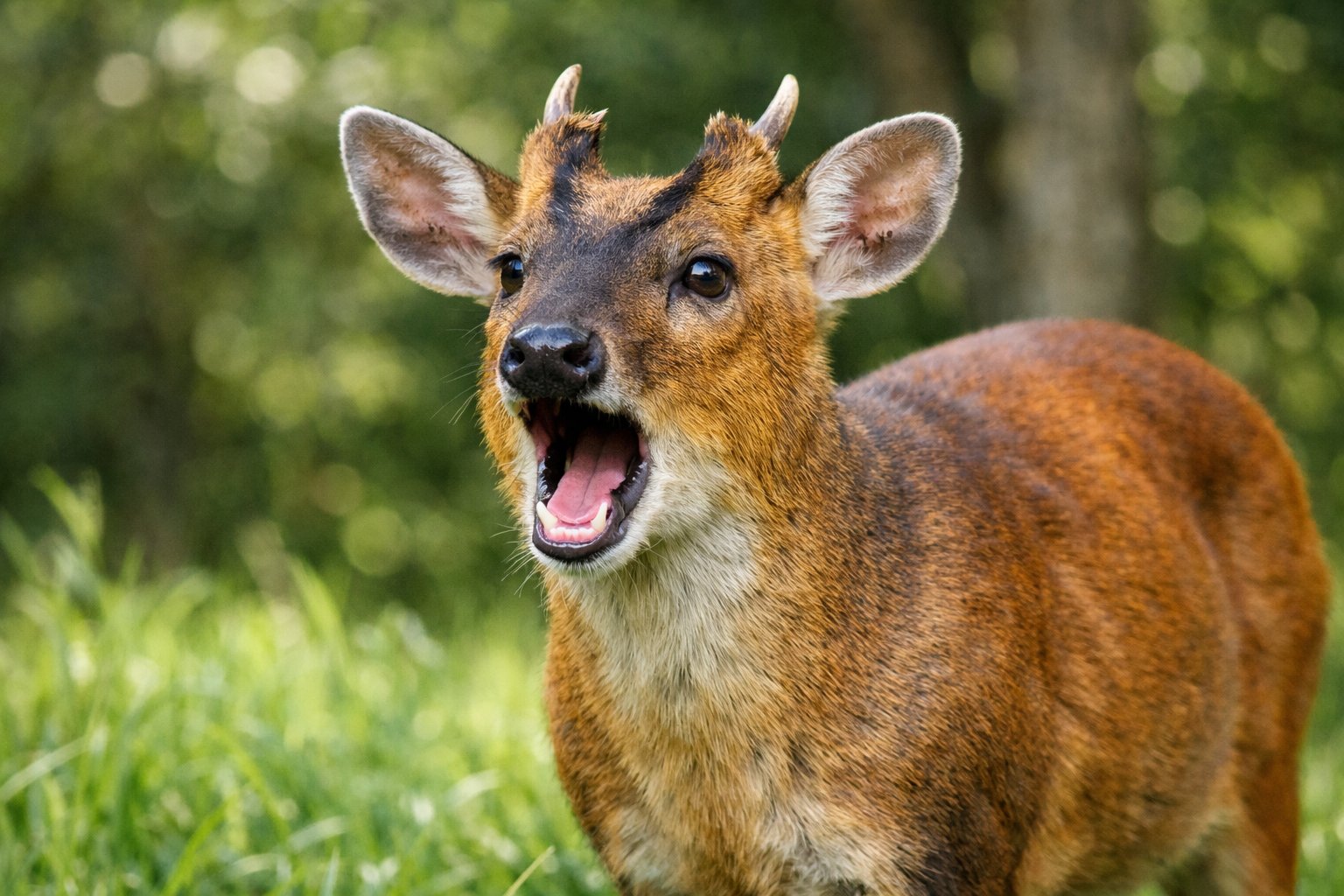
Let’s talk about where muntjac hang out, why they make that weird sound, and how you can tell their bark apart from a dog’s.
I’ll also throw in some quick facts about their size, habits, and how that bark actually helps warn other deer.
Which Deer Barks Like a Dog?

So, which deer really sound like a dog? Muntjac top the list, but a few others come close.
You’ll hear about how these deer produce those odd barks, what the calls actually sound like, and why they bother to make them at all.
Muntjac: The True ‘Barking Deer’
People usually mean the muntjac when they say “barking deer.” These little guys belong to the genus Muntiacus and live in South and Southeast Asia.
You might even spot the Reeves’ muntjac (Muntiacus reevesi) in the UK or Europe, since they’ve managed to set up wild populations there.
Muntjac are small — honestly, about the size of a small dog. Males have stubby antlers and some pretty impressive upper canine tusks.
You’re most likely to hear their bark if they get startled or sense trouble.
Their calls serve as a warning to other deer nearby, and sometimes, they even manage to scare off predators. For more about what muntjac do and where they live, check out this article on the barking deer’s traits and voice.
How the Muntjac’s Bark Sounds
A muntjac’s bark is short and sharp. It’s usually repetitive too.
Most people say it sounds a lot like a small dog’s bark, or maybe a harsh, sudden “yap.” The call can go on for several seconds, and sometimes, if a bunch of muntjac get worked up, they’ll all start barking at once.
Their bark works as both an alarm and a way to claim territory.
The sound travels well through thick undergrowth, especially at dawn or dusk, which is when muntjac are out and about.
People sometimes mistake it for a fox or a little dog barking in the distance.
If you listen to recordings, the muntjac’s bark is usually more abrupt than a real dog’s, and if the deer gets really freaked out, it might even turn into a high-pitched scream.
Other Deer With Bark-Like Calls
Muntjac aren’t the only deer that can bark, though. Roe deer (Capreolus capreolus) in Europe also let out a sharp, dog-like bark, especially if they’re alarmed or during the rut.
Their bark is usually shorter and not quite as repetitive as the muntjac’s.
Some other deer species can make alarm yelps, grunts, or snorts that might sort of sound like a bark, depending on the situation.
That includes a few North American species when they’re stressed or showing off during mating season.
If you hear a bark out in the woods, pay attention to the animal’s size, what time it is, and where you are. That’ll help you figure out if it’s a muntjac, a roe deer, or maybe something else entirely.
For a quick comparison, you can check out this overview of animals that produce bark-like sounds.
Facts About Muntjac (Barking Deer)

Let’s dig into where muntjac actually live, how the males look, and why their bark could fool you into thinking there’s a little dog nearby.
I’ll cover species, appearance, and what’s up with their noisy habits.
Muntjac Species and Distribution
Muntjacs fall under the genus Muntiacus, and you’ll find several species out there.
The common Indian muntjac (Muntiacus muntjak) lives all over India and Southeast Asia.
Reeves’s muntjac (Muntiacus reevesi) originally came from China and Taiwan, but people introduced them to Britain, where they’ve settled in pretty well.
There’s also the giant muntjac and the leaf muntjac, but those are a lot rarer and stick to small parts of Southeast Asia.
Scientists described Muntiacus putaoensis in northern Myanmar, and it lives up in the high-altitude forests.
Most muntjacs prefer dense undergrowth, forest edges, or secondary woodlands.
Some are about the size of a dog, but the giant muntjac is, well, giant by comparison.
A lot of species adapt to disturbed habitats, which is probably why Reeves’s muntjac have done so well in British forests.
Unique Appearance: Antlers, Canines, and Scent Glands
Male muntjacs look pretty different from females. They’ve got short, backward-sloping antlers and long upper canine teeth.
Their antlers are small — usually less than 10 cm — and they grow back every year.
Those canines act like little tusks during fights, especially in the rut when males compete for territory or mates.
Muntjacs mark their space using scent glands on their faces.
They rub their frontal glands (on the forehead) and pre-orbital glands (near the eyes) on plants to leave a scent behind.
If you look closely, you might spot branches or leaves with rub marks or even footprints nearby.
These scent marks let other deer know who’s boss, who’s ready to mate, or just who’s around, without having to fight all the time.
Barking Behavior and Purpose
Muntjac barking sounds sharp and a bit like a dog’s repeated call. Both males and females bark, though males tend to do it more, especially when they’re defending territory or during the rut.
The main reason they bark? It’s usually an alarm if a predator or a person shows up. That bark warns other muntjacs to steer clear of the area someone’s already claimed.
You’ll often hear them bark at dawn, dusk, or in the middle of the night. The calls echo through thick forest and can sometimes go on for several minutes. Sometimes you’ll catch the sound before you spot the deer—they might freeze or dart into cover right after sounding the alarm.
Researchers have matched different bark patterns to different situations. Quick, short barks mean immediate danger. If you hear a longer series, it’s probably a male showing off his territory during mating season.
If you’re curious and want more details, check out field guides or species accounts like the Muntjac – Wikipedia entry.


