
Ever wondered if owls can actually see better than humans? The answer’s yes, especially when it’s dark out. Owls have these wild, specially adapted eyes that let them see in the dark way better than we can.
Their huge eyes pull in more light, so they can spot prey even when it’s almost pitch black—while you’d probably be tripping over your own feet.
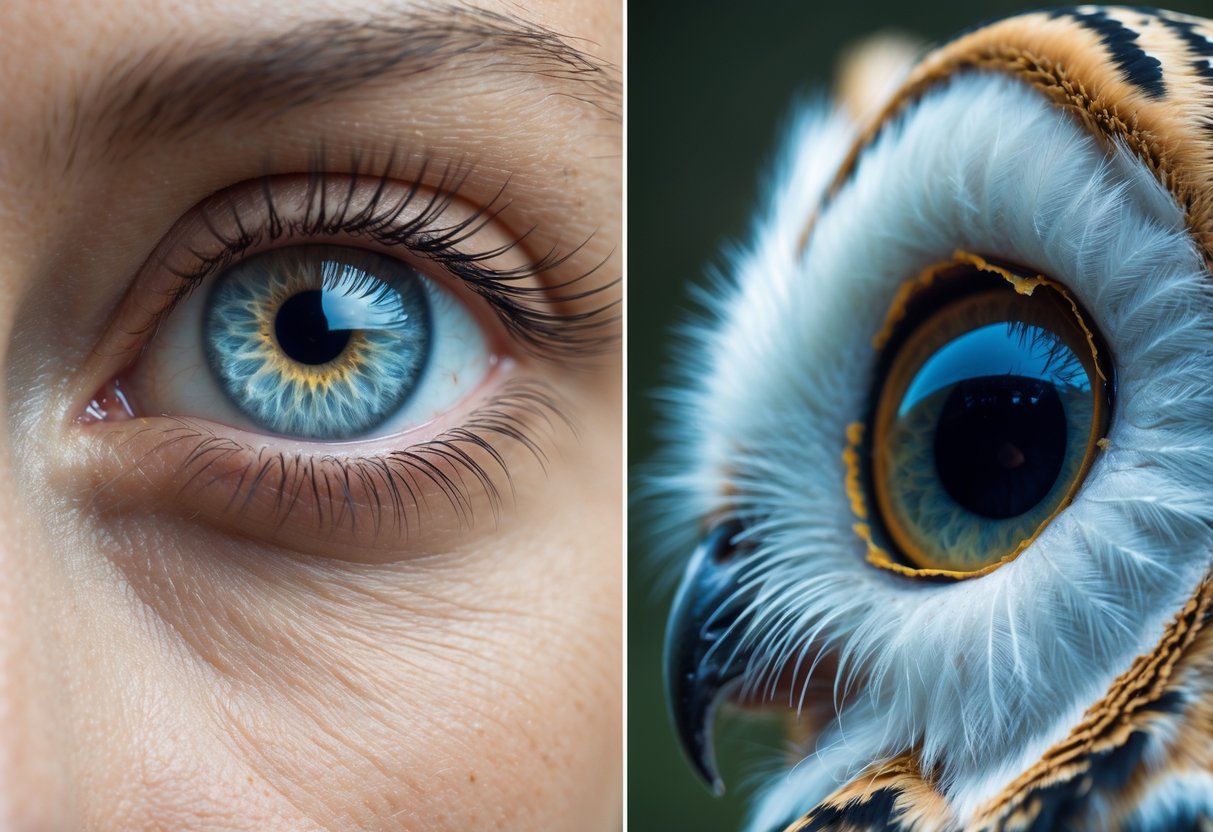
Your eyes work best when it’s bright, but owls depend on their night vision to hunt. They even have three eyelids and a funky eye shape that helps them focus and shields their eyes.
These differences are a big part of why owls are such incredible nighttime hunters.
Let’s dive into how owl eyesight works and how it stacks up against human vision. It’s honestly pretty cool to see what makes owl eyes so special and why you just can’t compete with them in the dark.
How Owls See Better Than Humans

Owls have some wild differences in their eyesight compared to us. Their vision works great in the dark, and they can judge distance and find prey even when it’s barely light out.
That’s what makes their sight so unique.
Differences Between Owl and Human Eyesight
Owl eyes aren’t round like yours—they’re more like tubes. This shape helps them focus on things far away.
Humans have lots of color receptors (cones), but owls have way more rods, which are good for seeing in low light. So, owls can see better when it’s dim, but they miss out on most colors.
Their retinas have about 30 times more rods than cones, so they mostly see black, white, and a bit of blue or yellow. Owls also have three eyelids to protect their eyes, which is pretty unusual if you think about it.
Night Vision Capabilities
Owls can see with just a tiny fraction of the light you’d need. Their big eyes scoop up more light, making it easier for them to find prey when it’s almost totally dark.
Both of their eyes face forward, which gives them sharp binocular vision—super handy for nighttime hunting.
With all those rods in their retinas and the way their eyes are built, owls notice even the slightest movement in the dark. That’s how they manage to hunt so well at night, while you’d probably miss just about everything.
Field of View and Depth Perception
Owls don’t have as wide a field of view as you do, since their eyes point forward. But that gives them awesome depth perception, so they can tell exactly how far away their dinner is.
Their big skull lets them twist their heads up to 270 degrees. That’s kind of mind-blowing, right?
You’d have to turn your whole body to see what’s behind you, but owls just swivel their heads. Their binocular vision and flexible necks help them spot food or danger from all sorts of angles, fast.
Owl Eye Adaptations and Unique Vision Features

Owls have these special eyes that let them see in ways we just can’t. The shape, the colors they pick up, how sensitive they are to light—it all works together so they can spot prey in the dark and judge distances easily.
Eye Structure and Shape
Owls’ eyes look huge compared to their heads. They’re tube-shaped, not round like ours.
That tube shape gives them a wider field of view and sharper focus. Since their eyes face forward, owls get binocular vision, just like us.
Both eyes working together helps them see depth and distance, which is perfect for hunting.
Their eyes don’t move around like yours, though. Instead, owls turn their heads up to 270 degrees to look around.
This eye structure gathers more light in dim conditions, making their night vision even better.
Color Vision in Owls
Owls can see some colors, but not nearly as many as we can. Their color vision sticks mostly to blue and yellow.
That’s not a lot, but it works for them.
They have fewer cones for color, and way more rods for seeing in low light. That setup helps them focus on movement and shapes instead of bright colors.
So, when you picture how owls see, just remember: their world looks a lot simpler and darker, but it’s perfect for their nighttime lifestyle.
Light Sensitivity and Detection
Owls’ eyes grab even the faintest bits of light. They pack a ton of rod cells, which spot movement and light in the dark.
A special layer in their eyes—the tapetum lucidum—kicks things up a notch. This layer bounces light back through the retina, so owls get a second shot at catching whatever little light is around.
Thanks to all these tweaks, owls see way better than you in low-light situations. Still, they can’t see in pitch blackness. They need at least a sliver of light to hunt and slip through the night without a sound.
Curious about how their night vision really works? Check out what makes owl eyes unique.


