
When you think of owls, do you ever wonder how they manage to see in the dark and catch prey so easily? Their eyes are pretty special—they see in three dimensions, so they’ve got depth perception that lets them judge distances much like we do.
That’s a huge help when they’re trying to spot tiny animals in low light. It’s no wonder they’re such skilled hunters compared to other birds of prey.
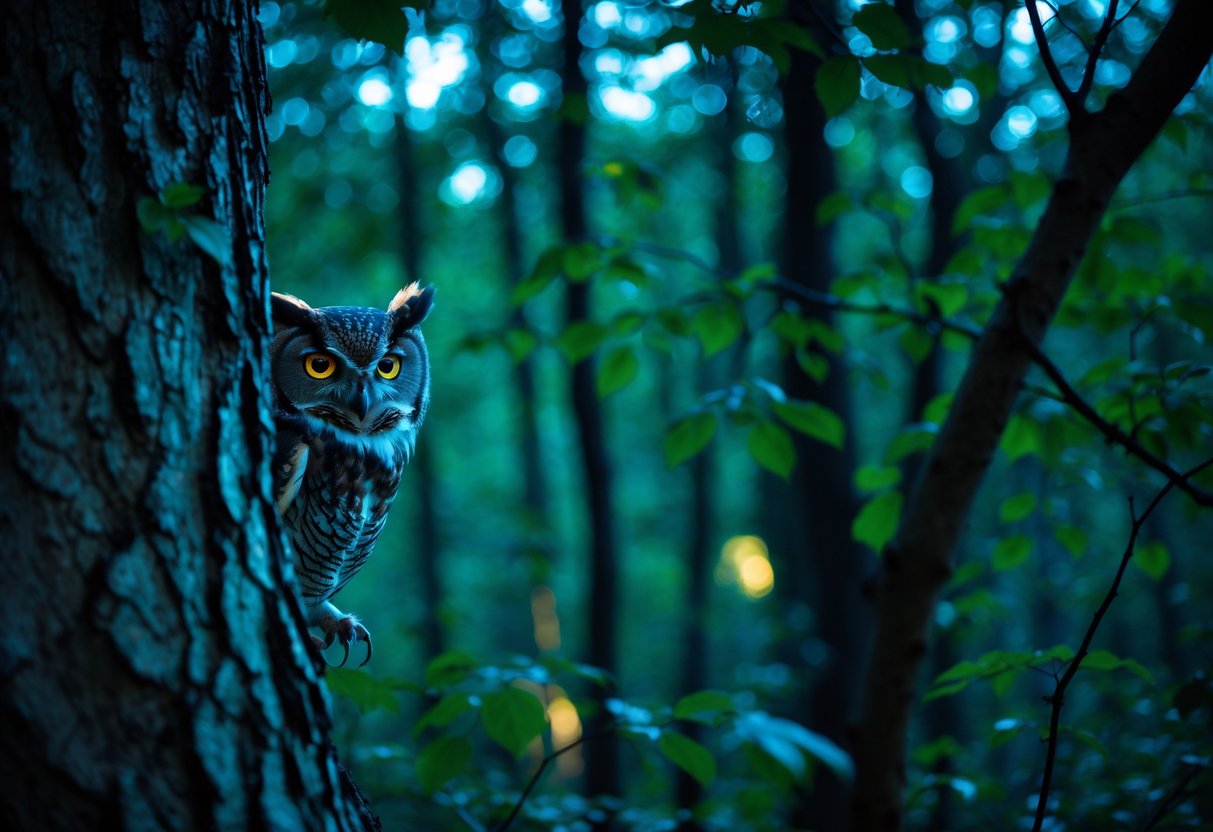
Most birds have eyes on the sides of their heads, but owls? Their eyes face forward. They use both eyes together for sharp, focused vision.
Their eyes are almost tube-shaped, which lets them see far away and pick up details even when it’s pretty dim. As raptors, they really depend on this kind of eyesight to hunt at night or during those dusky hours.
Here’s something you might not expect—owls can see colors, but not quite like we do. Their color vision stays mostly in the blues and yellows.
That’s just enough for them to get by in their world. When you learn how owls see, it’s hard not to admire how they fit into the wild.
If you’re curious, check out even more about owl vision at Owl Eyes & Vision.
How Owls See: Vision and Eye Structure

Owls have eyes built for the dark, and they’re great at judging distances. Their eye shape is different from most birds, which helps them focus on prey.
They keep an eye on their surroundings thanks to their wide head rotation and good field of view.
Owl Eyes and Binocular Vision
Your owl’s eyes point forward, so it gets binocular vision. Both eyes work together on the same object, which helps with depth and distance.
With a 110-degree field of view and about 70 degrees of that being binocular, owls see less than humans do—but it’s enough for them to hunt with precision.
Their eyes aren’t round like ours; they’re more like tubes. These long eyes pull in more light, which is perfect for dim conditions.
Owls can’t move their eyes in their sockets, so they turn their heads instead. It’s a clever workaround.
If you want to dive deeper into binocular vision, you can visit Owl Eyes & Vision.
Night Vision Capabilities
Owls mostly come alive at night, so their eyes are all about low-light vision. Big pupils and corneas let in lots of light, which makes a huge difference in the dark.
Their retinas are packed with rod cells that pick up movement and light. They don’t have many cone cells, so their nighttime world is mostly black, white, and gray.
Behind the retina, a reflective layer called the tapetum bounces light back through the eye. This boosts their night vision, kind of like cats.
Owls even have a thin, see-through eyelid that sweeps across their eyes to keep them clean without blocking their view.
Field of View and Head Rotation
Owls don’t see as wide an area as we do, but they make up for it by turning their heads up to 270 degrees. That lets them look almost everywhere without shifting their bodies.
Their field of view is about 110 degrees because their eyes face forward. This gives them awesome depth perception, though their peripheral vision is a bit limited.
Since they can’t move their eyes side to side, their super-flexible necks do all the work. It’s a big part of how they spot prey and stay alert for danger while flying quietly.
If you’re curious about owl necks, check out Why Owls Can Turn Their Heads So Far.
Owl Species and Unique Visual Adaptations

Different owls have their own tricks for seeing and hunting. Their eyes and senses match up with the light and hunting style they need, whether it’s bright daylight or total darkness.
Barn Owl and Hunting Strategies
Barn owls sport big, forward-facing eyes that give sharp depth perception. That’s how they judge distances so well while flying low over fields for mice and other small creatures.
Their eyes are great at picking up movement in almost complete darkness.
Barn owls also lean heavily on their hearing. Their uneven ears help them find prey by sound, even when it’s pitch black.
They’ve got those big, round faces that funnel sound to their ears. The mix of sight and hearing makes them stand out among owls.
Great Horned Owl: Adapted for Darkness
Great horned owls are out mostly at night. Their eyes have loads of rod cells, which let them see well in the dark.
Even a little bit of light is enough for them. Their tube-shaped eyes stay fixed in place by bony rings, so they can’t move their eyes like we do.
Instead, they turn their heads up to 270 degrees to scan their surroundings.
These owls have dark eyes—a hint that they hunt at night. With sharp vision and powerful talons, they rule as top predators in forests and open land.
Snowy Owl: Seeing in Bright and Dim Light
Snowy owls spend their lives in places where the days can stretch on forever or vanish into endless night. To handle that, they need eyes that work in both bright sunlight and near darkness.
Their yellow eyes let them quickly adjust pupil size, whether they’re squinting in the sun or peering through the gloom.
Unlike great horned owls, snowy owls hunt whenever they feel like it—day or night. Their sharp eyesight helps them spot a lemming from way off, even across a snowy, empty field.
Snowy owls have more cone cells than most other owls. That means they see colors better than their mostly nocturnal cousins.
This little advantage? It helps them pick out prey hiding against all that white snow.
| Owl Species | Eye Adaptation | Hunting Time | Key Strength |
|---|---|---|---|
| Barn Owl | Large eyes + asymmetrical ears | Night | Silent flight, sound locating prey |
| Great Horned Owl | Rod-rich eyes, fixed tube shape | Night | Extreme night vision, head rotation |
| Snowy Owl | Yellow eyes, balanced rods/cones | Day & Night | Adapted to bright light and colors |


