
Ever seen a deer’s eyes glow in your headlights and wondered if they’re secretly night vision experts? Well, not exactly. Deer can’t see in total darkness, but they definitely outshine humans when it comes to seeing in low light. Their eyes have special adaptations that boost sensitivity and help them spot movement when the sun dips down.
That’s why deer get so active at dawn, dusk, and even on those bright, moonlit nights.
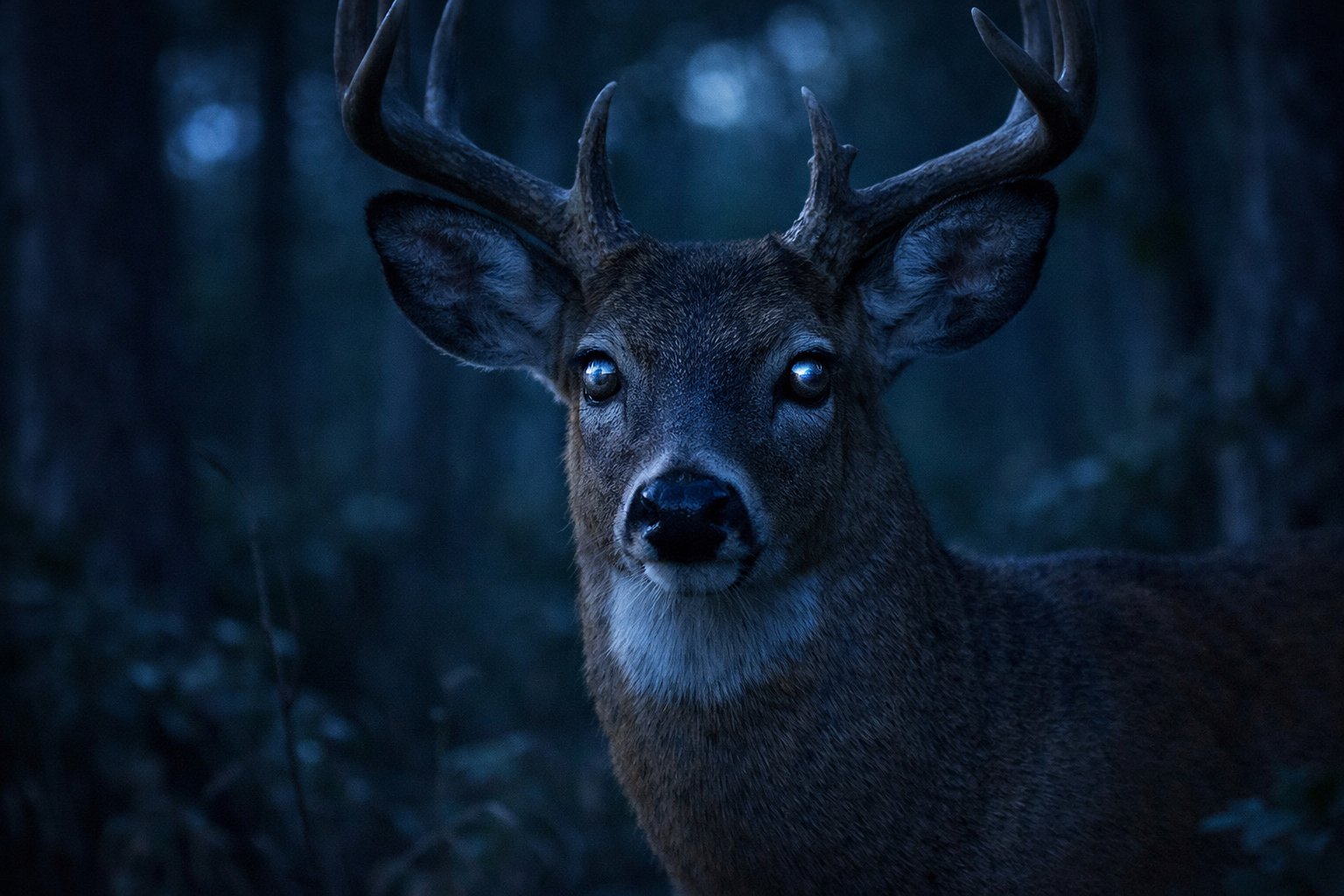
Let’s dig into how their eyes actually work. What can they see in the dark, and what’s a mystery to them? There are some surprising blind spots and color quirks that shape how deer behave.
If you know these facts, you’ll have a better shot at predicting where deer might pop up—on trails, roads, or deep in the woods.
How Deer See in the Dark

Deer depend on a few clever features in their eyes to move safely when it’s dim out. Their eyes pick up faint light, certain cells do the heavy lifting, and a shiny layer in the back gives their night vision a boost.
The Science Behind Deer Night Vision
Deer don’t see in pitch black, but they do a lot better than us in low light. Their eyes pack way more rod cells than ours.
Rods specialize in picking up faint light and movement, although they don’t give you crisp detail or much color. That’s why a deer can notice the slightest twitch at dusk but might not make out exactly what it is.
Deer tend to be crepuscular, which means they’re most active at dawn and dusk. Their eyes tune in best to blue and near-UV light, which is everywhere during those times.
This helps them catch subtle contrasts and spot motion, especially along the ground.
Those wide-set eyes? They give deer almost 310 degrees of vision. So, you’ll often see a deer react to movement from the side, not just straight ahead.
Anatomy of Deer Eyes
A deer’s retina is loaded with rod photoreceptors, but not so many cones. Rods help them see in low light and detect motion.
Cones handle color and sharpness, so deer don’t see as much color or detail as you do. Their visual acuity is lower, and distant objects look blurrier to them.
Their pupils can open up wide to let in more light. Because their eyes sit on the sides of their head, deer get a huge field of view but sacrifice some depth perception up front.
That means they’re great at spotting movement but not so great at judging distance right in front of them. Deer can also see ultraviolet light, so some clothing that looks dull to you might actually stand out like a beacon to them.
Role of the Tapetum Lucidum
Deer have a tapetum lucidum—a reflective layer behind the retina—that bounces light back through the rods. This gives them a second shot at catching any stray photons.
You see this as that classic eye shine in your headlights.
The tapetum boosts sensitivity but makes images a bit fuzzier because the light scatters. So, deer can spot movement from farther away under moonlight, but they won’t see fine details.
The tapetum and all those rods work together to give deer solid low-light vision, but it’s not quite the same as true night vision.
Differences and Limitations of Deer Night Vision

Deer absolutely beat us at seeing in the dark, but they give up sharp details and true color for that ability. They’re all about catching movement and keeping an eye on a wide area.
Comparison with Human Night Vision
Deer have way more rod cells than we do. Rods help them pick up dim light and spot motion, so a whitetail can notice things in near-darkness that you’d never catch.
Humans have more cone cells, which means you get better detail and color in daylight, but you’re not so hot under the stars.
The tapetum lucidum gives deer a physical edge by reflecting light back through the rods. This makes them extra sensitive, but not any sharper.
A deer might see movement at 50–200 feet in low light, but those shapes will look fuzzy compared to what you’d see in daylight.
Color Perception and Dichromatic Vision
Deer are dichromats—they’ve got two types of cone cells, not three like us. That shrinks their color palette.
Reds and oranges pretty much look gray or brown to them, but blues and yellows pop out more.
If you’re a hunter or just love watching wildlife, keep this in mind when picking out clothes or gear. Fabrics with UV brighteners can glow to a deer, even if you can’t see it.
Your red jacket might look dull to a deer, but a blue shirt or anything that reflects UV could practically shout at them.
Field of View and Depth Perception
Deer’s wide-set eyes give them a massive field of view—about 310 degrees for a lot of species. They can keep tabs on almost everything around them.
You get a narrower view but better overlap up front, which helps with depth perception.
Because deer don’t have as much binocular overlap, they’re not as good at judging distance close up. When it’s dark and things are farther away, their depth perception gets even weaker.
That’s when they rely more on movement, hearing, and smell to figure out what’s going on.
How Far Can Deer See in the Dark
How far can deer see at night? Well, it depends—light levels, the weather, and even the type of deer all play a part.
Deer don’t see as sharply in the dark as you do during the day. Most estimates put their ability to clearly recognize shapes somewhere between 20 and 60 feet.
But here’s the thing: if there’s good moonlight, deer can pick up on movement from as far as 100 to 200 feet away.
Thinking about watching deer with binoculars or a trail camera? They might notice your movement before they actually figure out what you are.
If you want to observe deer at night, try using a steady, low-glare light. Also, keep your movements slow and minimal.
Deer tend to act differently when they sense someone—even when they can’t quite tell who or what it is from a distance.


