
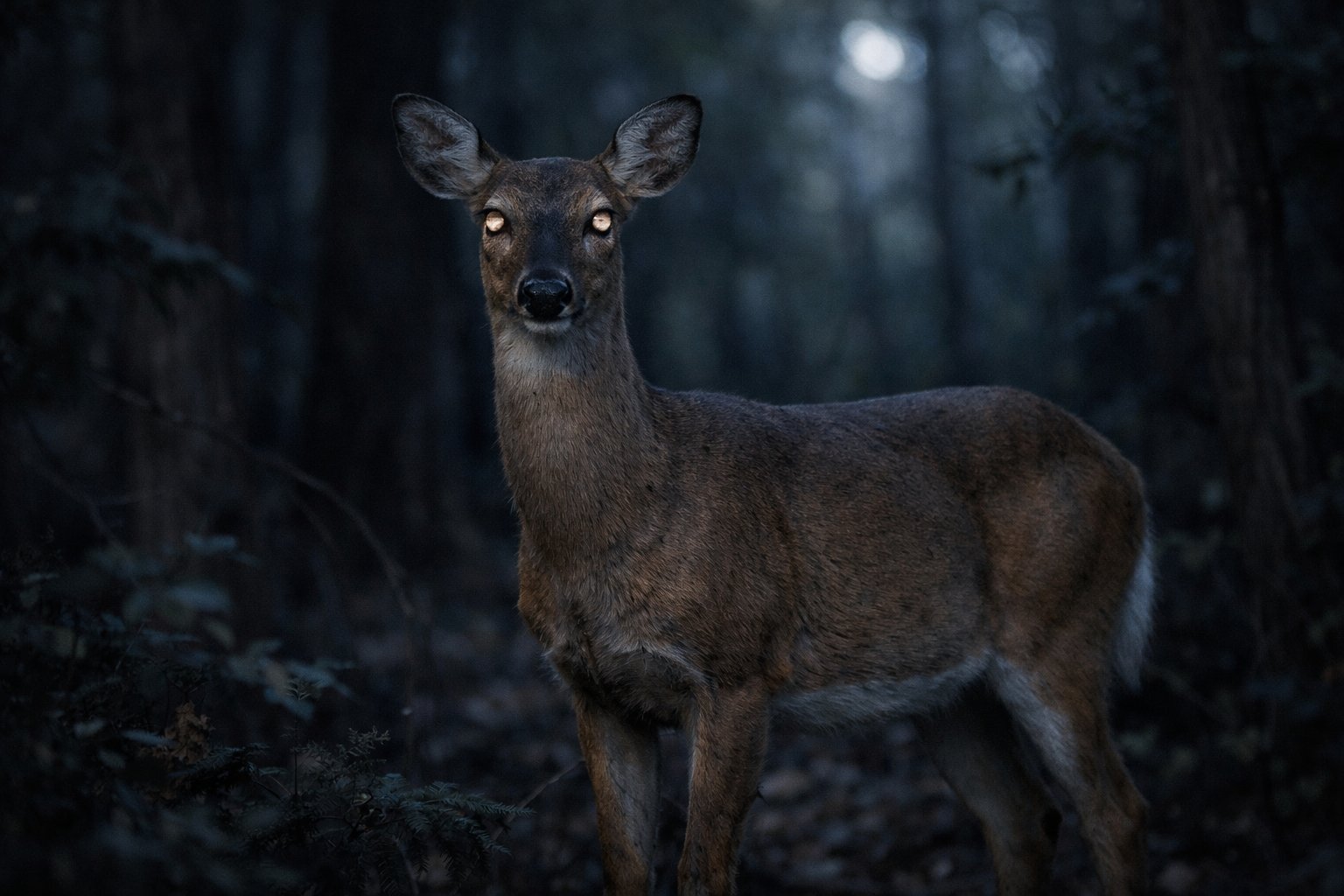
Ever noticed a pair of glowing eyes in your headlights and wondered if deer can actually see in the dark? Yeah — deer see way better than you do in low light. Their eyes grab more light and spot movement from pretty far away. That’s why you’ll often catch them moving at dusk or dawn, and honestly, staying still can really help you avoid startling them.
So, how exactly do their eyes work when it gets dark? What can they actually see, and where do their night vision skills hit a wall? Let’s take a closer look before you head into the woods at night.
How Deer See in the Dark

Deer can’t see in total darkness, but in low light, they have a real advantage over you. Their eyes are made to catch even a little light, notice movement from the side, and really make the most of moonlight or the faint glow at dawn and dusk.
Night Vision Adaptations
You’ll see deer eyes on the sides of their heads, giving them a crazy-wide field of view—almost 310 degrees. This helps them notice movement from nearly any angle, no head-turning needed.
At night, their pupils open up wide, pulling in more light. Your shape and any motion stand out, but they don’t focus on fine details.
Deer depend more on picking up movement than getting a sharp image. Their vision isn’t as crisp as yours—details at a distance? Not so much. But if you move, they’ll catch it right away.
You’ll usually find deer most active at dawn and dusk. That’s when their eyes work best.
Role of the Tapetum Lucidum
Deer have a reflective layer behind the retina called the tapetum lucidum. It acts like a built-in light amplifier. When light passes through the retina and bounces back, their photoreceptors get a second shot at catching photons.
That’s why their eyes glow in headlights—it’s kind of wild, right? The tapetum lets them use weak light, like moonlight, way better.
But here’s the trade-off: the tapetum makes their vision more sensitive but less sharp. So, they’ll spot movement at night, but not tiny details.
It also boosts short-wavelength light, so blues and violets pop more for deer than reds or oranges.
Rod Cells and Low-Light Sensitivity
Rod cells handle dim light, and deer have a ton of them—way more than cones. Their eyes are built to focus on brightness and motion, not color or fine detail.
Rods respond to super low light, which is why deer see better than you at dusk, dawn, or under a full moon.
Deer don’t have as many cones, so their color vision is limited to two types, not three like humans. Their color range is kind of like red–green color blindness.
Deer can also pick up some ultraviolet light. That means fabrics or plants that reflect UV might stand out to deer, even if they can’t see your favorite camo color.
Capabilities and Limitations of Deer Night Vision

Deer have eyes built for low light, sharp motion sensing, and limited color perception. So, what exactly can they pick out at a distance? How do they see movement, and which colors actually matter to them?
How Far Can Deer See in the Dark
If there’s enough light, deer can spot big shapes and movement from pretty far away. In open areas with moonlight, whitetail deer might notice motion or a silhouette up to 150–200 yards out.
Of course, that range drops fast in thick woods, brush, rain, or fog.
Their retinas are packed with rod cells that boost sensitivity to dim light. So, you can bet deer will spot contrasts and moving things farther than you can at night.
But tiny details and small objects? They’re tough for deer to see unless they’re close.
Lighting really changes things. Snow or a full moon can stretch their range. Headlights or other artificial light can mess with their vision, making it harder for them to judge distance.
Motion Detection and Field of View
Deer are pros at noticing movement. With eyes on the sides of their heads, they get about a 300-degree field of view.
That wide sweep lets them notice predators sneaking up from the side.
But this setup means they don’t have as much overlap in front. Deer pick up movement across the scene more than small, still details.
Quick motions grab their attention way faster than slow or subtle changes.
Their tapetum lucidum bounces light back through the rods, cranking up sensitivity. You’ll see deer react to even tiny movements you might not spot in the dark.
Color Perception and Dichromatic Vision
Deer see mostly blues and yellows—dichromatic vision, if you want the technical term. They don’t have as many cone cells for color as humans do.
Reds and greens? They look pretty muted, almost the same.
So, if you’re wearing bright orange, it just looks dull to a deer. Blues and yellows, though, really stand out.
Don’t assume deer are totally color blind—they just see a different range than you.
Foraging and social cues use these color limits. Some plants or markings that reflect blue or UV light might be way more visible to deer than you’d guess.
Depth Perception and Binocular Vision
Deer just don’t have much binocular vision compared to predators. Their eyes don’t overlap much in the front, so their depth perception isn’t great, especially when it’s dark.
You might notice them pausing before they leap over a ditch or try to cross a road at night. They’ll often bob their heads or shift around to make up for it.
Deer rely on their sense of smell and their hearing when their eyesight lets them down. Young deer pick up tricks as they explore, learning the lay of the land and getting a bit bolder—but honestly, darkness still throws them off.
If you’re driving or walking at night, keep in mind that deer can freeze up or dart out without warning. They just can’t always tell how far away things are unless something else tips them off.


