
You might think a tiny deer is always called a fawn, but it depends on what you mean by “small.” If you’re talking about a young deer, sure, that’s a fawn. But the smallest adult deer? That’s a pudu.
A fully grown pudu — not a baby — holds the record as the world’s smallest deer species.
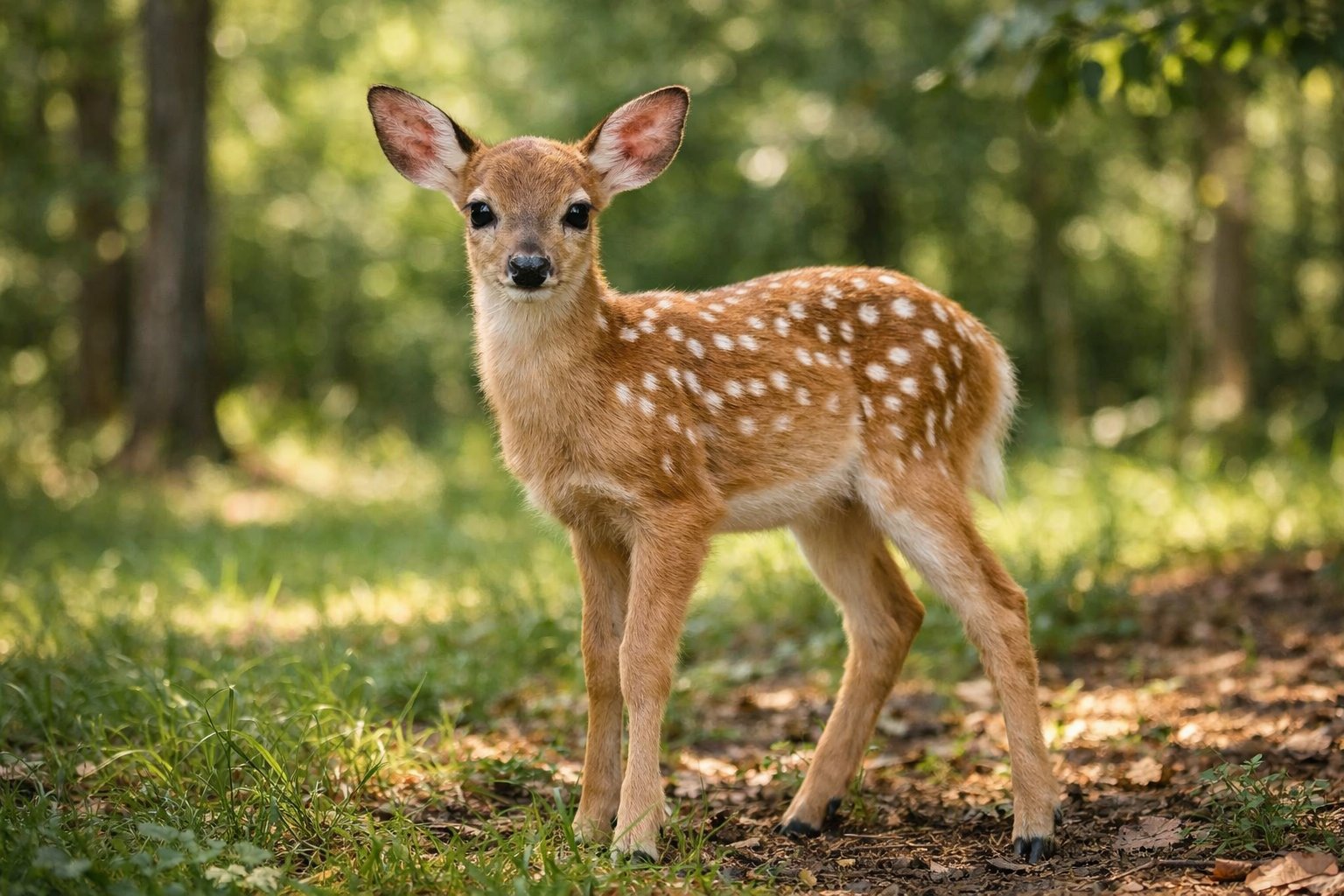
If you’re curious about how names shift with age and species, let’s break down the common terms for young deer and explore what makes these tiny species unique.
We’ll also wander into the forests of South America to meet the pudu and see why this little deer stands out from the rest.
Names and Types of Small Deer

Small deer come in all sorts of shapes and sizes.
You’ll see how scientists decide what counts as “small,” meet the tiniest species, and get familiar with the usual names for these deer and their young.
Defining Small Deer: What Makes a Deer “Small”
People usually judge a deer as small by its body weight, shoulder height, and how it stacks up to other deer in the family (Cervidae).
Take the pudu, for example. It stands just 12–15 inches at the shoulder and weighs less than 15 pounds. Compare that to a typical white-tailed deer, which can tip the scales at 100–300 pounds.
Scientists also look at things like habitat, litter size, and antler size when they call a species “small.”
Small deer usually live in dense forests or on islands, where limited food and space make a compact body more practical.
Their behavior shifts, too. Many small deer prefer to be alone or stay hidden, and some use camouflage instead of speed to avoid danger.
The Pudu: The Smallest Deer in the World
The pudu takes the prize for being the smallest deer species around.
Southern and northern pudu species usually weigh between 7 and 13 pounds and stand about 12–15 inches tall.
You can find them in South American temperate forests. Their short legs and rounded bodies help them slip through thick undergrowth.
Males grow tiny antlers that barely branch, and both sexes blend into the forest floor with their dark brown coats.
Pudus munch on leaves, fruits, and shoots.
Because they’re so small, they tend to hide from predators instead of running long distances.
Other Notable Small Deer Species
A few other small deer deserve a mention.
- Chinese water deer: 20–31 pounds, famous for their long canine “fangs” instead of big antlers.
- Indian hog deer: compact, with a low, running style; found across South and Southeast Asia.
- Pygmy brocket and Visayan spotted deer: small-bodied species from South America and the Philippines.
- Muntjacs (barking deer): small, often solitary, with short antlers and loud calls; native to Asia.
- Chevrotains (mouse-deer): technically not true deer, but tiny, deer-like creatures often called “mouse-deer.”
Each species has its quirks. Some browse near water, some hide in bamboo thickets, and a few have adapted to life on islands with few predators.
Naming Conventions for Small Deer and Their Young
Names shift with age, sex, and location, but the patterns repeat.
- Adult males: buck, stag, or sometimes bull (though “bull” is usually reserved for elk or moose).
- Adult females: doe or hind.
- Young ones: fawn, kid, or calf, depending on species and local habits.
Small species often get names that highlight size or special features: “pygmy,” “dwarf,” “barking” (for muntjacs), or “water” (for Chinese water deer).
If you flip through field guides, you’ll see both scientific names (for precision) and common names (for local use). For more examples and photos, check out this list of common deer types and ID tips.
All About the Pudu: The World’s Smallest Deer Species

Here’s what you need to know about pudus: how to spot them, where they live, what they eat, how they act, and the main threats they face today.
Physical Features and Identification
Pudus are tiny deer, standing just 32–44 cm (13–17 in) at the shoulder.
The northern pudu (Pudu mephistophiles) is the smallest, at about 32–35 cm tall and 3–6 kg, while the southern pudu (Pudu puda) reaches 35–45 cm and up to around 12 kg.
Look for a stocky body, short slender legs, small black eyes, rounded ears, and a stubby tail.
Males have short, single-spiked antlers, while females don’t grow antlers at all.
Their coat ranges from reddish-brown to dark brown and might get darker in winter.
Fawns usually show pale spots along the back.
If you want more details or range maps for the northern and southern pudu, the Pudu – Wikipedia page is a good place to start.
Habitat and Geographic Range
Pudus live in temperate rainforests and dense mountain forests along the Andes and in southern South America.
The northern pudu lives in Colombia, Venezuela, Ecuador, and Peru, usually at 2,000–4,000 meters elevation.
The southern pudu hangs out in southern Chile, southwest Argentina, and Chiloé Island, from sea level up to about 2,000 meters.
They like thick underbrush, bamboo thickets, and places with lots of shrubs, ferns, and fallen fruit.
These dense habitats give them cover from predators and a steady supply of plants to eat.
Protected areas and national parks matter a lot, since they hold much of the remaining pudu habitat.
Diet, Behavior, and Life Cycle
Pudus eat leaves, shrubs, ferns, fruits, berries, bark, and fungi.
Their food has so much water that they can go a long time without drinking.
You’ll see them browsing close to the ground, and sometimes they stand on their hind legs or bend bamboo to reach snacks.
They’re solitary and most active at dawn and dusk.
They mark their territory with dung piles and scent glands.
Mating happens in autumn (April–May), and gestation lasts about 202–223 days.
Usually, a single fawn is born in spring, weighing around 700–1,000 grams, though twins show up occasionally.
Fawns wean by two months; females mature by six months, and males by 8–12 months.
Threats and Conservation Efforts
Pudus struggle with habitat loss because people clear forests for agriculture and logging. Hunters, new predators, parasites, and tiny population sizes all put extra pressure on these deer.
The southern pudu shows up as near threatened on the IUCN Red List. On the other hand, the northern pudu doesn’t have enough data for a clear status.
People have tried several conservation steps. Protected areas, captive-breeding, and reintroduction programs all play a part.
CITES puts rules on international trade to cut down on commercial movement. Conservation groups and universities also get involved with captive programs and park monitoring—Nahuel Huapi is one example.
They hope these efforts will boost pudu numbers and slow down poaching and habitat destruction.


