
It’s pretty wild, but male seahorses really do carry babies. When a female seahorse deposits her eggs into the male’s brood pouch, he fertilizes them and takes on the job of incubating those eggs until they hatch. Male seahorses “give birth” because they carry and release fully formed young after nurturing the eggs in their specialized pouch.
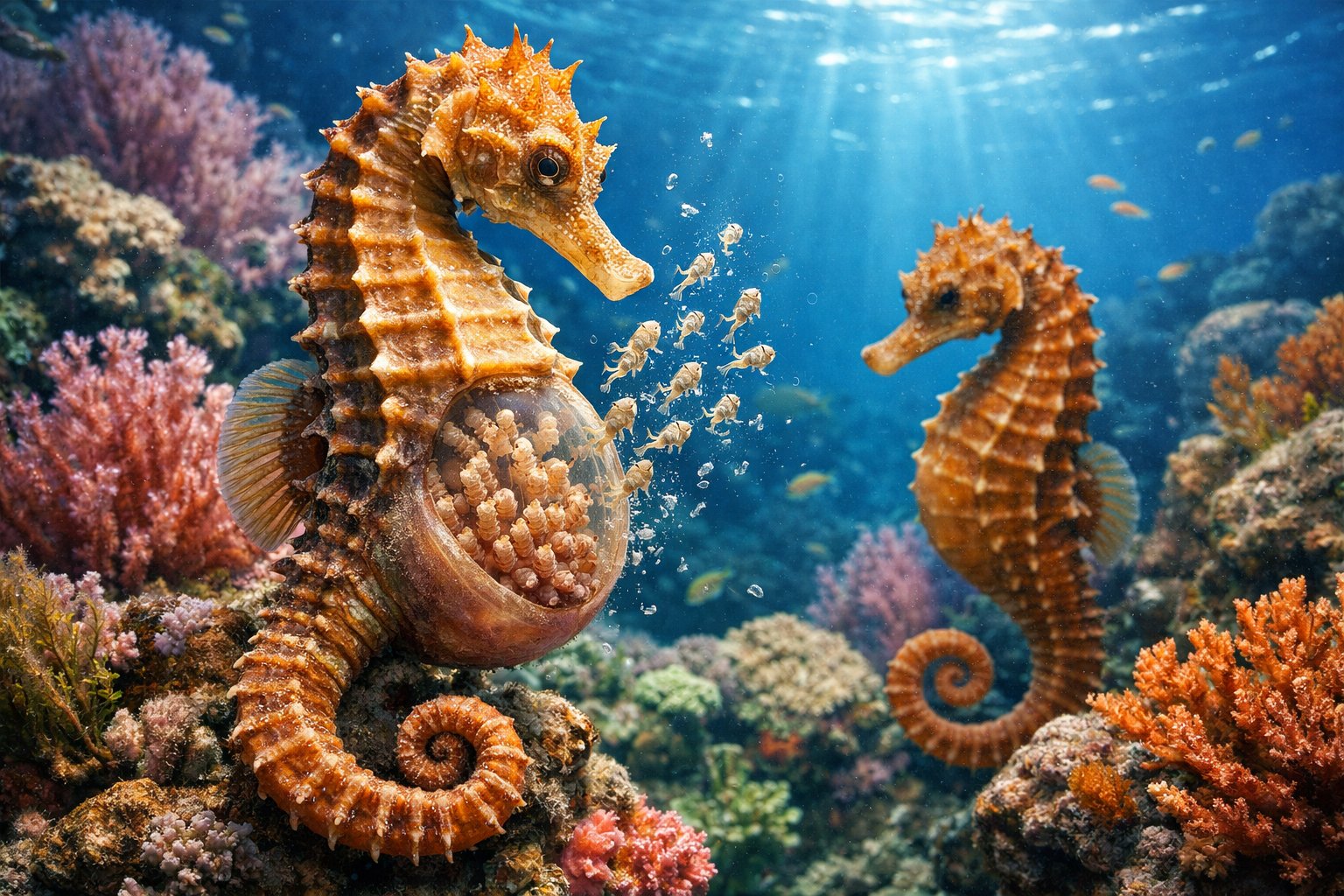
Let’s dig into how this pouch works, why evolution might’ve picked this setup, and how seahorses stack up against their relatives like pipefish and seadragons. There’s something kind of amazing about this bizarre parenting role.
Why Do They Say Male Seahorses Give Birth?

Male seahorses carry fertilized eggs in a pouch on their belly. They nourish the embryos and eventually release live young.
This switch in parenting changes who does the “pregnancy” work, how embryos get oxygen and nutrients, and even how birth happens.
Male Pregnancy in Syngnathidae
You’ll find male pregnancy not just in seahorses, but throughout the Syngnathidae family—think pipefish and seadragons too. In these species, females transfer their eggs into a male’s brood pouch during mating.
The male fertilizes the eggs right inside that pouch. It’s a pretty clever adaptation.
The pouch acts as a mini incubator for developing embryos. Males keep the embryos safe until they’re ready to hatch.
People describe this as male pregnancy because the male’s body takes on the main pregnancy duties, something you rarely see in the animal kingdom.
Brood Pouch Functionality and Development
The brood pouch sits on the male’s belly, working almost like a tiny womb. Once the female deposits the eggs, the pouch seals up, shielding the embryos from predators and unstable water.
Inside the pouch, things get pretty active. Blood vessels grow and the inner surfaces start moving oxygen and nutrients to the embryos.
Males rely on hormones—especially androgens—to build and maintain the pouch. The pouch even manages the male’s immune system so he doesn’t reject the embryos.
Cells in the pouch deliver oxygen and nutrients, and take away waste, right up until hatching.
Benefits and Evolutionary Reasoning
Male seahorse pregnancy seems like an evolutionary trade-off that benefits both parents. When males handle incubation, females can produce more egg batches in a single breeding season.
That means a pair can raise more young overall. For seahorses, male brooding also boosts offspring survival.
The pouch keeps eggs safer and more stable. In unpredictable waters or places with lots of predators, having one parent carry a protected nursery can really help more babies survive.
How Male Seahorses Give Birth
When the embryos are ready, the male’s muscles contract to push out the live young from his brood pouch. These contractions come from skeletal muscles around the pouch and can last minutes or even hours, depending on how many babies there are.
You might see dozens—or even hundreds—of tiny, fully formed seahorses spill out in one go.
After birth, the babies are on their own. The male’s pouch goes back to its resting state, ready for the next round.
That whole cycle—egg transfer, incubation, live release—is why people say male seahorses give birth.
Unique Features of Seahorses and Their Relatives

Seahorses and their relatives really break the mold when it comes to body shape and parenting. You’ll notice the prehensile tail, the male’s brood pouch, and those bony plates instead of normal fish scales.
Overview of Seahorse Anatomy
Seahorses (genus Hippocampus) use a long snout to suck up tiny prey like copepods. Their bodies have bony plates that form rings, not the usual fish scales.
This armor offers protection but makes them pretty lousy swimmers. They use their prehensile tail to grab onto seagrass or coral, anchoring themselves in strong currents.
That tail can’t coil like a monkey’s, but it wraps tightly around things. Male seahorses have a brood pouch on their belly or near the tail base.
Females transfer eggs into the pouch, and the male fertilizes and carries them until they’re born. The pouch supplies oxygen and nutrients to the embryos and controls fluid balance.
Pipefish and Sea Dragons: Similar Strategies
Pipefish and sea dragons are part of the same family—Syngnathidae—so they share a lot with seahorses. Pipefish have long, straight bodies and often carry eggs along their belly or in a simple brood area.
Sea dragons (Phycodurus and Phyllopteryx) look leafy and don’t have a coiling tail. They rely on camouflage and carry eggs on a small brood patch under the tail or belly.
Their bodies also have bony plates and a long snout. All these relatives use male brooding as their main reproductive strategy.
The pouch or brood area varies—a few have a fully enclosed pouch, others use open brood sites. Either way, the males provide most of the incubation care.
Seahorse Species and Family Traits
Inside the Syngnathidae family, seahorse species show all sorts of differences—pouch type, tail length, and where they like to live.
Dwarf seahorses, for example, are tiny and don’t stick around for long. They breed fast, too. Larger species, like the pot-bellied seahorse, can carry more embryos in each brood.
If you ever get the chance to watch them, you’ll spot unique courtship dances that line up perfectly with egg transfer. It’s honestly fascinating.
Color patterns and little skin filaments help them blend in with seagrass or kelp. Some really vanish into their surroundings.
Where they live—mangroves, reefs, or seagrass—shapes their bodies and how many young they can carry.
Conservation issues pop up depending on the species. Since so many seahorses depend on specific habitats, when seagrass or coral gets damaged, local populations can crash fast.
Their family traits stick out—bony plates, that oddly charming prehensile tail, and the way males handle brooding. These quirks shape everything about how they survive and raise young.


