
Ever wondered why humans and chimps, despite sharing so much DNA, can’t have babies together? The simple truth is this: humans and chimpanzees can’t breed because their chromosomes just don’t line up right, so a fertilized egg never gets the chance to grow into a living offspring. Even though we look kind of similar and share a distant ancestor, the biology just doesn’t cooperate.

But chromosomes aren’t the only problem. Humans and chimps have a bunch of genetic and biological differences that block any chance of producing a baby together.
These differences are way bigger than what you’d find between any two unrelated humans. If you dig into the details, you’ll start to see just how two species can be so close on paper, yet totally separate when it comes to reproduction.
Fundamental Reasons Humans Can’t Breed With Chimps

Clear biological roadblocks stop humans from breeding with chimps. DNA differences, mismatched chromosome numbers, and the way reproduction works all play a part here.
Once you see the specifics, it’s pretty obvious why mating between humans and chimpanzees just isn’t possible.
Genetic Divergence Between Humans and Chimps
Sure, humans and chimps share about 98-99% of their DNA. That sounds like a lot, but that tiny difference is actually huge.
Over the last 6 to 7 million years, since humans and chimps split from a common ancestor, a lot has changed. Genes that affect brain power, body shape, and development evolved in different ways.
Humans ended up with some unique genes that chimps just don’t have. So, if you tried to mix the two, your body wouldn’t recognize chimp cells, and nothing would come of it.
Differences in Chromosome Numbers
Humans have 46 chromosomes. Chimps have 48.
Why? Human chromosome 2 is actually a fusion of two separate chimp chromosomes. This changes how genes are organized.
For reproduction to work, sperm and egg cells need to have matching pairs of chromosomes. If they don’t, fertilization usually fails, or the embryo can’t develop. That mismatch alone blocks any hybrid from forming.
Reproductive Incompatibility
It’s not just about genes or chromosomes. The whole reproductive process is different.
Human and chimp reproductive organs don’t match up perfectly. Their fertility cycles and gestation periods don’t line up either.
Human sperm and chimp eggs usually can’t fuse, so fertilization doesn’t even get started. Even if it did, your immune system would probably attack the foreign cells.
And if by some miracle fertilization happened, the embryo wouldn’t develop properly. Genetic conflicts would stop it before it ever got going.
If you want more details, check out why humans and chimps can’t hybridize.
Debunking Myths and Scientific Attempts
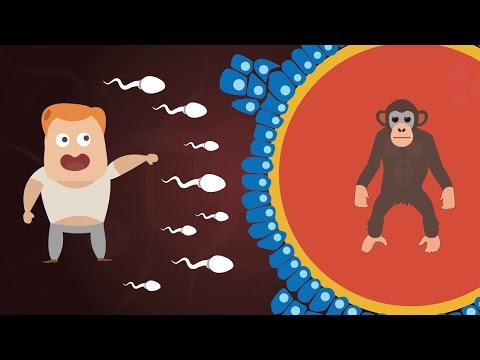
It’s easy to wonder if humans and chimps could ever mix, given how closely related they are. But once you dig into the science and history, most of those ideas fall apart.
The ‘Humanzee’ Hypothesis
The word “humanzee” pops up in stories and rumors about a human-chimp hybrid. But no real proof or confirmed case has ever shown one exists.
People talk about this because humans and chimps share over 95% of their DNA. Still, small genetic differences—like humans having 23 pairs of chromosomes and chimps having 22—make breeding impossible.
From an ethical and scientific standpoint, the idea doesn’t hold water. Any supposed attempts to create a humanzee weren’t backed by real science and never produced results. There’s just no credible evidence for these hybrids.
Evolutionary Separation Timeline
Humans and chimps split from a common ancestor about 5 to 7 million years ago. That’s a long time for each species to pick up new biological quirks.
One of the biggest is chromosome structure. Human chromosome 2 formed when two ape chromosomes fused together, which chimps don’t have.
A lot of genes are arranged or flipped differently, too. These changes built up enough barriers that, even with shared ancestry, the reproductive systems just don’t match up. So, no matter how close we seem, making a hybrid isn’t in the cards.
Failed Hybridization Experiments
Over the years, a handful of scientists and, honestly, some pretty curious folks have tried to mate humans with chimps. They didn’t get any viable offspring.
The main biological reason? Humans and chimps have different numbers of chromosomes, and their arrangement doesn’t match up. That messes with cell division right from the start, so embryos just can’t develop.
There’s more to it, though. Their mating behaviors and basic physiology don’t really line up either. Sure, a few animals with different chromosome numbers can mate, but the gap between humans and chimps is just way too wide.
Most scientists agree—these failed experiments make it clear that humans and chimps breeding is pretty much impossible.
For more detail, check out the discussion on why humans and chimpanzees can’t create hybrids at Biology Stack Exchange.


