
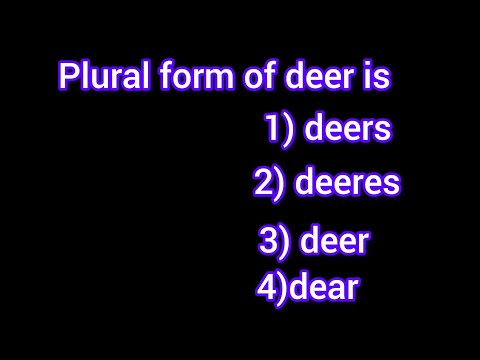
Ever get stuck wondering if you should write “deer” or “deers” when you mean more than one? The answer’s pretty simple: the correct plural is “deer.” The word doesn’t change, whether you spot one animal or a whole bunch. That’s one of those little grammar quirks you just have to remember.

So, why does English leave some plurals unchanged? And how do you actually tell if “deer” means one or many? I’ll walk you through the logic, toss in some quick examples, and share a couple of rules to make this all less of a headache.
The Correct Plural of Deer and Its Grammar

“Deer” works for both one animal and many. You decide the meaning by matching the verb and using context or numbers to show if you mean singular or plural.
Deer as a Singular and Plural Noun
You use “deer” for both one and more than one animal. If you spot a single animal, you’d say, “That deer is near the fence.”
If you see a group, you’d write, “Ten deer are in the field.” The word never changes, so you lean on articles, numbers, or the rest of the sentence to show how many you mean.
Verb agreement shifts depending on the number. Write “the deer is” for one and “the deer are” for several.
Collective words help too, like “herd of deer”: “A herd of deer grazes.” That makes things clearer.
Why “Deer” Doesn’t Become “Deers”
“Deer” breaks the usual -s rule for plurals. English has a handful of these oddballs, like “sheep” and “fish.” The form stuck around from Old English, so we just go with it.
You might run into “deers” in some dialects or casual speech, but major dictionaries and style guides say “deer” is correct. Don’t use “deers” unless you’re quoting a rare name or pointing out a mistake.
Plural of Deer Example Sentences
- Singular with number: “One deer crossed the road at dawn.”
- Plural with number: “Three deer crossed the road at dawn.”
- With collective noun: “A group of deer grazes by the river.”
- Verb agreement: “The deer is eating” (one) versus “The deer are eating” (many).
Use words like “the,” “a,” “three,” or “several” to make the number obvious. When you write, double-check the verb to match what you mean. If you want more details about irregular plurals, check this guide on the plural of deer.
Irregular Plural Forms, Noun Types, and Related Words
Deer keeps the same form for both one and many. So, what’s going on there? Let’s dig into why English does this, which noun types play along, and which other animals follow the same pattern.
Irregular Pluralization and Historical Origins
The word “deer” comes from Old English and Germanic roots, where some nouns never added -s. People just kept saying them that way, and the habit stuck. That’s why deer, sheep, and fish use a “zero plural”—the word looks the same for one or many.
Not every noun with Germanic roots kept this pattern. Plenty of them turned regular and now take -s. Some, like “man” and “men,” just changed the vowel. Others, like “child” and “children,” added endings.
Deer didn’t change at all. It just stayed the same.
If you know the history, you can guess other irregulars. Words that people used all the time kept their old forms. Less common ones usually picked up an -s.
Countable, Uncountable, and Collective Nouns
You can count deer: one deer, two deer, and so on. Don’t add an -s for plural. For groups, use phrases like “a herd of deer” or “a group of deer.”
Some regions toss around rare terms like “a parcel of deer” or “a mob of deer,” but honestly, “herd” and “group” are your safest bets.
Uncountable nouns, like “water” or “rice,” never use numbers. Pluralia tantum nouns, like “scissors,” only show up in the plural.
Deer doesn’t fit those types.
When you write, pair “deer” with numbers or collectives: “three deer” or “a herd of deer.” Just skip “deers.”
Other Animals with Irregular Plurals
A bunch of animals have odd plurals or just don’t change at all. Sheep and fish, for example, don’t bother with an -s: one sheep, two sheep; one fish, two fish.
Moose and elk keep it simple too. You’ll hear one moose, many moose; one elk, many elk. Caribou and reindeer? Same deal.
People do regularize some animals, though. Fox becomes foxes. Wild boar sometimes turns into wild boars, but honestly, you’ll also see wild boar used for both singular and plural, depending on who’s writing.
Regional names or species can get a bit unpredictable. Nilgai (that’s the blue bull) and spotted deer or black buck usually just get an -s in everyday talk. Nilgai, though, almost never changes. Scientific names might not always match what people say.
It’s tricky because usage shifts depending on where you are and who you’re talking to. If you’re not sure, it’s smart to check how people usually say it for that animal. Some nouns stubbornly stick to their old forms, while others have started following the regular -s rule.


