
Ever wondered what really sets an opossum apart from a possum? You’re definitely not alone. People toss those names around like they mean the same thing, but an opossum is a North American marsupial, while a possum is an Australian marsupial. They’re two different animals, even if the names sound almost identical.
Knowing that clears up a lot of confusion, especially if you hear someone in the U.S. talking about a “possum.” They probably mean the North American opossum, not the Australian one.
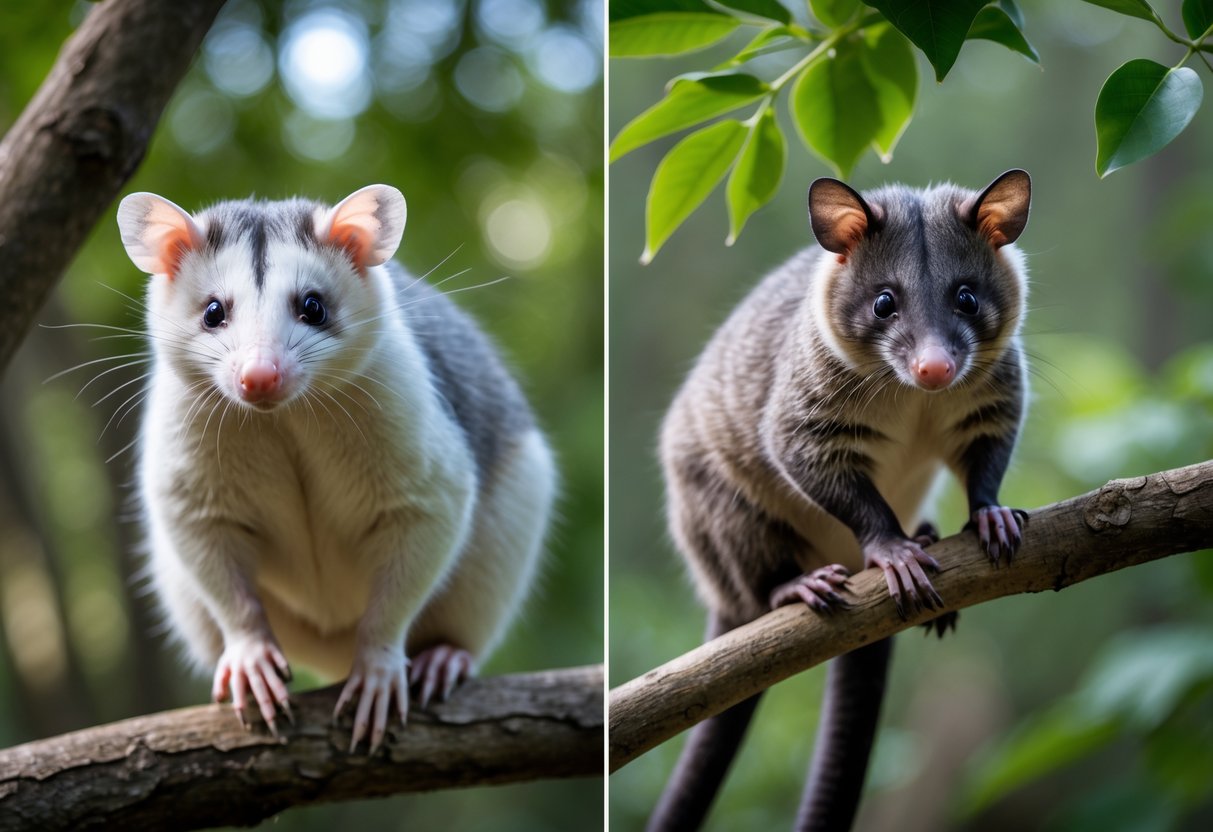
Both animals share a few things—they’re marsupials, and they eat fruits and insects. But honestly, they look and act pretty differently. Opossums have those sharp, pointed faces and a mouth full of teeth. Possums? Their faces are rounder, and their tails are way furrier.
Once you know what to look for, spotting them gets a lot more interesting. And if you’re curious about where these animals live, how they act, and why their names get mixed up so often, you’re in the right place.
Let’s dig in and see why people in different parts of the world use nearly the same name for two totally different creatures.
Fundamental Differences Between Opossums and Possums

You’ll spot some clear differences if you look at how opossums and possums are grouped, where they live, and what they look like. Even though both have pouches for their young, the rest isn’t quite so similar.
Taxonomy and Scientific Classification
Opossums, like the Virginia opossum, belong to the family Didelphidae. They come from North and South America, and scientists put them in the order Didelphimorphia.
Possums fall under the Phalangeridae family. You’ll find them mostly in Australia and nearby islands like New Guinea. They belong to the order Diprotodontia, which also includes animals like sugar gliders.
Both carry babies in pouches, but their family trees split a long way back. They’re marsupials, sure, but their evolutionary paths are pretty far apart.
Geographic Distribution
You won’t find opossums and possums living in the same places. Opossums are native to North and South America. The Virginia opossum, for example, shows up all over the United States and even into southern Canada.
Possums stick to Australia and nearby islands such as New Guinea. They don’t live in the Americas at all.
So, if you see a “possum” in the U.S., it’s actually an opossum. That difference in location is a big clue.
Physical Appearance and Features
Opossums and possums really don’t look much alike. Opossums usually have long, pointed snouts and grayish fur. Their tails are scaly, and young ones use them to grip branches. Adults can reach about 2-3 feet long, tail included.
Possums? They have thick, furry tails—hence the name brushtail possum for some types. They’re a bit smaller, around 1-2 feet long, with rounder faces and short noses. Their fur feels softer and looks fluffier.
Here’s a quick comparison:
| Feature | Opossum | Possum |
|---|---|---|
| Tail | Scaly, often used for hanging | Thick, furry (brush-like tail) |
| Snout | Long and pointed | Shorter and rounded |
| Size | 2-3 feet long | 1-2 feet long |
| Fur color | Grayish | Varies, often softer |
If you catch a glimpse of a furry tail, you’re probably looking at a possum, not an opossum.
You can read more at Terminix.
Behavior, Habitat, and Notable Traits

Opossums and possums don’t just look different—they act differently, too. Their habits, homes, and how they deal with threats are pretty unique.
Typical Habitats and Regions
Opossums, like the Virginia opossum, mostly live in North America. You’ll spot them from southern Canada, throughout the United States, and all the way down into Central and South America.
They’re adaptable. You might find one in a forest, a farm, or even sneaking around a suburban backyard.
Possums, on the other hand, stick to Australia and some nearby islands like New Guinea. They love trees and dense forests. Unlike opossums, they spend most of their time up in the branches, hiding out in hollow trunks or branches.
If you’re ever in Australia, look up—you might see a possum quietly hanging out in a eucalyptus tree.
Behavioral Adaptations
Opossums have a weird trick: they “play possum.” When they get scared, they flop over, open their mouths, show their teeth, and sometimes foam at the mouth. They even release a nasty smell to convince predators they’re dead.
Possums don’t bother with the drama. They rely on speed and hiding in trees to avoid danger.
Both are nocturnal, so you’ll mostly see them at night. Opossums spend more time on the ground, while possums prefer to stay up in the trees.
Disease Resistance and Rabies
Virginia opossums have a pretty tough immune system, which means they almost never get rabies. Honestly, you’ll rarely spot an opossum with this disease.
Their lower body temperature also keeps lots of infections away. It’s kind of fascinating how that works, isn’t it?
Possums in Australia, though, don’t have the same kind of resistance. Rabies doesn’t really show up in Australia, so it’s not something possums there deal with much.
Still, possums can carry other germs. It’s usually a good idea not to pick up or handle wild animals, just to be safe.
If you’re curious about how possums and opossums live, or what makes them tick, you might want to check out this possum vs opossum guide.


