
When a deer locks eyes with you, it’s not sizing up your style—it’s trying to figure you out. Deer care way more about your movements, your shape, and your scent than whatever color you threw on this morning. To a deer, you’re just a moving shape, and it’s watching to decide if you’re trouble.

Their wide-set eyes, sharp ears, and sensitive nose all work together to size you up from a safe distance.
That’s why they sometimes freeze, stare, or dash away—and if you want to keep them calm, you’ll need to understand what’s going on in their heads.
How Deer See You: Visual Perception and Sensory Abilities

Deer pick up movement first. They don’t see as many colors as you do, but their eyes are built for a wide-angle, motion-sensitive view.
They sacrifice sharp detail for the ability to spot danger at a distance, especially if it’s moving.
Field of View and Peripheral Vision
Because deer have eyes on the sides of their heads, they get almost a 300-degree view of the world.
That lets them spot you sneaking up from the side or even behind, all without moving their head.
Their binocular vision—the overlap zone where both eyes see the same thing—is tiny, maybe 20–60 degrees.
So, they don’t get great depth perception straight ahead.
You’ll only look sharp to them if you’re right in that small overlap.
Everywhere else, they use one eye at a time, which means less detail but more coverage.
If you move suddenly, even way off to the side, they’ll notice.
Color Vision and Ultraviolet Sensitivity
Deer see the world in two main colors thanks to only having two types of cone cells.
Reds and greens just blur together for them, so you don’t stand out much in those shades.
Blues and yellows, though, really pop.
Some studies hint that deer might even spot ultraviolet light because of their retinas and pigments.
If you wear clothes or use gear that glows under UV, you might be more obvious than you think.
So, maybe skip the bright blue or UV-reflective stuff in deer country.
Low Light Adaptations and Night Vision
When darkness falls, deer pupils get huge to let in every bit of light.
Their retinas have tons of rod cells, so they’re super sensitive in dim conditions, but they lose out on color.
A shiny layer behind the retina—the tapetum lucidum—bounces light back through, which is why their eyes glow and why they can see at dawn and dusk.
Deer definitely see better than you at night, but it’s not perfect.
They mostly pick up shapes and movement, not sharp details or distant patterns.
Motion Detection and Visual Acuity
Deer spot motion way faster than people do.
Their brains process movement quickly, so even a tiny shift in your arm or jacket could set them off.
Their vision isn’t as sharp as ours—maybe 20/40 to 20/100 compared to human 20/20—so they won’t notice tiny patterns or your facial features.
You’ll look kind of blurry from far away, but if you move too fast, you’ll stand out.
That’s why hunters and hikers move slowly and use natural cover to break up their outlines.
Understanding Deer Behavior When They Look at You
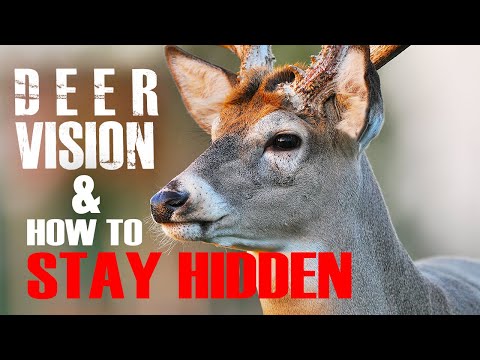
When a deer stares, it’s sizing up its options—should it run, stay, or check you out?
They combine sight, hearing, and smell, and their body language gives you clues about what’s coming next.
Deer Stare and Freeze Response
A deer that stares is usually freezing in place.
If you catch one locking eyes, you’ll often see it stand totally still, hoping you won’t notice it.
That motionless pose helps its camouflaged coat blend in while it figures out what you are.
Watch for subtle signs: nostrils flaring a bit, head up, breathing slow and steady.
All of these mean the deer’s on high alert.
If you make a sudden move, it’ll probably bolt.
On roads, this freeze-then-dash behavior causes the classic “deer in headlights” mess—first they freeze, then they panic and run, which is bad news for drivers.
Assessing Risk and Threat Detection
Deer make snap decisions about risk.
They use their wide vision and sharp hearing to figure out whether you’re a threat.
Their eyes focus on movement, not detail, so even a little shift in your stance, the shape of your backpack, or a dog nearby can change their mind.
Wind matters, too.
If your scent drifts their way, they’ll keep staring longer.
Hunters use this to their advantage by staying downwind or calling softly.
If you want to keep the deer calm, stay still, don’t walk straight at them, and always leave them an easy way out.
Body Language and Non-Verbal Communication
Deer talk with their bodies.
Check their ears, tail, and posture to get a read on them.
Ears forward and weight shifted back? They’re ready to run.
If you see a tail go up or hear a loud snort and stomp, they’re sounding the alarm—other deer catch on fast.
If the deer chews or stands with weight balanced, it’s probably just curious, not scared.
But never walk up to a doe with a fawn.
She might look calm, but she’ll defend her baby in a heartbeat.
Best thing you can do? Give them space and don’t block their escape.
Curiosity Versus Caution
Curiosity makes a deer hold its stare a bit longer, but that doesn’t mean it trusts you. Sometimes you’ll catch a head tilt, a few tiny steps forward, or those ears twitching around as it tries to figure you out.
These are just signs it’s investigating, not signals that it’s comfortable. If you notice the deer keeping its tail low and breathing easy, it might creep a little closer to get a better look.
But honestly, one weird sound or a sudden move and that curiosity vanishes—it’s gone in a flash. If you want to avoid spooking wildlife, just move slowly, keep quiet, and let the deer decide how close it wants to get.


