
If you’ve ever wondered about demons linked to owls, Kilili definitely stands out. Kilili, a female demon from ancient Mesopotamian myths, has a close connection to owls and often serves the goddess Ishtar. People sometimes call her an owl-demoness, and she haunts windows and abandoned places, which only adds to her strange reputation.
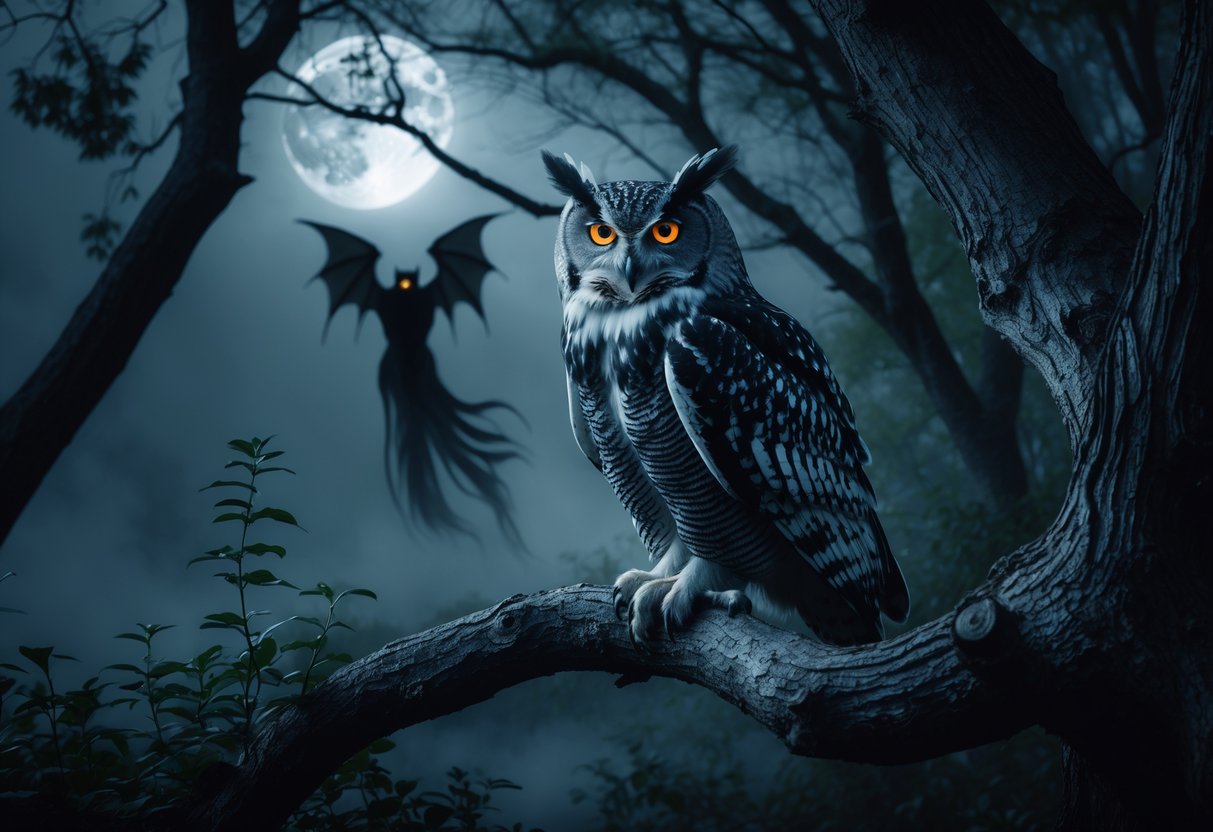
You might also hear about Stolas. In later occult books, Stolas gets the name “Owl Demon.” He looks like a mix of human and owl and supposedly commands legions in Hell. Stolas doesn’t have those ancient roots like Kilili but pops up in witchcraft stories and old grimoires.
Owls have always seemed both wise and a little spooky, so it makes sense that cultures tied them to spirits and demons. When you dig into these stories, you see how owls come to stand for mystery and the supernatural, whether in old legends or modern tales. If you want more about Kilili’s history or who Stolas is, there are detailed accounts of Kilili and her owl connections and the way owls relate to demons like Stolas.
Lilith: The Demon Most Associated With Owls

People often call Lilith the demon most tightly linked to owls, especially in old religious stories. She’s known for her deep ties to night creatures, female demons, and all sorts of dark myths.
You’ll hear about her beginnings, her role as Adam’s first wife, and her symbolic connection to owls. She pops up a lot in Jewish texts.
Origins of Lilith in Mesopotamian Mythology
Lilith’s story starts way back in ancient Mesopotamia. She shows up as a female demon or spirit in early Sumerian and Akkadian texts, which mention spirits called lilītu. These spirits were tied to the wind, disease, and the night.
You might see images like the Burney Relief, a terracotta plaque with a winged woman and bird feet. Some folks once thought this was Lilith, but now experts usually say it’s the goddess Ishtar or Ereshkigal.
Still, Lilith kept her reputation as a dark and mysterious figure, often connected with night creatures like serpents and owls. The “owl” idea probably took off because owls are nocturnal and have always seemed mysterious and maybe even a little dangerous in the ancient Near East.
Lilith and Adam’s First Wife Legend
A popular story claims Lilith was Adam’s first wife. She was made at the same time and from the same clay as Adam. Unlike Eve, she refused to be submissive.
Lilith left the Garden of Eden over this. She then joined fallen angels and became the mother of demons and spirits, including succubi—those female demons that supposedly visit men in their sleep.
You won’t find this tale in the Bible, but it shows up in later Jewish folklore and books like the Alphabet of Sirach. It paints Lilith as a strong female figure who won’t be controlled. The legend also links her to darkness and danger, which fits perfectly with her later ties to owls.
Lilith’s Association With Night and Owls
People have long connected Lilith to owls, especially screech owls. In Hebrew texts, the word lilit can mean a night creature or screech owl. This bird stands for wisdom but also mystery and the unknown.
You’ll spot Lilith’s name or image on magical objects—like amulets and bowls—meant to protect women during childbirth or keep evil spirits away. These often show an owl or a female demon.
Owls just fit with Lilith’s night-time vibe, her mystery, and her feared powers. An owl’s ability to see in the dark makes it a perfect symbol for Lilith’s role as a spirit of the night.
Lilith in the Talmud and Jewish Folklore
Jewish folklore and the Talmud paint Lilith as a dangerous female demon who threatens men and infants. Some rabbis even warned men not to sleep alone, afraid Lilith might show up.
The Talmud describes her as a spirit of darkness with wild sensuality. People feared her, but they also respected her, using her name in protective spells and stories about powerful night demons.
Lilith’s image has changed over time, but she still pops up in stories about night spirits, women’s fears, and the blurred line between the sacred and the dangerous. She often appears with other night creatures like serpents and jackals, showing just how much she belongs to the shadowy side of ancient life.
You can dig deeper into her story and her owl connections in sources like the New World Encyclopedia on Lilith and these Talmudic discussions.
Owls, Demons, and Supernatural Symbolism Across Cultures

Owls have always had a supernatural vibe. People saw them as powerful, mysterious, and sometimes a little unsettling.
Some cultures thought owls protected people. Others believed owls were warnings of danger or evil. Their night habits and eerie calls inspired all sorts of stories about owls carrying messages from the other side.
Owl Symbolism in the Ancient Near East and Egypt
In ancient Egypt, owls were tied to the ba and ka, two parts of the soul that made up a person’s spiritual self. Egyptians believed owls guided these parts in the afterlife.
They also linked owls to Thoth, the wise god connected to magic. Egyptians didn’t really see owls as evil; they thought of them as guardians of knowledge and the spirit world.
Nearby cultures, like the Hittites, sometimes saw owls as night creatures with supernatural powers. The bird’s silent flight made it a strong symbol of mystery and a watcher of hidden worlds.
Owls as Evil Omens in Folklore
In a lot of traditions, people saw owls as signs of bad luck or death. Their night calls made folks uneasy. In some places, if you heard a screech owl at night, you might worry about sickness or even witchcraft.
The white owl especially had a reputation for special powers. Some believed it was linked to demons like Lilith, who herself was associated with darkness and evil spirits in Middle Eastern stories.
In parts of Europe and among the Israelites, people sometimes saw owls as unclean or close to evil. If an owl showed up near your home, folks might just avoid it—or even feel a little afraid.
The Owl in Cherokee and Other Indigenous Beliefs
The Cherokee viewed owls in a pretty complicated way. Some folks saw them as messengers, while others felt a sense of warning whenever an owl appeared. People believed owls could predict death or hint at danger, so if you spotted one, maybe a message from the spirit world was close.
Other Native American groups often felt the same. Some believed owls could shapeshift or had ties to supernatural forces. The great-horned owl and screech owl popped up a lot as symbols of transformation or spiritual messages.
Honestly, these stories push you to respect owls as powerful beings, not just something spooky in the night. Depending on your community’s traditions, owls might act as guardians or serve as warnings—so much depends on how you see the world beyond the obvious.
If you’re curious and want to dig deeper into what different cultures say about owls, check out Are Owls Associated With Demons? Myths, Folklore, and Facts.


