
Ever wondered if a coyote is actually a wolf, or just a close cousin? Coyotes aren’t wolves, but they both belong to the Canis family. That means they share some traits, yet they’re definitely different species. Coyotes usually look smaller, with slimmer bodies and their own set of behaviors.
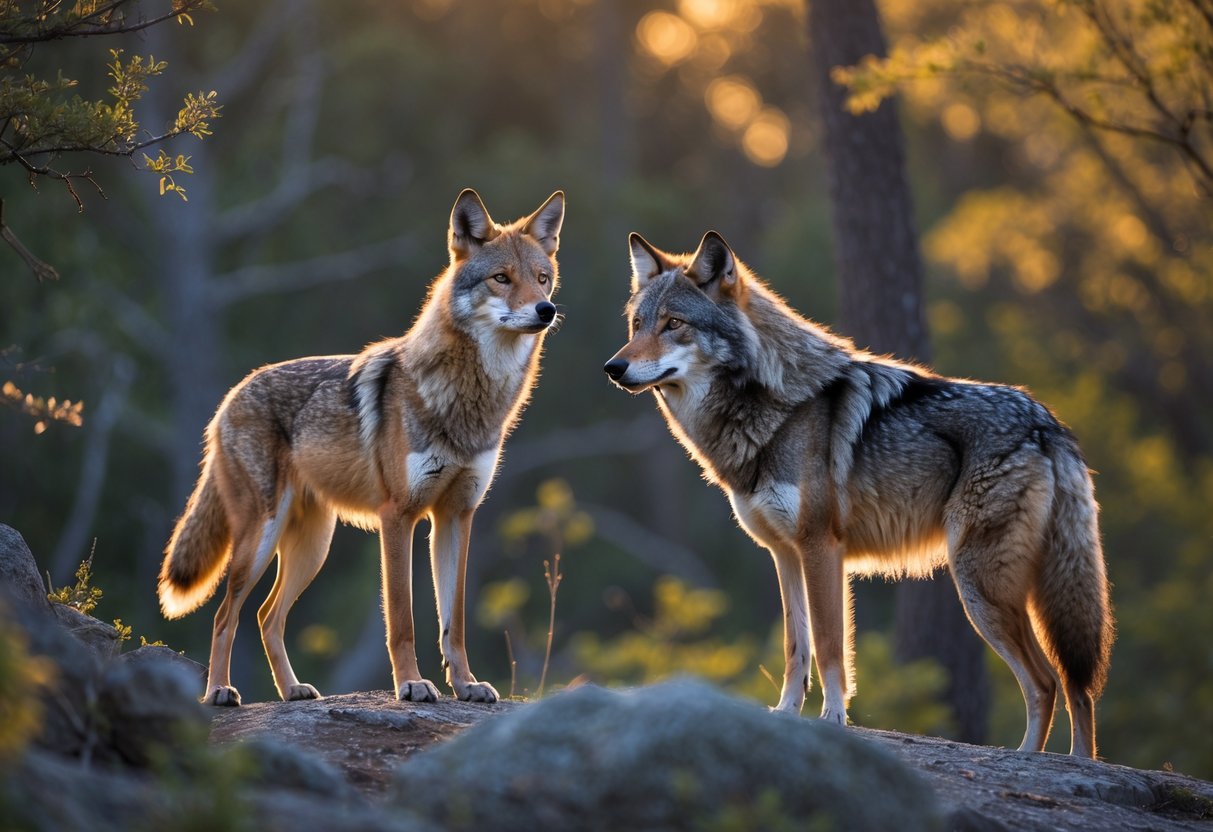
If you’ve seen one in the wild or heard their strange howls, you might think they look pretty similar at first glance.
But once you pick up on their key differences, it gets much easier to tell them apart.
Learning about these differences can help you appreciate both animals and the roles they play in nature.
Coyote vs. Wolf: Are They the Same?

Coyotes and wolves are related, but you’ll spot some big differences in how they’re classified, how they evolved, how they look, and how they act.
Knowing these details makes it a lot easier to see how they’re connected, but still very much their own animals.
Taxonomic Classification
Both coyotes and wolves belong to the genus Canis, so they share some genetic traits.
Wolves go by the scientific name Canis lupus, while coyotes are Canis latrans.
Think of them as cousins in a big family tree.
They come from the same branch, but split off long ago.
That’s why they look a bit alike, but they’re not the same animal.
Evolutionary Relationship
Coyotes and wolves evolved from a shared ancestor millions of years back.
Over time, wolves got bigger and adapted to hunting large animals in wild places.
Coyotes stayed smaller and learned to be flexible, often living near towns and cities.
This split helped coyotes survive almost anywhere, while wolves stuck to wilder, more remote spots.
Their shared history explains some similarities, but also why they act and live so differently today.
Physical Comparisons
Wolves are way bigger than coyotes.
A gray wolf can stand up to 30 inches tall and weigh around 175 pounds.
Coyotes, on the other hand, are about 24 inches tall at the shoulder and weigh less than 50 pounds.
Wolves have broad heads and shorter ears.
Coyotes have narrower faces and bigger ears.
Their fur colors sometimes overlap, but wolves usually have thicker, denser coats for cold weather.
Coyotes’ fur is thinner, with a blend of gray, brown, and red.
| Feature | Wolf (Canis lupus) | Coyote (Canis latrans) |
|---|---|---|
| Height | Up to 30 inches | About 24 inches |
| Weight | Up to 175 pounds | Up to 50 pounds |
| Head Shape | Broad and large | Narrow and pointed |
| Coat Density | Thick, good for cold | Thinner, good for warmth |
| Ear Size | Smaller relative to head | Larger relative to head |
Behavioral and Social Differences
Wolves live in packs with strict social hierarchies.
An alpha male and female lead the group, and everyone works together to hunt big animals like deer or elk.
They rely on teamwork and communicate with deep, echoing howls.
Coyotes usually live alone or in small family groups.
They hunt smaller prey—think rabbits and rodents.
Coyotes use high-pitched yips and barks that sound totally different from wolf howls.
They’re good at adapting to urban life and can change their habits to survive near people.
These differences in social life and behavior really show how each animal fits into its own world.
How to Distinguish Coyotes from Wolves in the Wild

When you’re out in nature, you might spot a coyote or a wolf based on size, sounds, and where they hang out.
Their body shapes, fur colors, and even their footprints can give them away.
Knowing these clues can help you tell them apart if you ever cross paths.
Size and Body Shape
Coyotes are just smaller.
Most weigh between 15 and 44 pounds, and stand about 21 to 24 inches tall at the shoulder.
Wolves tip the scales at 45 to 145 pounds and can reach 33 inches tall.
Coyotes have slender bodies, long narrow snouts, and thin legs.
Wolves look more muscular, with broader bodies, shorter and wider snouts, and thicker legs.
When they run, coyotes usually keep their tails low, but wolves hold theirs straight out behind them.
Distinctive Coat Colors
Check out their fur.
Coyotes often sport a tan or gray coat that blends into grasslands and urban edges.
They have more even coloring and a bushy tail with a black tip.
Wolves come in a bigger range of colors—white, gray, silver, black, tan.
Their fur is thicker, especially if they live somewhere cold.
Wolves’ tails aren’t as bushy and usually match the color of their bodies.
Ears, Snouts, and Face Features
Coyotes have long, pointy ears that stick up like a fox’s.
Their snouts are thin and long.
Wolves have shorter, rounded ears and broader, stockier snouts.
If you see a face with thinner, sharper features, it’s probably a coyote.
Wolves’ faces are bigger and rounder.
Coyotes even look a bit more like foxes in the face than wolves do.
Vocalizations and Sounds
Coyotes make high-pitched noises—short howls, yaps, and barks.
Their howls are quick and sharp.
Wolves go for low, long howls that carry across the landscape.
If you hear a deep, drawn-out howl, you’re probably listening to a wolf.
Short, sharp yelps and yips are usually coyotes.
Learning these sounds can clue you in to which animal is around.
Tracks and Footprints
Coyote tracks are small—about 2.5 inches long—and look oval or narrow.
Wolf tracks are way bigger and rounder, usually 4 to 5.5 inches long.
You’ll find coyote tracks in both city and country areas.
Wolf tracks usually turn up in wilder places.
Their sharp claws show in the prints, and the size difference is pretty obvious once you know what to look for.
Common Habitats and Ranges
Coyotes live all over North America, from cities to forests.
You might see eastern coyotes in towns or near farms.
Western coyotes often stick to grasslands or deserts.
Wolves prefer remote forests, mountains, and big open spaces.
Gray wolves roam parts of the U.S., Canada, and Europe.
Red wolves mostly stay in eastern North Carolina.
Wolves stay away from cities much more than coyotes.
Interactions with Humans and Domestic Dogs
Coyotes often show up near people and can live close to neighborhoods.
Sometimes they get into trouble with pets, but they rarely go after people.
Wolves avoid people and almost never come near towns.
Wolf attacks on humans are extremely rare.
Both coyotes and wolves might cross paths with domestic dogs.
Coyotes sometimes even mate with dogs, but wolves almost never do.
Coyote and Wolf Populations Across North America
Coyote numbers have really exploded, especially in eastern and western North America.
Their knack for adapting helps them thrive near humans.
Wolf populations are much smaller and more limited.
Gray wolves have bounced back in some places, but red wolves are still endangered.
Wildlife managers keep an eye on these trends to help protect both species and their habitats.
Hybridization: Coywolves and Eastern Coyotes
In parts of the eastern U.S. and Canada, coyotes and wolves have actually interbred. That mix has given us animals called “coywolves,” which honestly have a weird but fascinating blend of traits from both parents.
Eastern coyotes usually carry some wolf DNA. They’re noticeably bigger than their western cousins, and they can go after larger prey.
These hybrids really show how animals find ways to adapt and shift as their environments change.


