
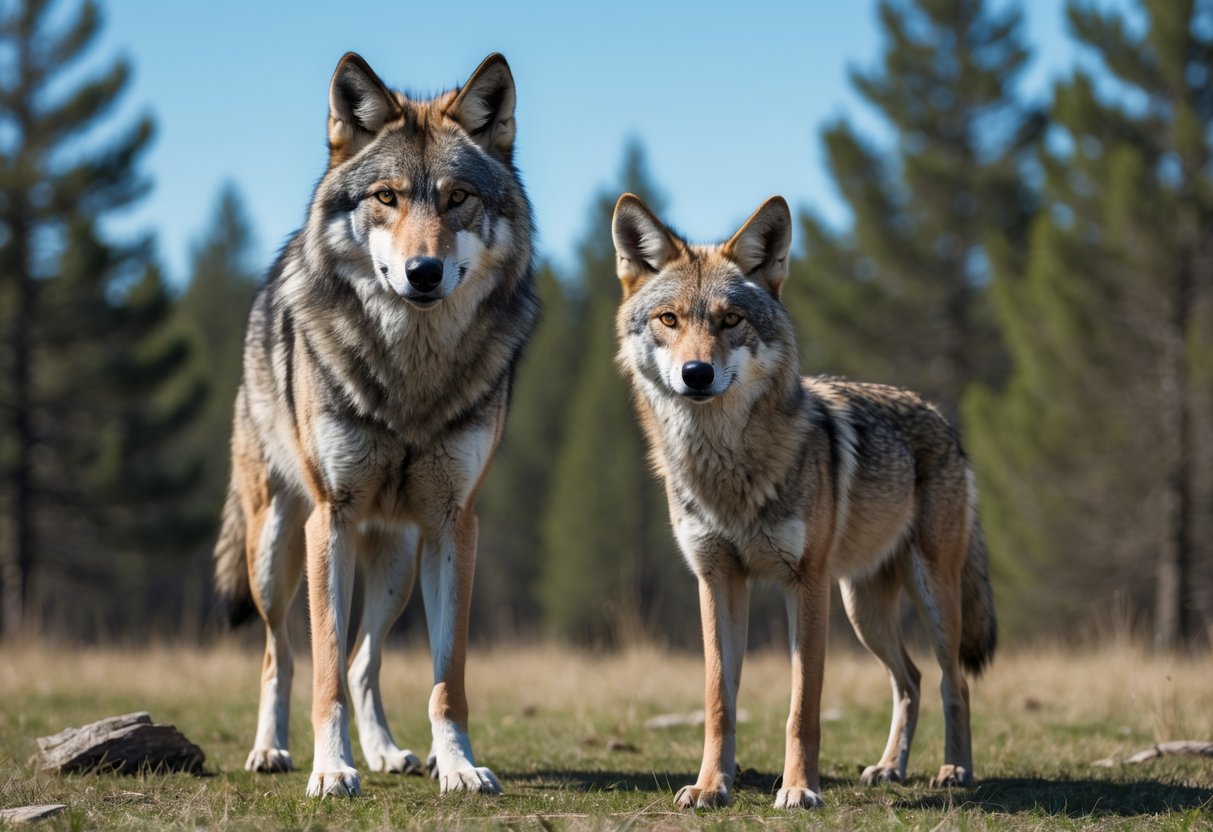
Trying to tell a wolf from a coyote? It can be tough since they look pretty similar at first. But honestly, size gives it away—wolves are much bigger, with broader faces and those rounded ears, while coyotes stay on the smaller side with pointy ears and skinny snouts. Their tails help too. Coyotes usually keep their tails low when they run, but wolves stretch theirs out straight behind them.
The way they sound? That’s different too. Wolves let out deep, drawn-out howls, while coyotes go for the higher-pitched yips and quick barks.
Their social lives don’t match up either. Wolves stick together in big packs where everyone has a job, but coyotes mostly hang with their families or wander solo.
Once you get used to spotting these things, telling them apart feels easier. Just watch for their size, shape, and those classic sounds.
If you want more details, you can check out guides on how to spot wolves and coyotes by behavior and looks.
Key Ways to Tell a Wolf from a Coyote

You can figure out if you’re looking at a wolf or a coyote by noticing their size, head shape, ears, tail, and fur. These details stand out, even if you’re just catching a glimpse in the wild.
Some features are obvious, but others take a little more practice to spot.
Physical Size Differences
Wolves? They’re huge compared to coyotes. Adult wolves usually weigh somewhere between 80 and 150 pounds, and from nose to tail tip, they can stretch out to 6 feet.
Coyotes are a lot lighter—usually 20 to 50 pounds, and about 3 to 4 feet long.
If you see an animal as big as a large German Shepherd, chances are it’s a wolf. Coyotes look more like medium-sized dogs.
Eastern coyotes can get a bit bigger than their western cousins, but they’re still no match for a wolf’s size.
Wolves walk on longer legs and have bodies that look bulkier and more muscular. Their chests are wide, but their waists pull in narrow.
Coyotes look slimmer and more delicate.
Head and Facial Features
Look at the head, and you’ll spot some clear differences. Wolves have these broad, blocky heads with big, strong jaws.
Their snouts are wide and shorter compared to their face length.
Coyotes? Their faces look narrow, and their snouts stick out long and pointed. Their heads seem smaller overall.
You’ll probably notice their noses look sharp and slim.
Wolves’ eyes sit closer together and show a yellowish or amber color. Coyotes’ eyes are set a bit farther apart, and you’ll see eye color from yellow to dark brown.
If you check out the skull shape, wolves’ heads come off rounder and bigger. Eastern coyotes sometimes have more wolf-like features because of hybrid genes, but size and head shape still help you tell them apart.
Ear and Tail Characteristics
Wolves have smaller, rounded ears for their head size. Their ears sit lower and point out a bit.
Coyotes, on the other hand, have big, pointy ears that stick straight up.
Now look at the tail. Wolves keep their bushy tails low or straight behind them when they’re relaxed.
Coyotes often lift their thinner tails up with a slight curve, especially when they run.
A wolf’s tail looks thick and furry, while a coyote’s is skinnier with less hair. The way they carry their tails gives you a pretty good clue.
Coat Color and Texture
Wolves grow thick, dense fur to survive cold winters. Their coats usually mix gray, black, brown, and white. The fur feels coarse and fluffy, especially around the neck.
Coyotes wear lighter fur, usually tan, gray, or light brown with a pale underside. Their coats look smoother and not as full as a wolf’s.
Eastern coyotes can have darker, thicker coats than those out west, sometimes almost wolf-like. Still, their fur never gets as full or dense as a real wolf’s.
If you pay attention to fur quality and color, you’ll spot the difference even from a distance. Wolves have coats that look almost “luxurious,” while coyotes seem a bit scruffier.
Behavioral Clues and Tracks
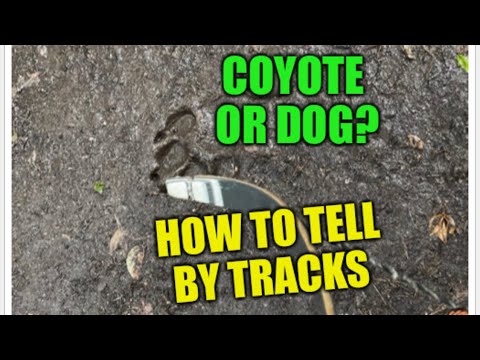
You can pick up a lot just by listening to their calls, checking out where they live, or looking at their tracks. These clues help you figure out which one you’re dealing with out in the wild.
Howling and Vocalizations
Hear a howl? That’s a big clue. Wolves let out deep, long howls to talk to their pack across big distances.
Their calls sound drawn out and low.
Coyotes do things differently. Their howls go higher and don’t last as long.
You’ll hear yips, barks, or a jumble of sounds that come off more playful or quick.
Coyotes howl to mark territory too, but usually by themselves or with a couple others. Wolves, though, almost always howl as a pack.
If you listen closely, you can tell if you’re near a lone coyote or a group of wolves. Wolves’ howls carry farther because of that pack power.
Habitat and Range
Where you spot tracks or hear howls tells you a lot. Wolves stick to forests, tundra, and remote wild places where their populations are healthiest.
They choose spots with plenty of room and lots of prey.
Coyotes play it differently. They adapt to grasslands, deserts, and even cities. You might see coyote tracks in suburban neighborhoods or near farms.
If you’re deep in dense woods with not many people around, you’re probably in wolf territory.
In more open or mixed places, coyotes are usually the ones you’ll run into. Knowing the landscape helps you guess which animal you’re tracking.
Paw Prints and Tracks
If you want to tell a wolf from a coyote, tracking is one of the best ways to do it.
Wolf paw prints usually stand out—they’re big, about 4 to 5 inches long. The pads look broad, and the toes have this lobed shape. Their tracks tend to look oval and kind of sturdy.
Coyote paw prints? They’re smaller, maybe 2.5 to 3 inches long, and a lot more narrow. The toes often make a V shape, and you’ll spot those sharper claw marks.
Take a look at the spacing between the footprints. Wolves walk with a long stride. Sometimes their back feet even overlap the front ones by as much as 18 inches, making a pretty clear trail.
Coyotes, on the other hand, move in a much more scattered or zigzag pattern.
Here’s a quick comparison:
| Feature | Wolf Tracks | Coyote Tracks |
|---|---|---|
| Length | 4-5 inches | 2.5-3 inches |
| Shape | Oval with lobe-shaped toes | Narrow with V-shaped toes |
| Claw Marks | Often visible | Sharp, clearly visible |
| Gait Pattern | Long stride, overlapped footprints | Shorter stride, scattered pattern |
So, if you pay attention to these details, you’ll have a much better shot at figuring out which animal left those tracks.


