
Most people assume only female animals get pregnant, right? Seahorses totally break that rule.
It’s the males who carry the eggs in a pouch, fertilize them, and then—believe it or not—give birth to hundreds or even thousands of teeny seahorses.
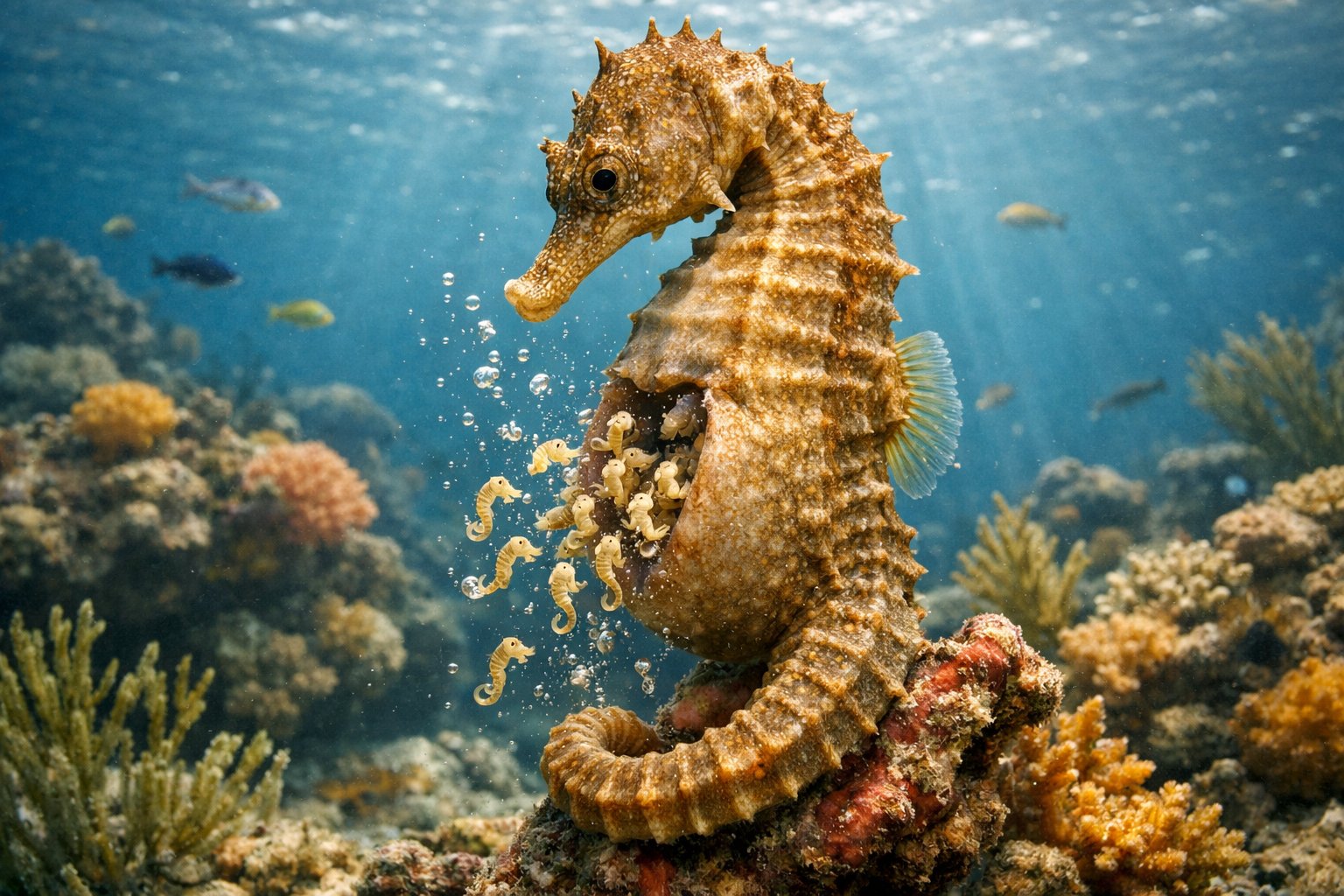
Here’s how it works: the female puts her eggs into the male’s brood pouch.
His pouch delivers oxygen and nutrients, and then he uses his muscles to push out the fully formed babies.
Different seahorse relatives and their habitats tweak the birth process in fascinating ways.
There’s a lot going on behind the scenes—the timing, the pouch’s weird functions, and the way seahorse dads get ready for, and recover from, birth.
How Male Seahorses Give Birth

Male seahorses take on the eggs, feed them, and eventually push out fully formed baby seahorses when they’re ready.
Let’s look at how seahorse pairs court, how the brood pouch works, and what goes on during fertilization and incubation.
Courtship and Mating Rituals
Seahorse courtship is kind of mesmerizing to watch.
Males and females do this color-changing dance, swim together, and lock tails.
That dance strengthens their bond and makes sure both are ready for the egg transfer.
You’ll probably catch the male nodding and flaring his dorsal fin, while the female moves her eggs toward his pouch.
She uses an ovipositor to place her eggs right into his pouch opening.
Courtship can include mutual feeding and daily displays, keeping the pair in sync until the big moment.
Timing is everything: most seahorses breed in cycles linked to water temperature and food.
This careful ritual boosts the odds that the eggs will transfer safely and the male won’t get too stressed out.
Role of the Brood Pouch
The brood pouch sits on the male’s tail or belly, depending on the species.
It acts like a protective nursery.
Once the female transfers her eggs, the pouch closes up and creates a safe space where the male manages salinity, oxygen, and nutrients for the embryos.
Inside, special tissues form a placenta-like structure that swaps gases and nutrients.
The male slowly shifts the pouch fluid from his own body chemistry to seawater as the pregnancy progresses.
This helps the embryos develop and keeps them from getting shocked by the ocean when they’re born.
The pouch also keeps eggs safe from predators and parasites.
If you spot a pregnant male, you’ll probably notice his belly swelling as the embryos grow.
Muscles and tiny bones in the pouch help him contract and expel the babies when the time comes.
Fertilization and Incubation
Fertilization kicks off inside the pouch right after the female drops off her eggs.
The male releases sperm into the pouch, fertilizing each egg and embedding them in a moist, oxygen-rich matrix.
Incubation usually lasts about two to four weeks, give or take, depending on the species and water temperature.
During this time, the male provides oxygen through his pouch’s blood vessels, and sometimes delivers ions and a bit of nutrition.
It’s a short, very fish-specific version of pregnancy.
When the embryos are ready, the male starts rhythmic contractions with muscles near the pouch’s opening.
Sometimes, he’ll use his anal fin to help push the babies out.
He can release dozens, hundreds, or even thousands of tiny, independent seahorses—ready to swim and feed right away.
If you want a deep dive into brood pouch anatomy and birth mechanics, check out this detailed explanation: how male seahorses give birth.
Seahorse Species, Relatives, and Habitats

Seahorses come in all sorts of shapes, sizes, and colors.
Some are tiny and cling to seagrass, while others grow much bigger and live near reefs or kelp.
Diversity of Seahorse Species
There are about 40–50 seahorse species in the genus Hippocampus.
Some, like the dwarf seahorse (Hippocampus zosterae), barely reach 2 cm.
Others, like the big-bellied seahorse (Hippocampus abdominalis), can stretch to 30 cm.
Many species show off wild body shapes, skin filaments, and colors that help them blend in.
Litter size and breeding habits vary a lot.
Dwarf seahorses may release just a few dozen young, while larger species can have hundreds or even thousands at once.
Where they live changes things too; some hang out in warm tropical waters, while others stick to cooler zones.
If you want more details about seahorse variety and their life stories, check out Britannica’s seahorse overview.
Seahorse Relatives: Pipefish and Sea Dragons
Seahorses belong to the family Syngnathidae, which also includes pipefish and those wild-looking seadragons.
Pipefish look like straight-bodied seahorses without the curly tail.
They swim horizontally and usually hide in seagrass or algae.
Sea dragons (or seadragons) are close cousins with leafy appendages that look just like seaweed.
Both pipefish and seadragons share some odd reproductive tricks with seahorses: the males carry the eggs.
Sea dragons don’t have a tight pouch; instead, they hold eggs along their tails or undersides until the young hatch.
If you’re curious, the National Oceanic and Atmospheric Administration explains male pregnancy in seahorses and their relatives here.
Habitats and Survival Strategies
You’ll usually spot seahorses hanging out in shallow coastal waters—think seagrass beds, mangroves, estuaries, and coral reefs.
The tiny dwarf H. zosterae tends to stick to seagrass meadows. In contrast, H. abdominalis likes to live near kelp and rocky reefs.
These places give seahorses something to grab onto with their prehensile tails. If you look closely, you might catch them clinging to plants or coral, just staying put.
Seahorses depend a lot on camouflage and slow, careful movements when they feed. They use their tube-like snouts to suck up tiny crustaceans and plankton.
Sadly, habitat loss, pollution, and bycatch put many seahorse species at risk. Some have even landed on vulnerable or endangered species lists.
If you want to see photos or dive deeper into where they live, National Geographic’s seahorse page has birth numbers and more habitat info: https://www.nationalgeographic.com/animals/fish/facts/seahorses.


