
If you spot a deer and a horse together, it’s easy to assume they must be close cousins since both have hooves. But that’s not really the case—deer belong to the even-toed ungulates (Artiodactyla), while horses fall under the odd-toed ungulates (Perissodactyla).
That simple split changes the whole story of how they evolved, and it explains why they share some similarities but actually differ in big ways.
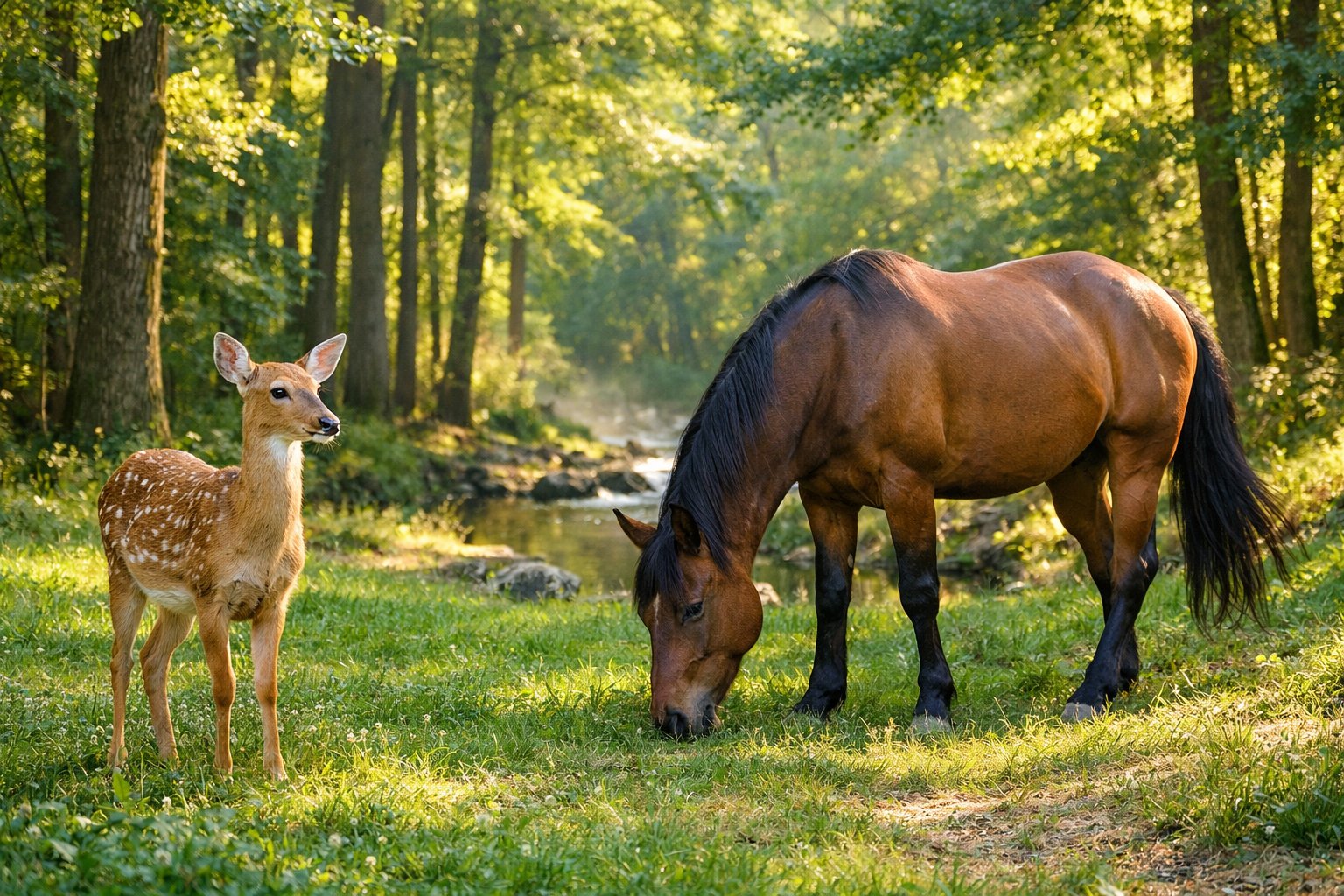
Stick around, and you’ll see how their toes, stomachs, and family trees took different routes long ago. Deer are actually closer relatives to cows than to horses, believe it or not.
Let’s dig into their evolutionary ties and the clear differences that pop up when you really compare them.
Are Deer Related to Horses? Evolutionary Relationship Explained

Deer and horses share a distant ancestor, but most of their differences come from traveling separate evolutionary paths for millions of years.
Let’s see how scientists classify them, where they split on the mammal family tree, and which traits just look similar on the surface.
Taxonomy: Orders, Families, and Species
First, you’ve got to look at the broad taxonomic ranks. Both deer and horses sit in the class Mammalia and the kingdom Animalia.
But from there, they split at the order level.
Deer fit into the family Cervidae within the order Artiodactyla—the even-toed ungulates. That group also has cattle, sheep, and a bunch of other hoofed mammals.
Horses belong to the family Equidae in the order Perissodactyla—the odd-toed ungulates. That order covers horses, zebras, donkeys, rhinos, and tapirs.
Here’s the basic breakdown:
- Kingdom: Animalia
- Class: Mammalia
- Deer: Order = Artiodactyla → Family = Cervidae
- Horses: Order = Perissodactyla → Family = Equidae
This split means you really shouldn’t treat deer and horses as close relatives. They’re in different major mammal branches.
Origins and Divergence in the Evolutionary Tree
Deer and horses both trace their roots back to early placental mammals, but they split tens of millions of years ago.
Their common ancestors lived after the Paleocene, moving into the Eocene epoch when a lot of hoofed mammals started to branch out.
By the Miocene, true deer (early cervids) had already shown up and specialized as browsers. Meanwhile, early horse ancestors evolved toward grazing and adapted to open plains.
Genetic research and fossils suggest their evolutionary paths diverged about 30–55 million years ago, depending on which lineages you check.
Chromosome counts add another twist. Many deer species have high diploid numbers (like white-tailed deer with 70 chromosomes), while horses usually have 64. These genetic differences show how long they’ve been evolving separately.
Ungulates: Similarities and Superficial Traits
At first glance, deer and horses have some things in common—long legs, hooves, plant-based diets. Lots of ungulates share those features because they help with running from predators and eating plants.
But when you look closer, the contrasts stand out:
- Toe structure: deer have two main toes (even-toed), horses have just one (odd-toed).
- Digestion: deer are ruminants with multi-chambered stomachs, while horses have a single stomach and ferment food in their hindgut.
- Headgear: deer grow antlers (and shed them each year), but horses never have antlers.
So, while they both evolved for speed and grazing, their differences run deep. Anatomy, genetics, and fossil records all show they’re not close kin.
Key Differences Between Deer and Horses
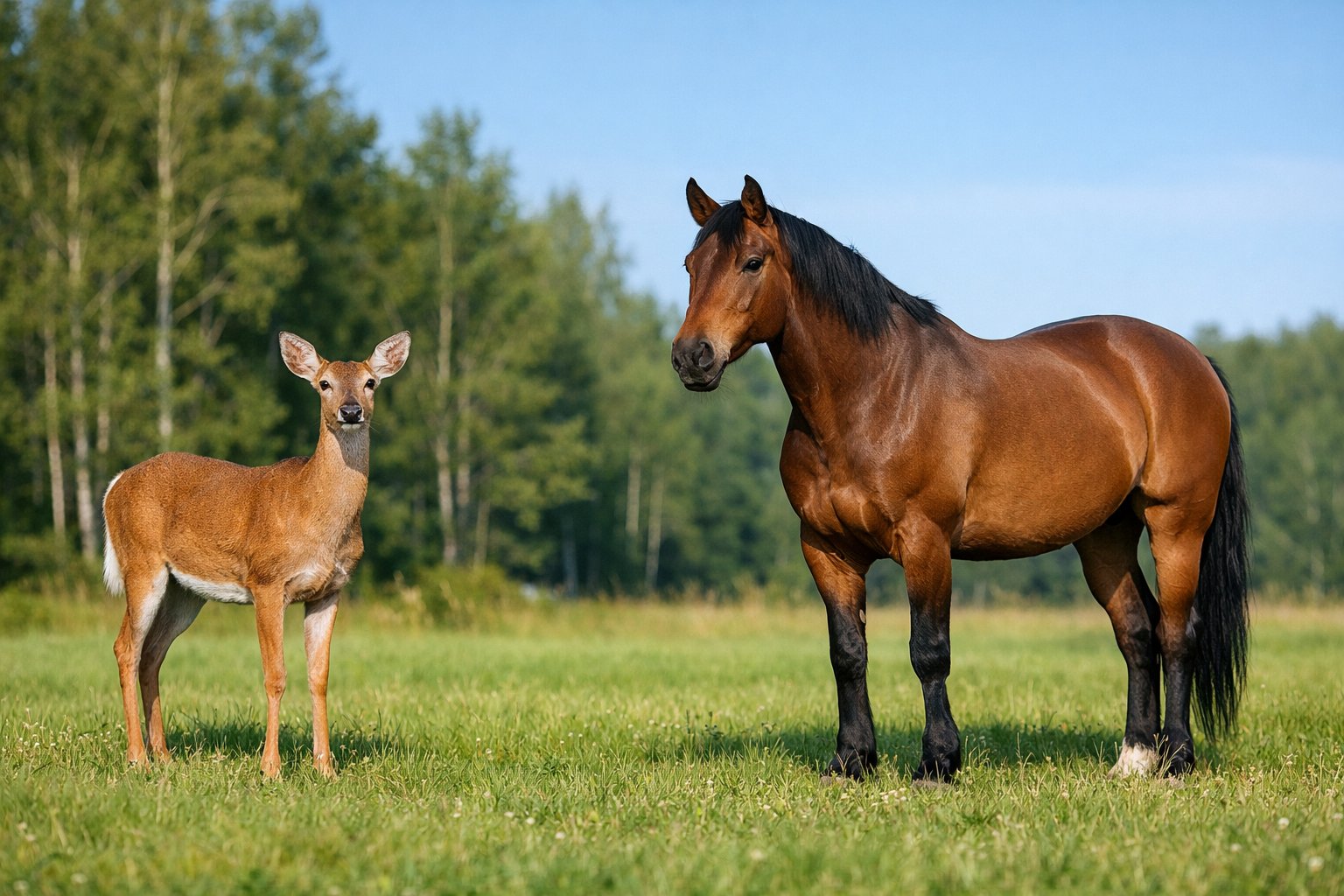
Deer and horses might both be large plant-eaters, but they go about life in very different ways.
Their feeding habits, feet, and body features all set them apart.
Digestive Systems: Ruminant vs Hindgut Fermenter
The way they digest plants couldn’t be more different. Deer are ruminants, so they have a four-chamber stomach that lets them ferment food in the rumen.
Microbes break down tough cellulose, and then the deer re-chews its cud. This system is super efficient for getting nutrients from coarse, low-quality plants.
That’s why deer like white-tailed deer, elk, moose, and red deer can survive on twigs and whatever else they find.
Horses, on the other hand, are hindgut fermenters. They’ve got a single-chamber stomach, and they rely on a big cecum and colon to ferment fiber after it passes through the small intestine.
This setup is great for grazing on bigger amounts of higher-quality food. Horses have to eat more often and in larger amounts to get enough energy.
These digestive differences shape where each animal can live and how they compete with other grazers.
Hoof Structure and Limb Adaptations
You can spot the difference just by looking at their feet and legs. Deer, as even-toed ungulates, have cloven hooves—two main toes on each foot.
Cloven hooves give them a wider base, making it easier to grip soft or uneven ground. That helps deer move quietly and change direction quickly in forests and brush.
Their legs are built for agility and quick bursts of speed.
Horses, meanwhile, are odd-toed ungulates. Modern horses have one strong hoof per foot.
That single, solid hoof evolved from several ancestral toes, and it’s perfect for long-distance running on open ground.
Horse legs are longer and stiffer, built for endurance and steady speed. Their skeletons feature long cannon bones and a springy fetlock, which makes every stride more efficient.
Antlers, Horns, and Other Unique Features
Take a look at deer and horses—you’ll spot some pretty dramatic differences in their heads right away.
Most male deer, like bucks or stags, grow antlers each year. They’re made of bone, they branch out, and deer shed them annually. Oddly enough, in species like reindeer (or caribou), females can grow antlers too.
Deer mainly use their antlers for showing off during mating season and, well, fighting.
Horses, on the other hand, never grow antlers or horns. Their skulls are built to support strong teeth for grazing, plus those powerful neck and shoulder muscles that help them carry weight or pull things.
Some other hoofed animals have permanent horns, but deer stand out because their antlers grow and fall off every year.
All these features shape how these animals behave, how they mate, and honestly, they make it a lot easier to tell different deer species apart when you’re out in the field.


