
You’ve probably heard someone say chimpanzees are still evolving into humans. It’s a common idea since chimps are our closest living relatives, but that’s not how it works—chimpanzees aren’t evolving into humans.
Humans and chimps both came from a common ancestor millions of years ago. Since then, each has gone its own way down the evolutionary road.
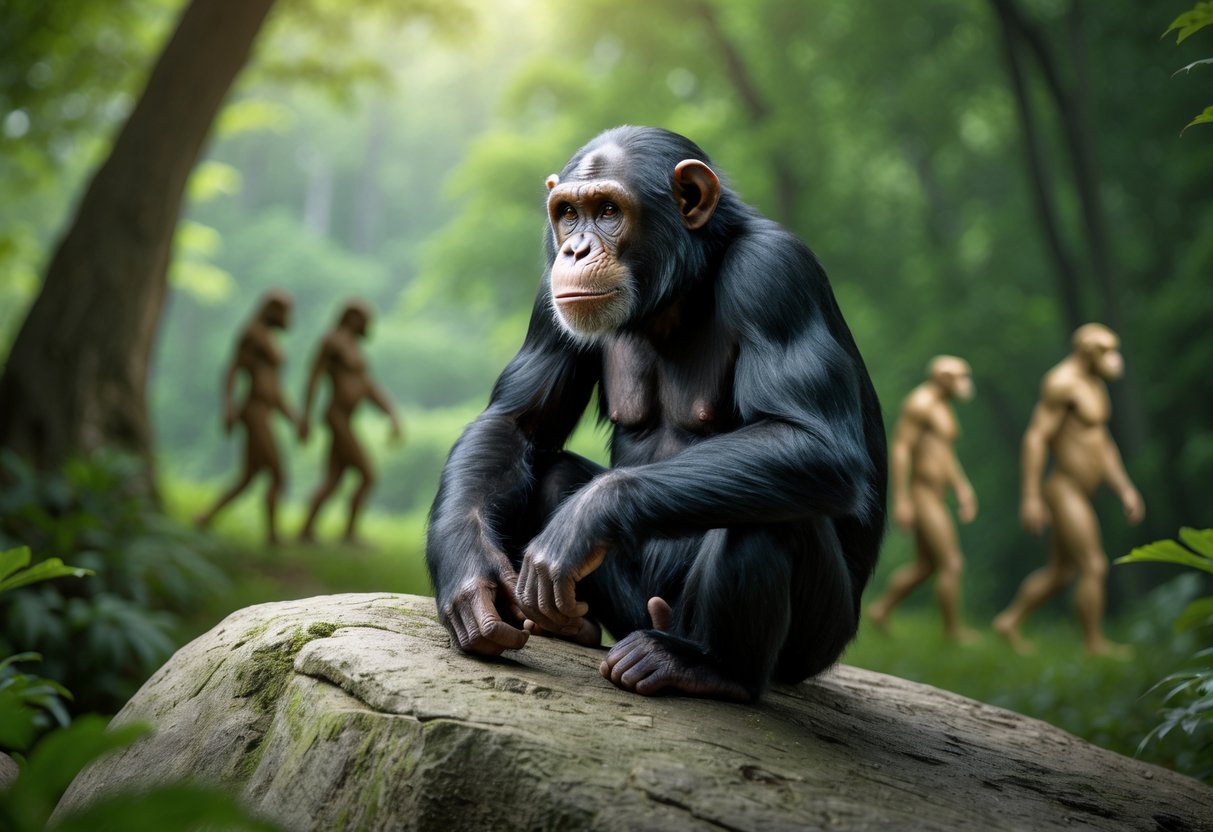
Evolution isn’t about one species turning into another that already exists. It’s a gradual process, with populations changing over generations. Chimps are definitely evolving, but not into people.
Knowing this clears up a lot of confusion about how evolution actually works.
Curious why chimps aren’t turning into humans? Or what evolution really means? Stick around. There are some surprising details about our shared ancestry and how both species adapted in their own ways.
Are Chimpanzees Still Evolving Into Humans?

Chimpanzees aren’t on a path to become humans. Both species share a long-ago ancestor, but each followed a unique path since then.
Evolution doesn’t just turn one species into another over time. It’s more complicated—and honestly, more interesting—than that.
Misconceptions About Chimpanzee Evolution
Maybe you’ve heard people say chimps are “almost human” and will eventually become like us. That’s just not true.
Chimps are fully evolved animals, just like we are. They’re not some sort of “unfinished” humans.
They’ve adapted to their environments in ways that help them survive. Their traits fit their habitat and lifestyle.
Thinking they’ll become humans mixes up the idea of a common ancestor with direct descent. That’s not how it works.
Shared Ancestry of Humans and Chimpanzees
We share a common ancestor with chimps that lived around 6 to 8 million years ago. This ancestor wasn’t a chimp or a human, but something in between.
From there, humans and chimpanzees split off and took different evolutionary routes. Both changed in response to their environments and challenges.
This shared history explains why chimps are our closest living relatives, but not our ancestors.
How Evolution Works in Primates
Evolution happens when gene changes get passed down over generations. These changes help species survive in their particular environments.
Both humans and chimps are still evolving, but they’re doing it in their own ways.
Evolution isn’t a straight ladder where one species sits on top of another. It’s a branching tree, with lots of species changing or going extinct.
So, the idea that chimps are evolving into humans? That’s just not how it works.
| Fact | Explanation |
|---|---|
| Humans and chimps share DNA | About 98-99% similarity, from common ancestor |
| Evolution is branching | Different species evolve separately |
| Chimpanzees are evolving | But not toward humans—toward their own traits |
When you get this, it’s easier to see why chimps and humans are more like cousins—not one turning into the other.
If you want to dig deeper, check out Chimpanzees and Human Evolution.
Current Evolutionary Changes in Chimpanzees

Are chimps changing right now? What does that look like? Scientists are digging into their genes, behaviors, and environments to find out how chimps adapt.
Their evolution keeps happening, but it’s definitely not aimed at becoming human.
Recent Research on Chimpanzee Genetics
Chimps evolve at the genetic level, just like everything else alive. Even small DNA changes build up over generations.
Those changes help chimps survive in their own habitats.
Researchers have spotted genetic differences between chimp groups, tied to things like disease resistance and diet. For instance, some groups have genes that help them fight off infections in their area.
Knowing that chimps share a lot of genes with us highlights how evolution can take different paths. Genetic studies show chimp evolution is unique and ongoing, but not heading toward humanity.
If you’re curious, studies at Gombe National Park dig into this even more.
Adaptations in Wild Chimpanzee Populations
Wild chimps adapt to changing environments through behavior and physical traits. Some groups come up with new ways to use tools or switch up their diets depending on what’s around.
You might see them using sticks to fish for termites or getting better at hunting. These behaviors show cultural evolution, but they don’t make chimps more human.
Environmental pressures—stuff like changing climate or competition from other animals—push chimps to adapt. These changes help them get by, but they’re not the same as the ones that led humans to walk upright or talk.
Why Chimpanzees Are Not Becoming Human
Let’s get one thing straight: chimpanzees aren’t on some journey to become people. You and chimps did share a common ancestor, but that was millions of years ago.
After that split, both species just went their own way. Evolution doesn’t work like a ladder, and there’s no finish line where “higher” creatures win.
Chimps have evolved in ways that suit their lives. They didn’t pick up human traits like walking on two legs or chatting in complex languages, but honestly, why would they?
If you think about it, chimps are more like distant cousins than anything else. Humans took some weird turns—like learning to cook food and building complicated societies—that chimps never did.
That’s really the heart of it. Chimps keep being chimps. If you want to dig deeper, there’s some research at knowanimals.com.


