
Most people expect the female to carry the babies, right? But seahorses completely flip that idea on its head. The male seahorse actually gets the eggs from the female and carries them in a special brood pouch. The female never gives birth.
This strange switch lets the male fertilize, protect, and deliver live young. Meanwhile, the female can start making more eggs for the next round.

If you look closer at seahorse reproduction, you’ll see that the pouch really works like a tiny incubator. Why did this evolve? Well, it’s a fascinating question.
The next parts will dig into the seahorse’s mating dance, how eggs get transferred, and what actually happens inside the pouch during gestation.
Why Doesn’t a Female Seahorse Give Birth?
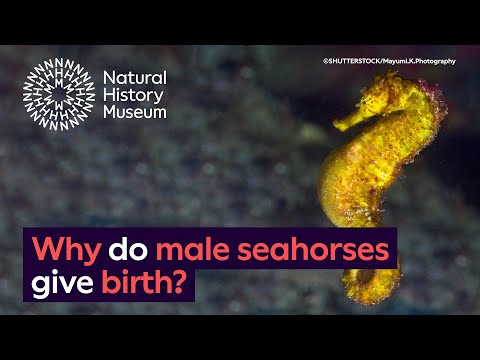
Female seahorses make eggs and deliver them. Males accept those eggs, carry them in a pouch, and later release live young.
Unique Anatomy: The Female’s Ovipositor and Lack of Pouch
Females use an ovipositor, a short tube-like organ, to place eggs into the male’s brood pouch. The ovipositor fits right into the pouch opening and helps deposit eggs directly into the male’s tissue-lined space.
Females just don’t have a brood pouch. They never develop the pouch’s special blood vessels, tissues, or muscles needed for contractions.
Because of this, females can’t fertilize, carry, or give birth to young the way males do.
The Male Brood Pouch: Role in Pregnancy and Birth
When a male seahorse carries eggs, you’re seeing male pregnancy in action. The female transfers eggs through her ovipositor, and the male fertilizes them inside his pouch.
The pouch supplies oxygen, tiny nutrient transfers, and keeps the salt levels just right for embryos. As the embryos grow, the pouch’s muscles contract during birth.
Depending on species and size, males can give birth to dozens, or sometimes thousands, of fry. The pouch makes it possible for males to give birth, not females.
Division of Parental Roles and Benefits to Females
The male’s pouch takes on the hard work of gestation. This frees up the female to make more eggs sooner and breed again.
She can produce more eggs over a single breeding season this way. In places where most young get eaten, making extra eggs really matters.
By splitting the work—the female produces eggs with her ovipositor, and the male carries them in his pouch—both parents boost their chances of reproductive success. If you want more on male pregnancy and the brood pouch, check out this article on how male seahorses give birth.
How Seahorse Reproduction Works

Seahorse reproduction really flips the script: males carry and give birth, while females focus on making and transferring eggs. Let’s look at how courtship, egg transfer, and internal fertilization shape this unusual system.
Seahorse Mating Ritual and Egg Transfer
Seahorse pairs perform daily courtship dances. They change color, hold tails, and rise together in the water.
Sometimes it lasts a few minutes, sometimes days. These dances help time the egg release.
When ready, the female uses her ovipositor—a narrow tube—to deposit eggs straight into the male’s brood pouch. She usually times it with the male opening the pouch.
The number of eggs depends on species. Larger males can get hundreds or even thousands of eggs in one go.
Courtship helps reduce stress and makes sure the male’s pouch has the right conditions for the eggs. If the pair is bonded, they might repeat this transfer several times in a season.
It’s all about coordination: the female’s egg production, the male’s pouch readiness, and their synchronized dance.
Fertilization and Incubation by Males
After eggs enter the pouch, the male fertilizes them. His brood pouch acts like an incubator, supplying oxygen, removing waste, and managing salt for the embryos.
The pouch lining grows blood vessels to deliver nutrients. Early on, embryos also rely on their yolk sacs.
Gestation usually lasts 2–4 weeks, depending on species and water temperature. Warmer water speeds things up.
During incubation, the male sometimes adjusts pouch fluid or even expels some eggs if things aren’t right. At birth, the male’s muscles contract and push out the tiny, fully formed fry.
Broods can be as small as a few dozen or as big as over a thousand, depending on the species. Once released, the baby seahorses are on their own and have to feed on microscopic zooplankton right away.
Evolution of Male Pregnancy Among Syngnathidae
Male pregnancy shows up all across the Syngnathidae family. Scientists think it evolved to help both parents: females can make more eggs if males carry the young, and males get a better shot at paternity by guarding embryos in their pouch.
The brood pouch probably started as a simple skin fold and slowly evolved into a complex organ with blood vessels and salt control. Different species show all sorts of pouch designs, so it seems like this evolved step by step.
There are trade-offs, of course. Males spend a lot of energy carrying young, but females get to breed again sooner. This shift in roles changed the way seahorses mate, with many species forming monogamous pairs to coordinate repeated broods during a season.
Comparisons: Pipefish, Seadragons, and Seahorse Species
You’ll see male pregnancy in seahorses, pipefish, and seadragons, but the pouch structure and behavior really aren’t the same. Pipefish usually have simpler brood areas along the belly.
Some pipefish species just carry eggs glued right onto the male’s skin instead of tucking them inside a sealed pouch. That always seemed a bit risky to me, honestly.
Seadragons don’t have a true pouch at all. Males carry eggs on a brood patch under the tail, and the eggs just stick there on the outside.
Seahorses, on the other hand, have the most enclosed pouches. This lets them control the internal conditions for the eggs much more closely.
Species differences also shape brood size, gestation time, and how they mate. Some seahorses stick with one partner for life and do daily courtship rituals.
Other syngnathids? They mate with multiple partners, depending on the situation. These differences probably relate to their habitats, how much risk they face from predators, and their life strategies.
If you want more on seahorse reproduction, there’s a nice overview at Animal Corner: https://animalcorner.org/seahorse-reproduction/


