
Most people assume only females get pregnant, but with seahorses, it’s the males who carry and give birth. Male seahorses actually take the eggs from females, fertilize them inside a special brood pouch, and carry the young until they’re ready to be born. This switch lets females focus on making more eggs, while the males handle protection and nurturing of the embryos.
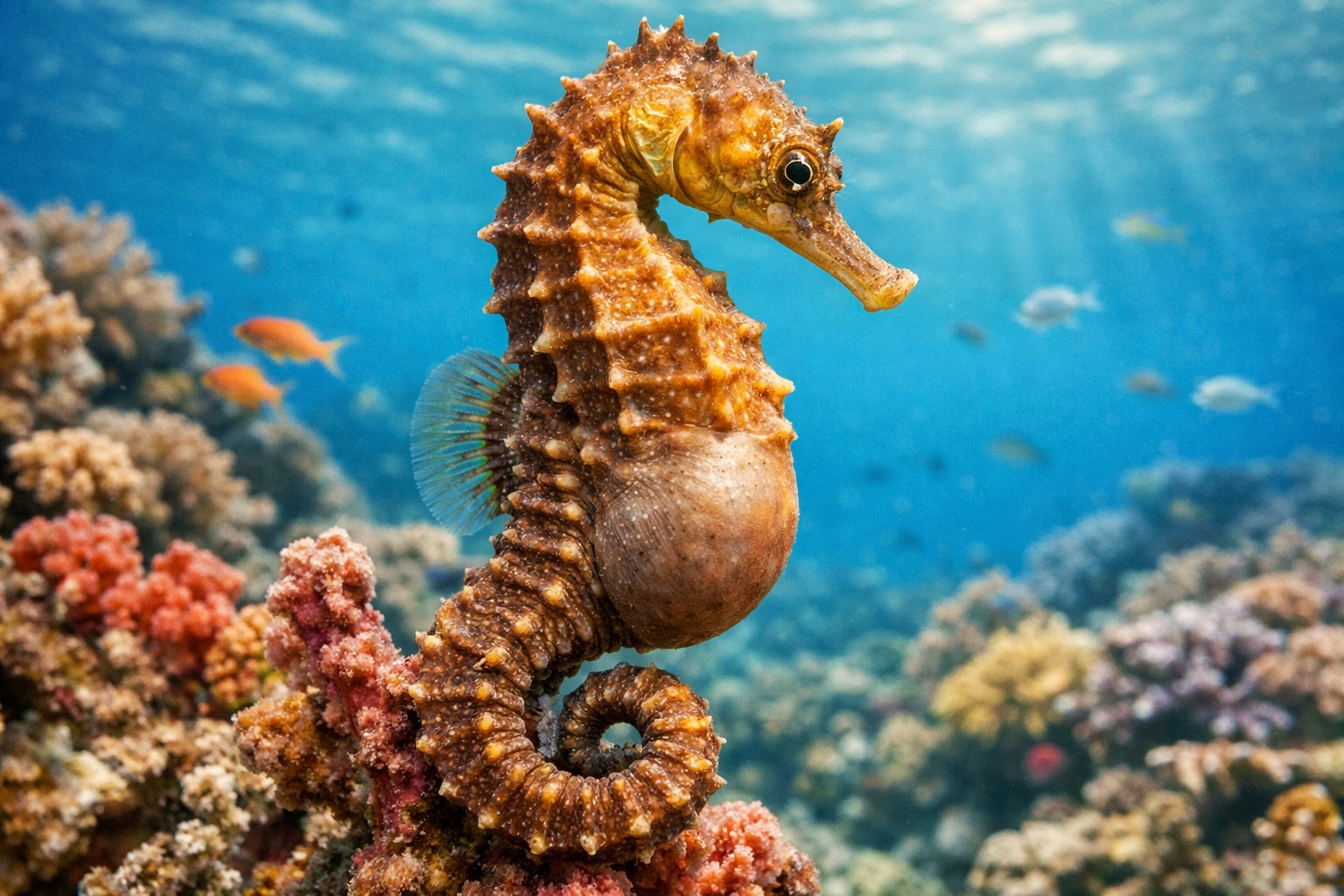
So, why does this role reversal work so well for seahorses? You’ll get a look at how the male’s pouch works almost like a tiny incubator. I’ll break down the biology, the benefits for both parents, and how the males actually carry and deliver their babies.
Curious for more? Here’s a summary of male pregnancy in seahorses: HowStuffWorks.
Why Do Male Seahorses Give Birth Instead of Females?

Male seahorses carry and protect eggs inside their pouch. They trade off who makes the eggs and who broods them, which changes how they court, mate, and time their births.
Unique Role Reversal in Seahorse Reproduction
It’s a rare switch-up: females produce and deposit eggs, but then males take them into a brood pouch. The pouch lining provides oxygen, nutrients, and a safe spot for embryos to grow.
Males fertilize the eggs as they enter the pouch. They also control things like salinity to help embryos develop.
Not all seahorse species have the same kind of pouch. Some hold just a few dozen eggs, while the bigger species can carry hundreds or even thousands.
After gestation, the male uses muscle contractions to give birth to tiny, fully formed seahorses.
Evolutionary Advantages of Male Pregnancy
Male pregnancy speeds up how often a pair can have young. While females spend time making large, energy-rich eggs, males can often brood and then mate again pretty quickly.
This can boost how many babies a pair makes each season. Carrying embryos in a pouch also helps them survive. The pouch protects them from predators and keeps conditions stable, unlike eggs left floating in the water.
If a species faces a lot of egg predators, this higher survival rate really matters for keeping their numbers up.
How Male Pregnancy Impacts Seahorse Mating Dynamics
You’ll see the role reversal even in courtship. Females often compete for access to available males, since males are the ones carrying the young.
Courtship gets pretty elaborate—color changes, synchronized swimming, and long dances help synchronize egg release and pouch readiness.
Monogamy pops up in some seahorse species because pairs coordinate timing and protect broods together. In other species, males may mate with several females between broods.
Either way, male pregnancy shifts how sexual selection and parental roles work compared to most animals.
- Key players: male seahorses, female egg producers, and the baby seahorses.
- Outcomes: faster reproductive turnover and different mate competition.
Want more details? Check out HowStuffWorks for a deep dive on male brood pouches, or see Discover Wildlife for a species-focused look at male pregnancy.
How Male Seahorses Give Birth: The Reproductive Process

Male seahorses carry fertilized eggs inside a special pouch. They control embryo development and then expel fully formed young.
Let’s look at how the pouch works, what happens during gestation and birth, and the female’s part before and after the transfer.
The Brood Pouch and Its Role
The brood pouch sits right on the male’s belly. It’s a muscular, skin-lined chamber packed with blood vessels that bring oxygen and some nutrients to the embryos.
In Hippocampus species, the pouch can match seawater salinity to help embryos adjust before release. When a female deposits eggs, the male fertilizes them inside the pouch.
The pouch seals up, keeping eggs safe from predators and infection. Sometimes, the male removes excess eggs or even cares for eggs from several females at once, which can increase genetic diversity in a single brood.
Pouch size and structure vary across the Syngnathidae family. Some pipefish have simpler pouches or just attach eggs to their bodies.
Seahorse pouches, though, act most like a temporary womb. They give developing fry a steady, protected environment until they’re ready to swim off.
Gestation, Labor, and Delivery in Seahorses
Gestation length depends on the species, water temperature, and health. For many seahorses, it’s anywhere from two to six weeks.
Warmer water usually speeds things up, while colder water slows development. Before birth, embryos have visible tails, eyes, and fins.
The male’s pouch muscles contract to push fry toward the opening. These contractions can be pretty strong and rhythmic, sometimes expelling dozens or even hundreds of tiny seahorses in just a few minutes.
Labor takes a lot of energy out of the male. He might breathe faster and eat less.
After birth, the fry are on their own. They get no further care from either parent.
You’ll see high mortality among newborns, since they have to find food and shelter right away.
Female Seahorses’ Role in Reproduction
Female seahorses make and mature their eggs in their ovaries. When courtship starts, you’ll notice their color shifts and the way they swim together—almost like a choreographed dance.
They use this timing to transfer eggs. The female pushes her eggs straight into the male’s pouch using an egg tube, which people call an ovipositor.
Usually, she’ll get started on a new batch of eggs soon after the transfer. Since the male takes over carrying the brood, the female can get ready with more eggs a lot faster than if she had to carry the embryos herself.
That split in roles really boosts how many offspring both partners can produce. After she’s done, the female might keep courting the same male or even look for a new mate, depending on the species.
She doesn’t help with incubation in the pouch, but her timing and the quality of her eggs play a huge part in whether the baby seahorses survive.


