
Maybe you’ve seen a photo of a “pregnant” seahorse and wondered if it can actually switch sexes. Nope — seahorses are born male or female and stick with it for life. Still, they’re undeniably weird; the male carries the eggs in a pouch, which just raises more questions about how their bodies and behavior even work.

Let’s look at why the male gets pregnant, how courtship and egg transfer actually happen, and what makes seahorse reproduction so different from other fish.
There are some pretty neat examples and simple explanations ahead, so you’ll get a good sense of how their unique biology fits together.
Do Seahorses Change from Male to Female?

Here’s how seahorse reproduction goes down and why most species never switch sex.
Check out these short explanations to see how male pregnancy is not the same as a true sex change.
Seahorse Gender Roles Explained
In seahorses, the female makes the eggs and the male carries them in a brood pouch.
During mating, the female puts her eggs directly into the male’s pouch.
He fertilizes and carries the embryos until he gives birth.
Male pregnancy is rare in the animal kingdom, but you’ll find it in all seahorses (Hippocampus) and some pipefish.
This isn’t about changing sex — it’s a special role swap.
Males keep their testes and sperm, females keep their ovaries and eggs.
Once they’re mature, their roles are set.
Key facts:
- Females lay eggs into the male’s pouch.
- Males incubate and give birth.
- This is role reversal, not a transformation of sex organs.
Myth vs. Reality: Gender Change in Seahorses
People sometimes mix up role reversal with something called sequential hermaphroditism.
That’s when an animal actually switches gonads and reproductive function from one sex to the other.
Some fish can do it, but there’s just no solid evidence that adult seahorses ever switch sex.
Most scientific studies and reliable reports agree: seahorses keep the sex they were born with.
You’ll see rare, anecdotal claims about sex change in seahorses, but those usually get misinterpreted or aren’t backed up by solid research.
If you’re studying seahorses or keeping them in an aquarium, it’s best to assume males carry the babies and sexes don’t change.
That’ll help you avoid any weird surprises or wrong expectations about their gender.
Unique Reproductive Biology of Seahorses
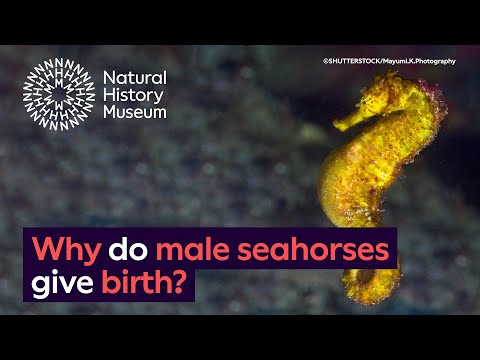
Seahorse reproduction completely flips what you’d expect: the males carry the embryos, and the females focus on making big, nutrient-rich eggs.
Their courtship is pretty elaborate, too.
You’ll see how the brood pouch works, what females bring to the table, how pairs coordinate, and maybe even why male pregnancy evolved in the first place.
Male Pregnancy and the Brood Pouch
Male seahorses have a brood pouch on their bellies where the embryos develop after the female gives him her eggs.
Inside, the male manages salt balance, supplies oxygen with a dense blood network, and might even provide nutrients.
This pouch keeps the young safe until they’re ready to be released.
Pouch structure isn’t the same for every species.
Some pouches are just simple pockets; others are fully enclosed and almost like a placenta.
During gestation, the male’s hormones and blood flow change to support the growing embryos.
When it’s time, the male contracts his pouch and gives birth to a whole bunch of tiny, fully formed fry.
Female’s Role in Seahorse Reproduction
Female seahorses make the eggs and time their release to match when the male is ready.
Her eggs are big and packed with nutrients, giving the embryos a better shot at surviving in the pouch.
Females put a lot of energy into egg quality instead of carrying embryos themselves.
She can influence how many babies there are by how many eggs she produces and their size.
Some species let females make dozens or even hundreds of eggs per mating, depending on her size and the species.
After she transfers the eggs, her job is basically done—he takes over, but her investment in strong eggs is crucial for the babies’ survival.
Courtship Rituals and Parental Care
Seahorse courtship is surprisingly involved.
They do daily dances, change colors, and swim in sync to strengthen their bond and get ready for spawning.
Partners line up, lock tails, and the female uses her ovipositor to put eggs into the male’s pouch.
Sometimes these rituals last just a few minutes, other times they drag on for days.
While the male handles almost all the parental care during gestation, after birth, the fry are on their own.
Some species stick with the same partner for more than one season, repeating this whole courtship and breeding process.
Others only pair up for a season or switch partners between broods.
Reasons Behind Male Pregnancy
Researchers have tossed around a few reasons why male pregnancy evolved, and honestly, it’s pretty fascinating when you compare it to what seahorses actually do. When males brood the eggs, females get a break and can bounce back to produce more eggs during the season.
That means the pair ends up with more offspring overall. Plus, the embryos stay tucked away in a safe, controlled spot, so predators have a tougher time getting to them early on.
Male pregnancy might also play a role in mate choice and territory defense. Males who successfully brood can attract more females and snag better breeding spots.
Evolutionary studies, along with some recent work on how the pouch develops at the cellular level, reveal that this trait required some unique structural and molecular changes. These changes aren’t the same across all seahorse species or habitats, which honestly makes it even more interesting.
If you’re curious about the nitty-gritty of pouch biology and how it all came to be, check out this research on the cellular and molecular mechanisms of seahorse male pregnancy.


