
Ever looked up at a squirrel and wondered how it can leap (or even drop) from a crazy height and just scamper away like nothing happened? Squirrels pull off these wild falls because they’re light, splay themselves out to slow down, and land in ways that keep their bones safe. That’s really the gist of it, but there’s a lot more going on with physics and some clever body tricks.

Let’s break it down. Size, air resistance, and smart body positioning all work together like a built-in safety net for squirrels.
They also have unique features—loose skin, bendy joints, and that iconic fluffy tail—that help them slow down and take the hit.
Once you know this, you might never see a falling squirrel as “lucky” again. They’re just built for it.
Physics Behind Squirrels Surviving Falls

Let’s talk about why squirrels can hit the ground slowly, even from way up high. Their small size, the way they flatten themselves out, and the drag from the air all play a part.
We’ll get into how top speed, opposing forces, and the differences between squirrels and bigger animals make all the difference.
Terminal Velocity and Surface Area
Terminal velocity is the fastest speed a falling object can reach, when air resistance pushes up as hard as gravity pulls down.
Squirrels, being so light and able to spread out, get a lot of air resistance. That slows them down so much that hitting the ground usually isn’t a big deal.
Picture a squirrel flinging its limbs and tail out wide. That makes more air push up against them, so they slow down even more than if they stayed all tucked in.
Flying squirrels take it up a notch with skin flaps, gliding and cutting speed even further.
Here’s the thing: a tiny animal weighing a few hundred grams falls much slower than a human. That’s really why squirrels can survive drops that would be deadly for us.
Force of Gravity vs. Air Resistance
Gravity pulls a squirrel down with a force based on its mass and gravity’s pull (9.81 m/s², if you’re into numbers). Since squirrels don’t weigh much, gravity doesn’t pull them down as hard as it does bigger animals.
Air resistance gets stronger as the squirrel speeds up and spreads out, so it quickly balances out gravity.
As a squirrel falls, acceleration drops because drag rises. When drag and gravity match, the squirrel stops speeding up and just coasts down at a steady speed.
That means less force to absorb when it lands.
The tail and loose fur really help here. They act like a tiny parachute, spreading out the impact and lowering the stress on bones and organs.
Comparison With Larger Animals
Big animals like humans have a lot more mass, but their surface area doesn’t increase as much. That means they fall faster and hit the ground harder.
A human’s falling speed and the energy at impact are usually lethal from high up. Squirrels, though, don’t have that problem.
It’s all about scaling: mass grows with volume, but air resistance depends on area. So as animals get bigger, mass outpaces area, and the result is much higher final speeds and impact forces.
Squirrels get creative, too. They spread their limbs and tail mid-fall, boosting drag and making a real difference in how they land.
Unique Adaptations That Keep Squirrels Safe
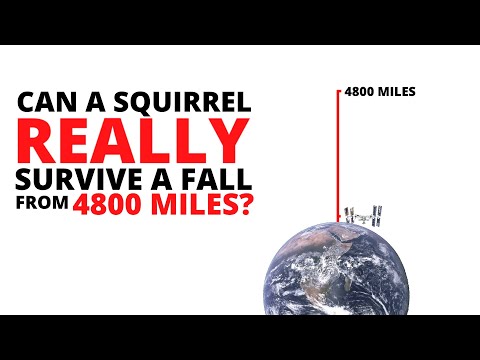
Squirrels rely on their shape, tail, muscle power, and quick reflexes to survive crazy falls. All these things work together so a fall almost never ends badly for them.
Lightweight Bodies and Flexible Skeletons
Squirrels are small and light—most gray squirrels weigh less than a kilogram.
Gravity just doesn’t have as much to work with, so the impact is way less than for bigger creatures.
Their bones are thin but a bit bendy, which helps absorb shock when they land.
Loose skin and a thick fur coat spread out the force, so there’s less chance of something breaking.
Their limb joints are strong and super flexible. When they land, the joints bend and act like springs.
Muscles contract quickly to soften the blow. Imagine a squirrel landing hard, but its joints and muscles flex to take the hit.
Role of the Bushy Tail During Descent
You can’t miss that bushy tail when a squirrel falls. It does a lot more than just look cute.
The tail boosts surface area and adds drag, slowing the fall like a tiny parachute.
It also acts as a stabilizer and a rudder. Squirrels twist and angle their tails to steer and make sure they land feet-first.
That control helps them avoid tumbling and land upright most of the time.
Flying squirrels use the tail with their skin flaps to glide, steer, and brake, making mid-air corrections much easier.
Falling Behaviors and Landing Techniques
Watch a squirrel mid-air and you’ll see it spread its legs and flatten its body. That ups the drag and lowers terminal velocity.
They also twist their spine and shift their weight to make sure they land on their feet.
Their righting reflex is lightning fast. Sensors in the ears and eyes tell muscles how to move in a split second.
Squirrels tuck their limbs, swing their tails, and get their legs ready to absorb the landing.
When they hit the ground, they bend their knees and sometimes roll or twist to spread out the energy.
They almost always land on all four paws, which spreads the force and keeps any one bone from taking too much stress.
You rarely see a squirrel hit the ground stiffly—they’ve got landing down to an art.
Differences Among Squirrel Species
Not every squirrel falls or glides the same way. Tree squirrels, like eastern greys, use their tails kind of like parachutes and control their limbs for short drops.
They’re built for quick climbing and those wild, agile leaps you sometimes see in the park.
Ground squirrels weigh more and usually stick close to the ground. They don’t mess with high falls.
Their bones feel sturdier but don’t bend as much, and they prefer to dash into burrows or sprint away from threats rather than risk a tumble.
Flying squirrels? They’ve got the wildest moves of all.
You’ll notice the patagium—a stretchy skin membrane—between their limbs. This lets them glide for surprisingly long distances and steer almost like a tiny wing.
Their bushy tails help fine-tune their direction and make landings way more precise.


