
Ever wondered why chimpanzees seem freakishly strong compared to us? It mostly comes down to how their muscles work. Chimps pack about 1.5 times more fast-twitch muscle fibers than we do, so they can explode with power in an instant. This muscle mix gives them a serious advantage when they’re climbing, pulling, or just moving suddenly.
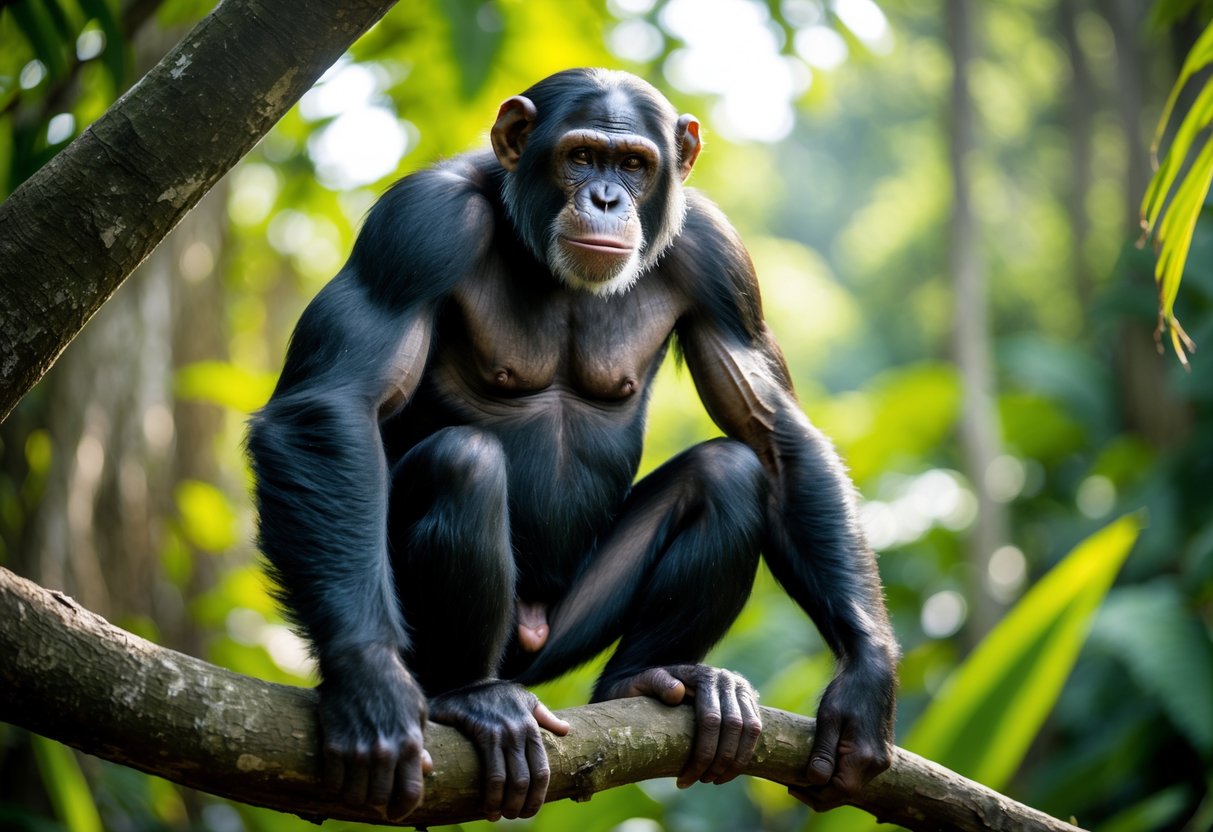
Their strength isn’t about having bigger muscles, but more about the length and blend of their muscle fibers. Humans, on the other hand, have more slow-twitch fibers, which help us with endurance stuff like running or hiking for miles.
You can really see how evolution tailored the chimpanzee’s body for wild living. I mean, would you want to challenge a chimp to a tug-of-war? Probably not. If you want to geek out more, check out how their muscle structure shapes their wild strength and what it tells us about both species. There’s more on chimp muscle differences over at ScienceAlert.
What Makes Chimps So Strong Compared to Humans?

Chimps out-muscle humans thanks to some pretty unique muscle features. Their muscles have a different structure, a special mix of fiber types, and a way of firing that really amps up their power.
Let’s break it down a bit more.
Chimp vs. Human Muscle Structure
Chimpanzee muscle stands out because the fibers are longer. Longer fibers mean they can pull harder and move with more force.
Chimps also have a more even mix of muscle fiber types. Humans lean toward slow-twitch fibers, which are awesome for endurance—but not so much for quick, powerful moves.
So, chimp muscles are built for sudden action—think climbing or jumping. Humans? We’re more about going the distance, like walking or running for hours.
Role of Fast-Twitch Muscle Fibers
Fast-twitch fibers are a big deal for chimps. They’ve got about twice as many as we do.
These fibers contract super quickly and make a ton of force. That’s why chimps can pull off such impressive bursts of strength.
Fast-twitch fibers burn through stored energy fast, so chimps can do intense moves without getting tired right away. That’s why they’re so good at climbing and pulling.
You have these fibers too, just not as many. That’s part of why chimps can be up to 1.5 times stronger than a human in certain tests. More fast-twitch means more raw power, plain and simple.
Muscle Power and Power Output
Muscle power is all about how quickly and forcefully muscles contract. Chimp muscles crank out about 1.3 to 1.5 times more power than human muscles of the same size.
They pull this off thanks to their longer fibers and higher fast-twitch count. Put those together and you get some seriously strong, fast moves.
Simulations show that chimps just blow us away in things like pulling and jumping. Even though our basic muscle fiber properties are pretty similar, the chimp’s muscle makeup gives them a big edge.
If you want to go deeper, check out this study on chimp muscle power and fiber differences.
Physical and Evolutionary Factors Behind Chimpanzee Strength

Chimps owe their strength partly to their body design and the way they evolved. Their muscles, bones, and daily habits all play a part.
Some folks exaggerate their power, but science actually gives us the real scoop.
Skeletal and Tendon Adaptations
Chimpanzee bones and tendons are set up to boost pulling power. Their muscles attach to bones in a way that gives them better leverage.
So, they can generate more force with less effort. Pretty efficient, right?
They’ve also got longer muscle fibers than we do. That means their muscles can work harder and more efficiently.
On top of that, their tendons are stiffer, which helps transfer muscle power quickly. This combo makes their muscles perfect for strength tasks like climbing or pulling.
You can see how their bodies are just made for powerful moves. There’s more detail in this explanation of chimpanzee muscle structure.
Impact of Arboreal Lifestyle
Chimps spend a ton of time in trees. Climbing and swinging around up there takes strong, fast muscles.
To keep up, chimps have more fast-twitch muscle fibers. These fibers give them quick, powerful bursts, though they don’t last super long.
This muscle setup helps them move fast and support their weight above ground. Their tree-dwelling lifestyle meant their ancestors kept these traits.
Humans, meanwhile, evolved for long walks and running. We rely more on slow-twitch fibers, which use less energy and are built for the long haul.
Addressing Myths and Misconceptions
People love to say chimpanzees are “super strong”—sometimes claiming they’re four or even six times stronger than us. But if you look at the research, chimps actually have about 1.5 times the muscle force of a human.
A lot of this myth probably comes from watching chimps pull or climb. They use better technique and their muscle fibers work differently. It’s not really about some wild, superhuman burst of strength.
Some folks think humans just hold back their muscle power on purpose, but honestly, the studies don’t really back that up.
There’s nothing magical about chimp strength. It comes down to their muscle type, the way their bones work, and how they live.
If you’re curious and want a solid overview, check out this summary of chimpanzee strength myths.


