
You’ve probably heard the phrase “four and twenty blackbirds baked in a pie.” It sounds strange—maybe even a bit cruel, right? But here’s the twist: the blackbirds in the rhyme aren’t actual birds baked in a pie. People used to hide live birds inside an empty pie crust, just for the surprise when someone opened it.
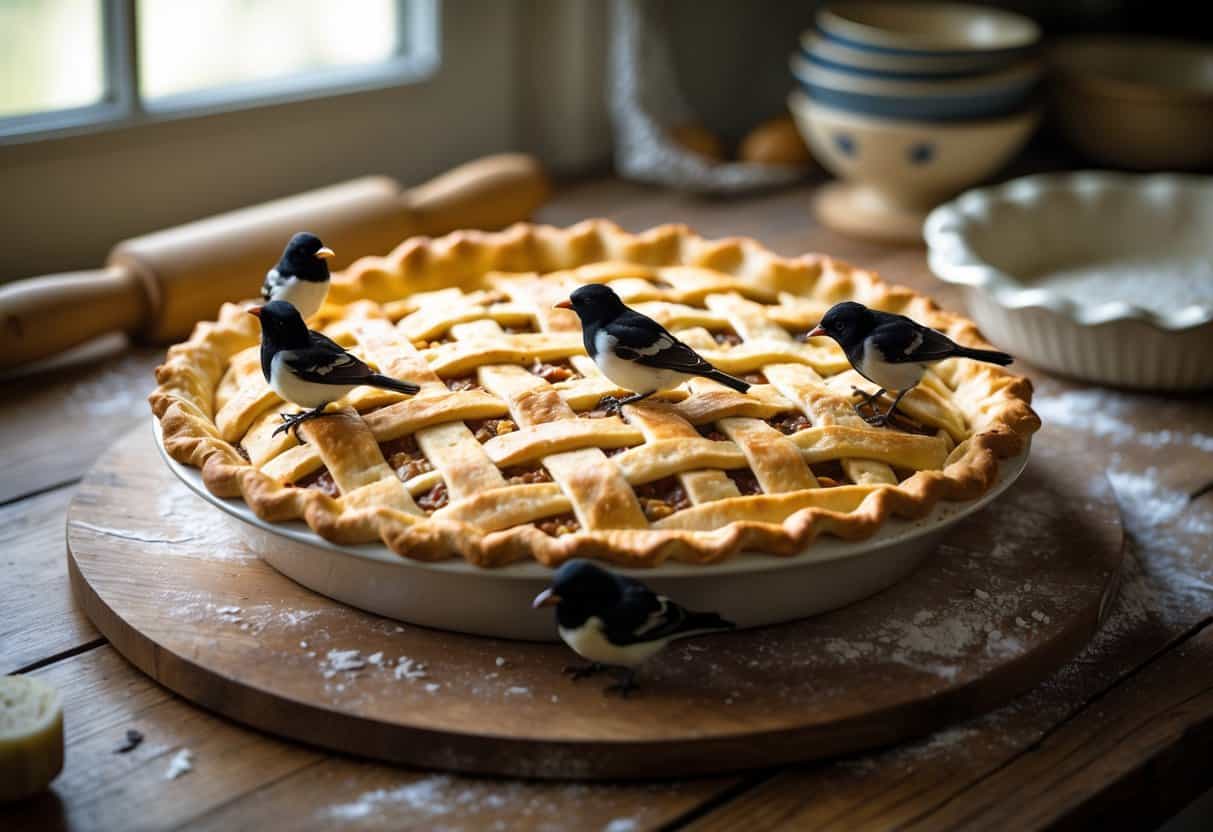
It sounds weird now, but back then, it was a clever way to entertain guests, especially royalty. The rhyme gives us this image of a royal feast where the birds sing when the pie opens—a playful moment in an otherwise serious setting.
Some folks think the poem hints at history or maybe even secret codes from pirate days. There’s more to it than just a quirky party trick.
If you’ve ever wondered what those blackbirds really mean, you’re in the right place. Let’s dig into why this nursery rhyme has fascinated people for centuries and how it ties into history and old-time surprises.
The Meaning and Symbolism of Four and Twenty Blackbirds
The phrase “four and twenty blackbirds baked in a pie” has both literal and symbolic sides. The blackbirds aren’t just birds—they carry meaning, and their number adds another layer.
Literal Versus Symbolic Interpretations
On the surface, “four and twenty blackbirds baked in a pie” just means a big pie stuffed with 24 blackbirds. People actually did this in medieval times.
Cooks would put live birds in pies, and when someone cut the pie open, the birds would fly out. It was a popular party trick at fancy feasts.
But there’s more going on. The rhyme isn’t only about food. Some people say the birds stand for things like hours in a day or even letters in printing. So, the rhyme mixes a real old practice with a dash of imagination.
Number Significance and Symbolic Meaning
The number “four and twenty” is just 24, but it shows up all over the place. Some say it’s about the 24 hours in a day, tying the blackbirds to time or cycles.
Others think it just sounds catchy and rhythmic. Maybe it points to choir monks or letters from early printing days.
Honestly, no one’s totally sure. Still, using 24 gives the rhyme a feeling of order and completeness.
Cultural Associations With Blackbirds
Blackbirds have a bunch of meanings in folklore. Often, they symbolize mystery or change.
In English stories and poems, blackbirds pop up a lot. Here, they might mean more than just birds.
Some folks say the birds stand for people or events—like figures at royal courts or happenings in the English Reformation. The whole “baked in a pie” thing also ties into festive celebrations where surprises wowed the guests.
If you want to dive deeper, check out A Short Analysis of the ‘Sing a Song of Sixpence’ Nursery Rhyme.
Historical Origins and Theories Behind the Nursery Rhyme
The story of “four and twenty blackbirds baked in a pie” comes from a mix of real medieval traditions, royal history, and the way the rhyme changed over time. What seems like a simple children’s song actually has roots in banquet tricks and maybe even famous figures like Henry VIII.
Medieval Pie Traditions
Back in medieval times, pies weren’t just food—they were entertainment. At big banquets, cooks made giant pie crusts called “coffins” and baked them empty.
Just before serving, they placed live birds like blackbirds inside. When someone cut open the pie, the birds would burst out and surprise everyone.
People called this an “entremet,” a kind of dinner show to impress nobles. The blackbird pie wasn’t meant to be eaten; it was all about the spectacle.
So when the rhyme mentions birds baked in a pie, it’s actually talking about this wild, theatrical tradition.
Tudor and Henry VIII Connections
Some people believe the rhyme refers to events during Henry VIII’s reign in the 1500s.
In this theory, the king is Henry VIII, the blackbirds are monks whose monasteries he closed, and the pie represents the land he took.
The queen might be Catherine of Aragon, and the maid could be Anne Boleyn, whose story ended in tragedy.
There’s no solid proof for this idea, since the rhyme was first printed later, in the 18th century. Still, it’s an interesting theory that adds a bit of intrigue to the song.
Evolution of Sing a Song of Sixpence
“Sing a Song of Sixpence” changed a lot over the years. The phrase “four and twenty” just means twenty-four, which was a common way to count in old English.
The rhyme probably started as a plain children’s song. Later, it picked up stories about kings, queens, and pies full of live birds.
Different versions added lines about money, bread, honey, and the maid getting pecked on the nose.
The meaning shifted over time—from a banquet trick to a playful tale. That’s part of why the rhyme stuck around and stayed fun for kids.
Blackbird Pie in Popular Culture
Blackbird pie pops up as a quirky image in stories and culture.
You’ll spot it in books, songs, and plays—sometimes it’s just a passing reference, but it sticks with you.
I think it stands for surprise and delight, though there’s a sense of old customs and history mixed in.
These days, people study the nursery rhyme and wonder about its odd beginnings.
There’s a lot of curiosity about where fact ends and fiction begins.
If you’re interested, you’ll find plenty of articles digging into its background, like this one about “Sing a Song of Sixpence”.


