
You might think “squirrel-like monkey” sounds like a silly nickname, but it actually refers to a real group of tiny, quick New World primates called squirrel monkeys. To put it simply: squirrel monkeys are small primates from the genus Saimiri, living in Central and South American forests. They dart through the treetops and stick together in big social groups.

As you read on, you’ll see what makes these monkeys stand out, how to tell the different species apart, and why their forest homes are in trouble. I’ll keep things straightforward—just the basics on their size, habits, what they eat, and what’s threatening their survival. You’ll spot the differences and maybe get why these little guys matter.
What Is a Squirrel Monkey?

Squirrel monkeys are small, speedy, tree-loving primates with bright faces and really long tails. Their name actually hints at their looks and habits, and they’re a bit different from other New World monkeys.
Defining Squirrel Monkeys and the Origin of Their Name
Squirrel monkeys sit in the genus Saimiri, part of the subfamily Saimiriinae. You’ll find them scattered across Central and South America, especially in the Amazon basin and some forests in Costa Rica and Panama.
They stick to the treetops and move in big groups that often break into smaller bunches to search for food.
The name Saimiri comes from Tupi, a local language: “sai” means monkey and “mirím” means small. It fits—they’re not big at all. Young adults measure about 25–35 cm (10–14 in), not counting their tails.
We call them “New World monkeys” because they evolved in the Americas, not Africa or Asia. Knowing their scientific group puts them close to other small tree-dwellers.
Squirrel Monkey Appearance and Unique Features
Squirrel monkeys have short, thick fur that’s a mix of black, yellow, and orange. Their white facial mask makes their expressions pop.
Their tails are long—usually 35–42 cm (14–17 in)—and mostly help with balance, not grabbing stuff. Males are bigger than females; adult males weigh around 750–1,100 grams, females about 500–750 grams.
You’ll see a bold white patch above their eyes, and the shape of that patch helps tell species apart. They have flat nails and tiny, nimble hands, perfect for grabbing bugs and fruit.
Squirrel monkeys only sweat from their palms and soles. To cool off, they look for shade or even pee on their hands and feet—yep, it’s weird but it works.
Their brains are surprisingly big for their size, which helps them move fast and handle social life in the trees.
Difference Between Squirrel Monkeys and Other New World Monkeys
Squirrel monkeys stand out from other New World monkeys in a few obvious ways. Unlike some, their tails can’t grip branches—they’re just for balance.
They hang out in really big groups—sometimes hundreds—while lots of other species stick to smaller families.
Their faces are easy to spot: a white mask and a compact body, not the long faces of capuchins or the tufts of marmosets. They move fast, leap a lot, and love hunting insects.
Taxonomically, Saimiri is its own genus, separate from capuchins (Cebus) or marmosets (Callithrix). If you want more on their range and genus, check out the Squirrel monkey overview.
Squirrel Monkey Species, Habitats, and Conservation
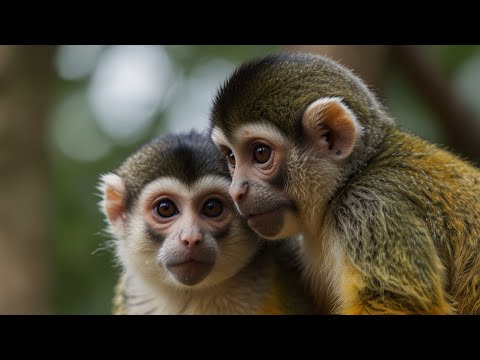
Squirrel monkeys come in several species, each with its own look and home. You’ll see where they live, how their troops work, and what puts them at risk.
Overview of Squirrel Monkey Species and Subspecies
Squirrel monkeys belong to the genus Saimiri. People now usually split them into five main species: Saimiri sciureus (common squirrel monkey), Saimiri boliviensis (Bolivian or black-capped squirrel monkey), Saimiri oerstedii (Central American squirrel monkey), Saimiri ustus (bare-eared squirrel monkey), and Saimiri vanzolinii (black squirrel monkey).
Each species might have subspecies, like S. b. boliviensis and S. b. peruviensis under S. boliviensis.
You’ll notice differences in head color, how thick the tail is, and sometimes the color of their arms. S. oerstedii lives in Costa Rica and Panama and has orange backs. S. boliviensis shows up in Bolivia, Brazil, Peru, and has a darker crown. S. vanzolinii only lives in a tiny spot in Brazil.
Some names, like Saimiri annectens or Saimiri fieldsi, pop up in older books or certain regions. Baby squirrel monkeys are tiny and cling to their moms; their fur colors can help you figure out the subspecies when they’re young.
Where Squirrel Monkeys Live: Habitats and Range
You’ll spot squirrel monkeys from Central America down into the Amazon Basin. S. oerstedii sticks to Costa Rica and western Panama.
S. sciureus lives across Brazil, Colombia, Venezuela, Guyana, Suriname, and French Guiana. S. boliviensis is found in Brazil, Bolivia, Peru, and Venezuela. S. vanzolinii only shows up near Lago Mamirauá in Brazil.
They like lowland tropical forests and spend time in the canopy and subcanopy. You’ll see them in untouched forest, regrowing forest, flooded areas, and even near forest edges.
They often use skinny branches—just 1–2 cm thick—and stay high up. Where they go depends on fruit and insects. Secondary forest can work for them, but when people clear too much land, there’s just not enough space left.
Social Structure and Troops of Squirrel Monkeys
You’ll usually see squirrel monkeys in groups with lots of males and females. Group size changes—a troop might have 20–50, but in rich forests, it can be way more.
Troops break into smaller groups to look for food, then meet up again. Social life is all about grooming, calling, and moving together.
Males bulk up before breeding season, which changes who’s in charge and who gets to mate. Adults and kids keep in touch with loud calls, especially when the trees get thick.
Baby squirrel monkeys cling to their moms or ride on their bellies for weeks. Other females sometimes help out, which is pretty sweet.
You’ll probably notice lots of chasing, playing, and nonstop movement as they hunt bugs and grab fruit.
Conservation Issues and Threats Facing Squirrel Monkeys
You probably already know that habitat destruction is the biggest threat here. Farmers, loggers, and road crews clear forests, which splits up populations of S. vanzolinii, S. oerstedii, and other squirrel monkey species.
People also hunt these monkeys and catch them for the pet trade or medical research. Local numbers drop fast, especially when nobody really enforces the rules.
Conservation status honestly depends on the species. Some populations landed on vulnerable or endangered lists because their ranges are tiny or their forests disappear quickly.
Protecting primary and secondary forests makes a big difference. Setting up connected reserves and cracking down on illegal trade helps squirrel monkeys stick around.
Community groups and local park managers in Costa Rica, Panama, and parts of the Amazon have stepped in. Their efforts have given S. oerstedii and others a much-needed boost.


