
Ever wondered if chimpanzees heal faster than humans? Turns out, they do. Chimpanzees and other non-human primates can heal wounds about three times faster than we can. Honestly, that’s pretty wild—our bodies and theirs work in surprisingly different ways, even though we’re close relatives.

You’d think that sharing so much DNA would mean we heal at the same rate. But nope—studies show humans take much longer to recover from cuts and scrapes. Maybe humans’ lack of fur, which changed our skin over millions of years, has something to do with that.
Understanding why chimpanzees heal so quickly can actually tell us a lot about our own health and evolution.
Comparing Healing Rates Between Chimpanzees and Humans
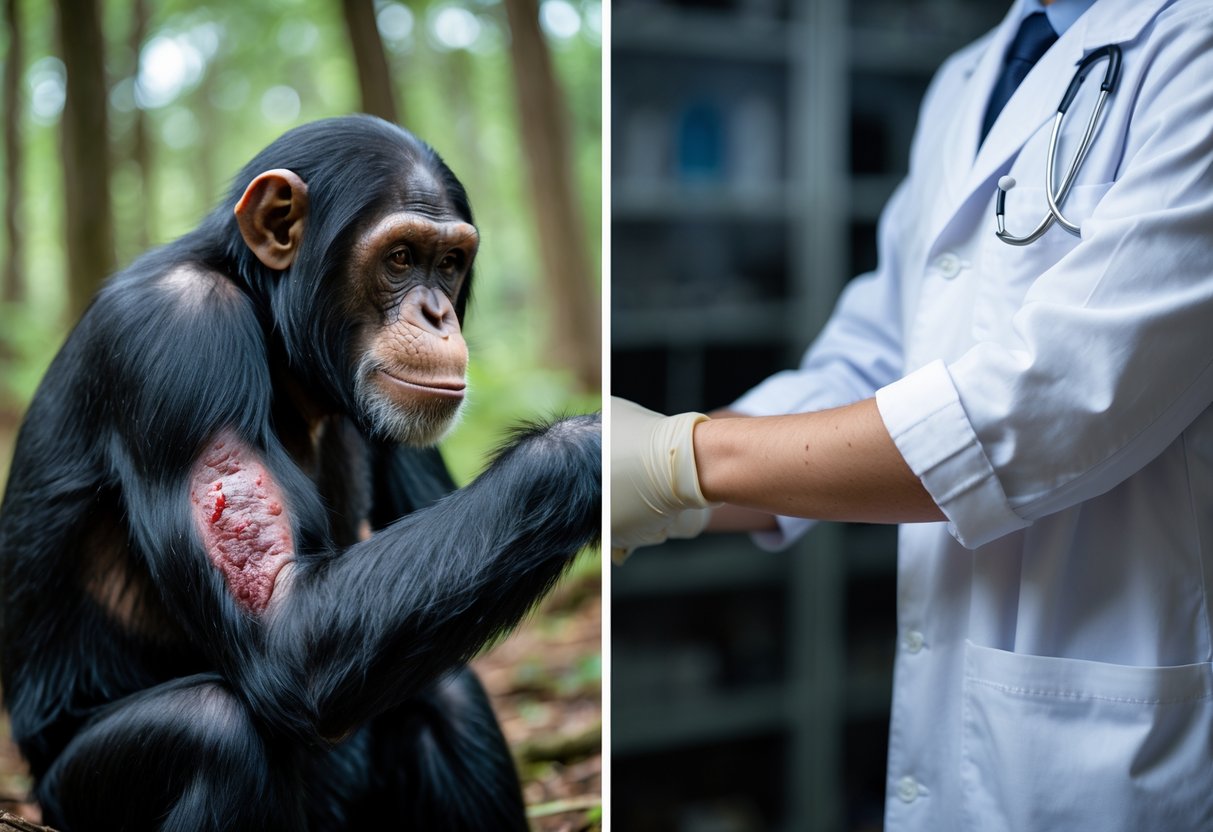
When you compare healing speeds, the differences are hard to miss. Scientists have looked at how fast wounds close, and the numbers don’t lie—chimps beat us by a mile.
Key Research Findings on Wound Healing
Akiko Matsumoto-Oda and her team at the University of the Ryukyus found that chimpanzees heal wounds way faster than we do. Humans close wounds at around 0.25 mm per day, but chimpanzees, olive baboons, and Sykes’ monkeys heal about three times as fast.
Wounds in chimps close up quickly, which probably helps them survive in the wild. These studies tracked wound size over time using photos and measurements, both in labs and out in nature.
That’s why your cuts drag on while a chimp’s barely slows them down.
Measuring Healing Rates in Different Species
Researchers usually observe wounds and check how much the edges move each day. They measure this “healing distance” in millimeters per day.
Matsumoto-Oda’s group studied baboons in Kenya and chimps at the Kyoto University Sanctuary. They snapped photos with rulers next to the wounds, checked healing every few days, and used software to measure the changes.
For humans, they mostly looked at wounds from skin tumor removals at the University of the Ryukyus.
This approach gives a clear comparison between us and our primate cousins.
Non-Human Primates vs. Humans: What the Studies Show
The numbers are pretty consistent: chimpanzees and other primates heal wounds much faster than we do. If you get a cut, it’ll probably take three times longer to heal than it would for a chimp.
Olive baboons and Sykes’ monkeys heal almost as quickly as chimpanzees. That points to a shared fast-healing ability among these primates.
Humans’ slower healing likely started after we split from our common ancestors with apes. Fast healing helps primates avoid infections, which is a big deal for survival.
If you want to dig deeper, check out the wound healing in primates research and Matsumoto-Oda’s findings.
Why Do Humans Heal More Slowly?

Humans just don’t heal as fast as chimpanzees or most other mammals. Our slow healing ties back to changes in our skin, the way we sweat, and even how we help each other when we get hurt.
Evolutionary Adaptations in Human Skin
Your skin’s thicker and less hairy than other primates’. Over time, we evolved a tougher outer layer for extra protection.
Thicker skin is great for defense, but it also slows down healing. This might be the trade-off for things like better temperature control or fewer infections.
These changes kicked in after humans split from chimpanzees about 6 million years ago. So, your skin’s structure is a big reason why you heal more slowly than a chimpanzee.
Role of Sweat Glands and Body Hair
We have way more sweat glands than chimpanzees. Sweating keeps us cool, but it also means we lost most of our thick fur.
Without all that hair, our skin’s more exposed and gets hurt more easily. To make up for it, our skin grew thicker, but that thicker skin slows healing.
Sweat glands add another layer of complexity, making our skin different from animals with fur and fewer sweat glands.
The Influence of Social Support and Medicine
People have always leaned on each other—and a bit of early medicine—when it comes to dealing with wounds.
Since wounds heal slowly, social groups had to get creative. Folks learned which healing plants worked, and that knowledge ended up being pretty crucial for survival.
You can clean wounds, stop infections, and help others bounce back. When friends or family step in to help, slow healing doesn’t seem quite as risky.
Care from others lowers the chances of infection and other complications. Wild animals, like chimpanzees, don’t really offer this kind of social help, so humans have an edge even though they heal more slowly.
If you want to dig deeper, check out the research on humans healing slower than primates at Live Science.


