
Most people assume bees only care about flowers or making honey, but guess what? Bees can actually recognize human faces. These tiny creatures pick out and remember individual faces, even with their tiny brains. That’s pretty wild, right? This skill lets them tell their beekeeper apart from a stranger.
Learning how bees see faces might just make you rethink what you know about them. Bees are way smarter than they get credit for. If you’re curious about how they pull off this face-recognition trick, stick around and dive into the science behind it.
Can Bees Recognize Human Faces?

Bees can tell one human face from another, which honestly seems surprising. They do it by noticing and remembering patterns—like where your eyes, nose, and mouth are. Scientists have set up experiments to figure out how bees manage this and how their skills compare to ours.
Scientific Experiments on Face Recognition
Researchers trained honeybees to connect certain human faces with food rewards. The bees learned to pick out specific faces from a lineup, proving they can remember and recognize these patterns.
A study at Cambridge in 2004 showed bees could tell real human faces apart, not just simple shapes. So, bees don’t need a full face to recognize someone. They focus on details or combos of features.
Bees get better at this with repetition. Over time, they improve at telling faces apart, which helps them spot familiar people, like their beekeeper. If you want to geek out on the details, check out Can Bees Recognize Faces?.
How Bees Process and Distinguish Human Faces
Bees use pattern recognition, looking at the whole face design instead of just a part here or there. It’s kind of like how humans see faces, but bees do it with way simpler brains.
Their brains are tiny—just a speck compared to ours. Still, they manage to notice relationships between facial features. They don’t read emotions or expressions; they just focus on shapes and positions.
Researchers describe bees as seeing humans like “strange flowers.” Faces are just complex shapes to them, not social images. This helps bees in nature to pick out flowers and other bees. There’s more on this at Bees Recognize Human Faces.
Comparing Bee and Human Face Identification
Humans have a brain area called the fusiform gyrus that lights up when we spot faces. Bees don’t have that, but they still use a “holistic” method—taking in the whole face pattern at once.
We can recognize faces instantly, even if there are small changes. Bees need training and a bit more time. But both us and bees rely on seeing faces as full patterns, not just a collection of parts.
You could say bees are quick learners that use memory and pattern clues, not emotional understanding. This helps them recognize the people who handle them often. Curious for more? Check out Do Bees Recognize and Remember Human Faces?.
The Science Behind Bee Vision

Bees see the world in a way that’s honestly pretty alien to us. Their eyes and brains work together to help them find flowers, follow patterns, and even recognize faces. All of this helps with pollination and finding nectar.
Structure and Function of Compound Eyes
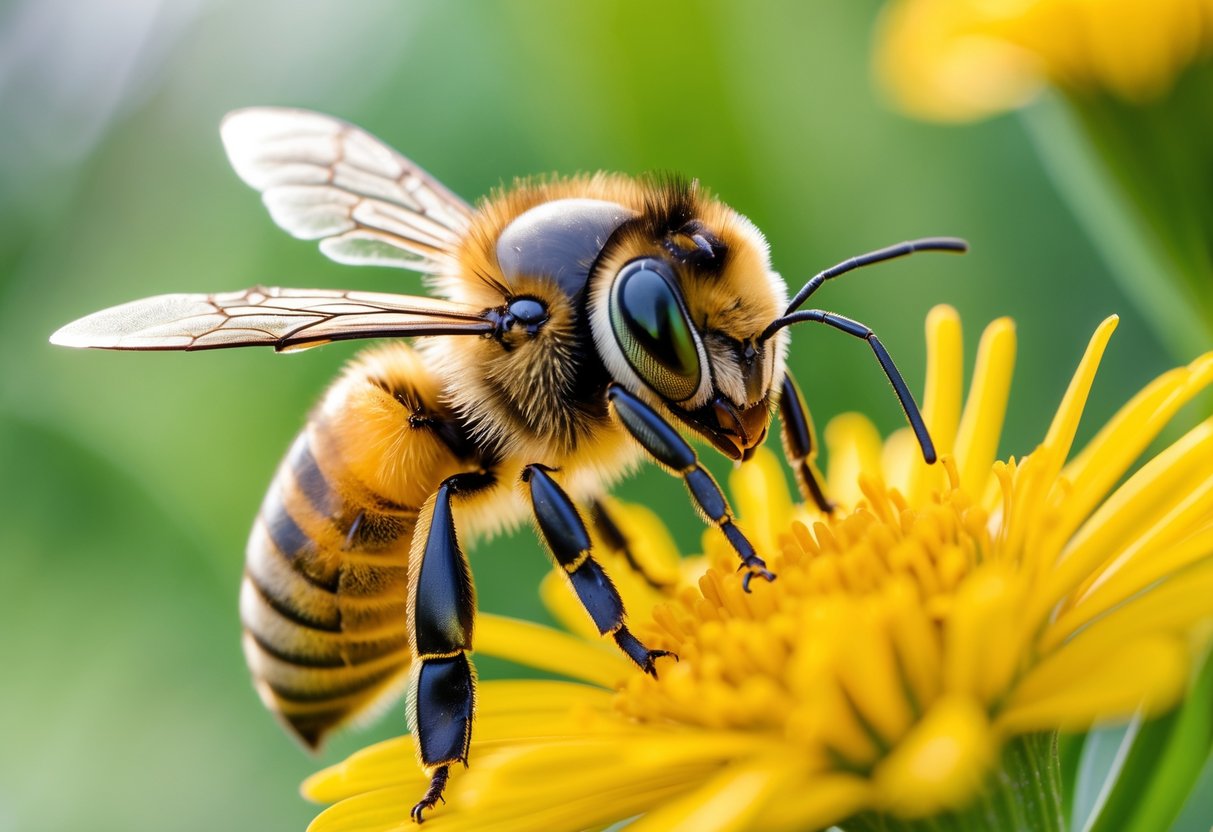
Bees have compound eyes made up of thousands of tiny lenses called ommatidia. Each ommatidium grabs a tiny piece of the image. Together, they give bees a wide, almost panoramic view.
These eyes help bees spot movement fast, which is super important for dodging predators and tracking down flowers. Their compound eyes also let them see patterns like nectar guides—markings on flowers that point the way to nectar.
Bees don’t see crisp, clear pictures. Instead, they see a mosaic of little images that help them zero in on useful details.
Trichromatic Vision and Ultraviolet Sensitivity
Our eyes see red, green, and blue. Bees also have trichromatic vision, but their colors are green, blue, and ultraviolet (UV).
UV vision helps bees spot patterns on flowers that we can’t see—like nectar guides that reflect UV light to show where the nectar’s hiding. This makes flowers easier for them to find and pollinate.
Since bees don’t see red well, flowers use colors bees can see—especially UV—to attract them and help them collect pollen.
Role of Visual Processing in Bee Behavior
Your brain helps you recognize faces by putting together details like eyes and mouth.
Bees have brains too, though theirs work in a simpler way when it comes to visual patterns.
Researchers have found that bees can actually learn and remember pretty complex visual patterns. In some lab studies, bees even recognized human faces.
That skill lets pollinators return to the same places and find food faster. Makes sense, right?
Bees use their ability to process visuals for things like navigating, finding nectar, and dodging threats.
Honestly, it’s kind of wild to think bees aren’t just mindless insects; they use their vision to interact with the world in surprisingly thoughtful ways.
Want to dig deeper? Check out more on how bees see and recognize faces at bees’ vision science.


