
You can tell a chipmunk from a squirrel quickly once you know what to look for. Chipmunks are smaller, striped, and ground-focused, while squirrels are usually larger and more tree-oriented.
If you spot size, stripes, tail shape, and where the animal spends its time, you can identify most sightings with confidence.

Both animals belong to the same rodent family, so it is easy to mix them up at first glance. The differences between chipmunks and squirrels become clear once you focus on a few field marks and habits.
How To Tell Them Apart Quickly
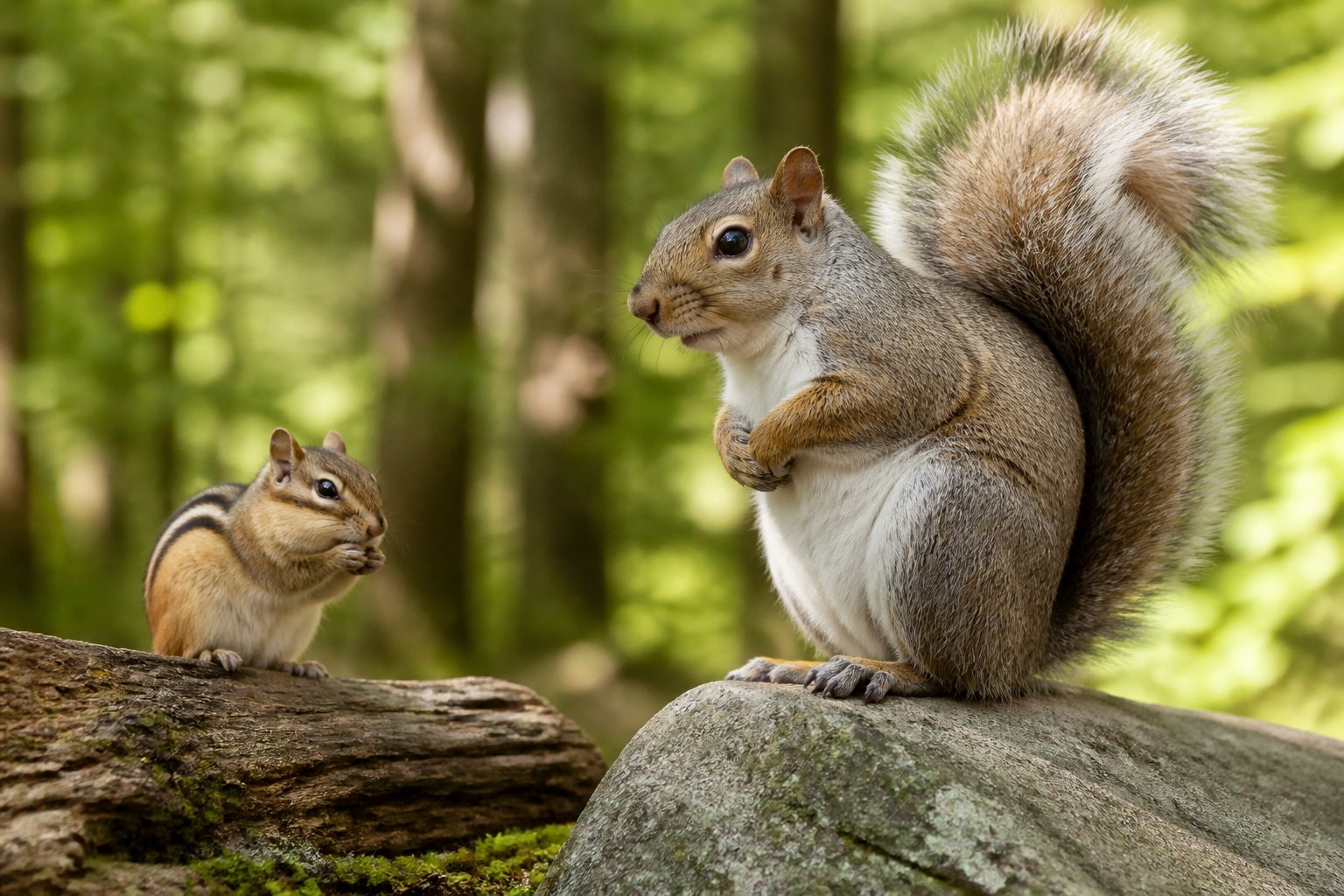
A quick look at body size, stripes, tail shape, and cheek pouches usually gives you the answer. The eastern chipmunk and eastern gray squirrel, or Sciurus carolinensis, show many of the classic differences between chipmunks and squirrels.
Size, Stripes, And Overall Body Shape
Chipmunks are much smaller than most squirrels, and they look compact and low to the ground. Many chipmunks, including the eastern chipmunk, have bold stripes that run along the back and face.
Squirrels tend to look longer-legged and smoother-coated, with no stripes in most common species. An eastern gray squirrel usually appears bulkier, taller, and more agile in the trees than a chipmunk on the ground.
Chipmunk Tail Vs Squirrel Tail
A chipmunk tail is shorter in proportion to its body and looks bushy, yet still fairly slender. A squirrel tail is longer, fuller, and often held high while the animal runs or climbs.
That tail difference is one of the quickest clues in the field. When you see a long, fluffy squirrel tail flicking above the body, you are probably not looking at a chipmunk.
Cheek Pouches And Other Fast ID Clues
Chipmunks have obvious cheek pouches for carrying food back to burrows. Squirrels do not show the same dramatic cheek pouch look, so a seed-stuffing animal on the ground often points to a chipmunk.
Ear shape and posture can help too. Chipmunks usually look smaller, rounder, and more ground-hugging, while squirrels often sit upright and move with more climbing energy.
Where They Live And How They Behave
Where you spot the animal tells you a lot about what it is. Chipmunks spend much of their time on the ground or underground, while many squirrels are built for climbing and tree travel.
Habitat And Daily Movement
Chipmunks prefer habitats with cover, like woodland edges, brush, and rocky spots where they can dash between hiding places. Squirrels are more likely to cross open ground briefly and then head up into trees.
Tree squirrels move with springy climbs and leaps. A tree squirrel rarely looks as low-slung as a chipmunk.
Ground squirrels, by contrast, stay lower, which can make them seem more chipmunk-like.
Ground Burrows Vs Tree Nests
Chipmunks usually live in ground burrows, where they can store food and retreat quickly. Tree squirrels build nests in branches, often called dreys, which sit high above the ground.
That housing choice is a strong clue when you watch movement near a yard or wooded edge. A flash heading into a hole or under roots suggests a chipmunk, while a nest high in a tree points to a squirrel.
Food Storage And Winter Survival
Both animals gather food, especially nuts and seeds, yet they do it in different ways. Squirrels often use scatter hoarding, hiding acorns and other food in many small caches across their range.
Chipmunks also store food, then rely on burrows and winter dormancy to get through colder months. Flying squirrels are another tree-dwelling group that stay far more arboreal than chipmunks, which makes their behavior easy to separate once you notice the pattern.
Why Ground Squirrels Are Often Mistaken For Chipmunks
Ground squirrels can look very close to chipmunks at a glance, especially when they have stripes. A few striped species and family similarities explain why a chipmunk vs ground squirrel ID can get confusing fast.
Chipmunk Vs Ground Squirrel
A chipmunk vs ground squirrel comparison starts with size and markings. Chipmunks are smaller, more finely striped, and usually look slimmer, while many ground-dwelling relatives are sturdier and less sharply marked.
Ground burrow use and tail shape help you sort them out. Chipmunks usually have a more compact look, while many ground squirrels appear broader through the body and less neatly patterned.
Striped Species That Cause Confusion
The thirteen-lined ground squirrel and golden-mantled ground squirrel can look strikingly chipmunk-like. The least chipmunk can also add confusion because it is small and striped, which makes quick field ID tricky.
If you only catch a brief glimpse, a striped ground dweller may seem like a chipmunk species even when it is not. In the same way, some squirrel species can blur the line when you see only movement, color, and stripes at a distance.
How They Fit Within The Sciuridae Family
Chipmunks, squirrels, prairie dogs, and many other ground-dwelling relatives all belong to the sciuridae family. That shared background explains why chipmunk species and squirrel species can seem so similar.
Not every striped rodent is a chipmunk. Not every ground dweller fits the same label.
When you compare body shape, behavior, and habitat, the different types of squirrels start to make more sense.


