
You might glance at a seahorse and wonder if it belongs in a storybook instead of the ocean. Yep — seahorses are real fish, with gills, fins, and a swim bladder. Still, their odd shape and habits make them feel pretty different from the fish you picture.
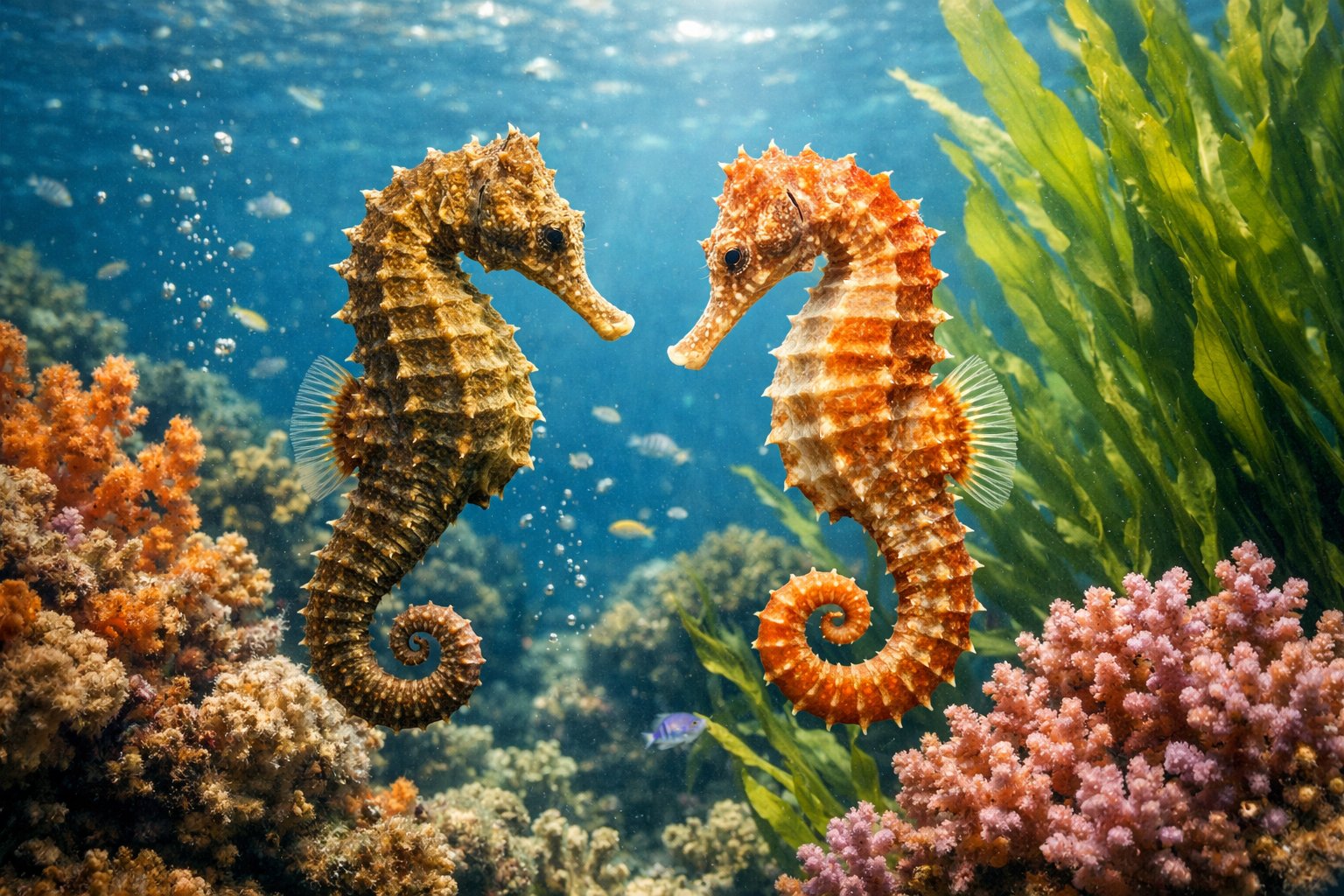
Their upright posture, bony armor, and gripping tails set them apart. These quirks help them thrive in shallow seagrass beds, reefs, and mangroves.
What Makes Seahorses Fish?

Seahorses tick all the main boxes for being fish. They breathe through gills, use a swim bladder for buoyancy, and belong to a recognized fish family with scientific names.
Their classification, fins, breathing, and body armor all connect them to other bony fishes. The weird body shape doesn’t change that.
Scientific Classification and Family
Scientists put seahorses in the genus Hippocampus, inside the family Syngnathidae. That family includes pipefish and seadragons too.
They belong to the class Actinopterygii (ray-finned fishes) and fit into the larger infraclass Teleostei.
Some quick taxonomy facts:
- Genus: Hippocampus.
- Family: Syngnathidae.
- Class: Actinopterygii (ray-finned bony fishes).
So, seahorses aren’t some separate animal group. They’re just a very specialized branch of bony fishes.
Defining Fish Characteristics in Seahorses
Seahorses have the basics that make a fish a fish. They use gills to breathe underwater.
They have a swim bladder, which helps them float or sink. Their dorsal fin pushes them forward, and the tiny pectoral fins near their heads help steer.
You won’t find regular fish scales or limbs with digits on a seahorse. Still, those gills, swim bladder, and fins check all the scientist’s boxes.
You can point to those features if someone asks whether a seahorse is a fish.
Unique Anatomical Features of Seahorses
Seahorses have some wild adaptations. Their heads stick out at a right angle, and their snouts are long tubes for sucking up tiny prey.
Instead of regular scales, they wear bony plates arranged in rings. This armor gives them extra protection in shallow waters.
They’re not great swimmers. Their dorsal fin beats fast to push them forward, while the pectoral fins steer.
These features make them slow but precise hunters. They grab food with suction instead of chasing it down.
Seahorse Relatives: Pipefish and Seadragons
If you want to compare, look at the rest of the Syngnathidae family: pipefish and seadragons. Pipefish look like stretched-out seahorses—same fused jaws, elongated bodies, and similar breeding roles.
Seadragons (leafy and weedy types) add camouflage and leafy appendages, but they keep those gills, fins, and bony plates.
Here are some shared traits:
- Fused jaws and tube-like snouts: both Hippocampus and pipefish have them.
- Bony plates instead of scales: all through Syngnathidae.
- Reproductive pouch or brooding area: males in many species have these.
These relatives show that seahorses fit right into a clear fish family tree.
Distinctive Seahorse Adaptations, Habitats, and Species Diversity

Seahorses survive thanks to some pretty unique features and their choice of habitat. Their tails and camouflage help them hold on and hide.
Male pregnancy? Yep, that’s a thing. And you’ll find different species in oceans all over the world.
Prehensile Tail and Camouflage Strategies
A seahorse’s curled, prehensile tail acts almost like a tiny hand. It grabs onto seagrass, coral, or mangrove roots, keeping the fish anchored in the current.
This lets them ambush prey without burning much energy.
Their skin pattern and texture usually match their home turf. Many can even change color and grow skin filaments to blend in with seagrass or coral.
That camouflage hides them from predators like crabs and bigger fish. It also helps them sneak up on tiny crustaceans, brine shrimp, and copepods.
Some, like the pygmy seahorse (Hippocampus denise), rely almost entirely on blending in. Bigger species, such as the big-bellied seahorse (Hippocampus abdominalis), use both their tail grip and cryptic coloring to hang onto kelp or sponges.
Their upright posture and slow fin movement make them less noticeable to both prey and predators.
Male Pregnancy and the Brood Pouch
Male seahorses carry the eggs in a brood pouch after the female deposits them with her ovipositor. Think of the pouch as a built-in nursery, protecting eggs until they hatch.
Fertilization happens inside the pouch. The male manages salt and fluid levels and even provides some nutrients.
This kind of parental care gives the babies a better shot at survival than just leaving eggs out in the open.
Incubation lasts anywhere from about 10 days to six weeks, depending on the species and water temperature.
Once the babies are born, they’re tiny versions of adults and get no more help from dad. Males can mate again pretty quickly, so they can have several broods each season.
That unique role reversal—male pregnancy—means seahorse populations can bounce back faster when the conditions are right.
Global Seahorse Species and Habitats
Seahorses live in shallow coastal waters, ranging from about 52° N to 45° S. You’ll spot them in seagrass beds, coral reefs, mangroves, and along temperate coasts.
These habitats support species like the long-snouted seahorse (Hippocampus reidi) and short-snouted or longsnout types. It’s kind of wild how much variety there is.
Scientists recognize around 45 to 50 species. That includes the Pacific seahorse (Hippocampus ingens), tiny ones like Hippocampus zosterae, and the spiny or zebra seahorse (Hippocampus zebra).
Other species? There’s Hippocampus abdominalis, H. kuda, H. barbouri, H. guttulatus, H. whitei, H. comes, H. camelopardalis, H. denise, H. reidi, and the Knysna seahorse. It’s honestly a pretty impressive lineup.
Many populations struggle with threats like bycatch, habitat loss, and trade. When people clear out seagrass beds and mangroves, it wipes out nursery areas for young seahorses.
Fossil and genetic research links seahorse evolution to big events, like the spread of seagrass in the late Oligocene. That shift really shaped the diversity we see in seahorses today.


