
Most people assume fish never give live birth, right? But seahorses totally break that rule in a pretty wild way.
Male seahorses actually carry fertilized eggs in a pouch, then release fully formed, live babies when it’s time. So, those tiny seahorses you spot swimming away? Yep, they were born alive—not hatched from eggs.
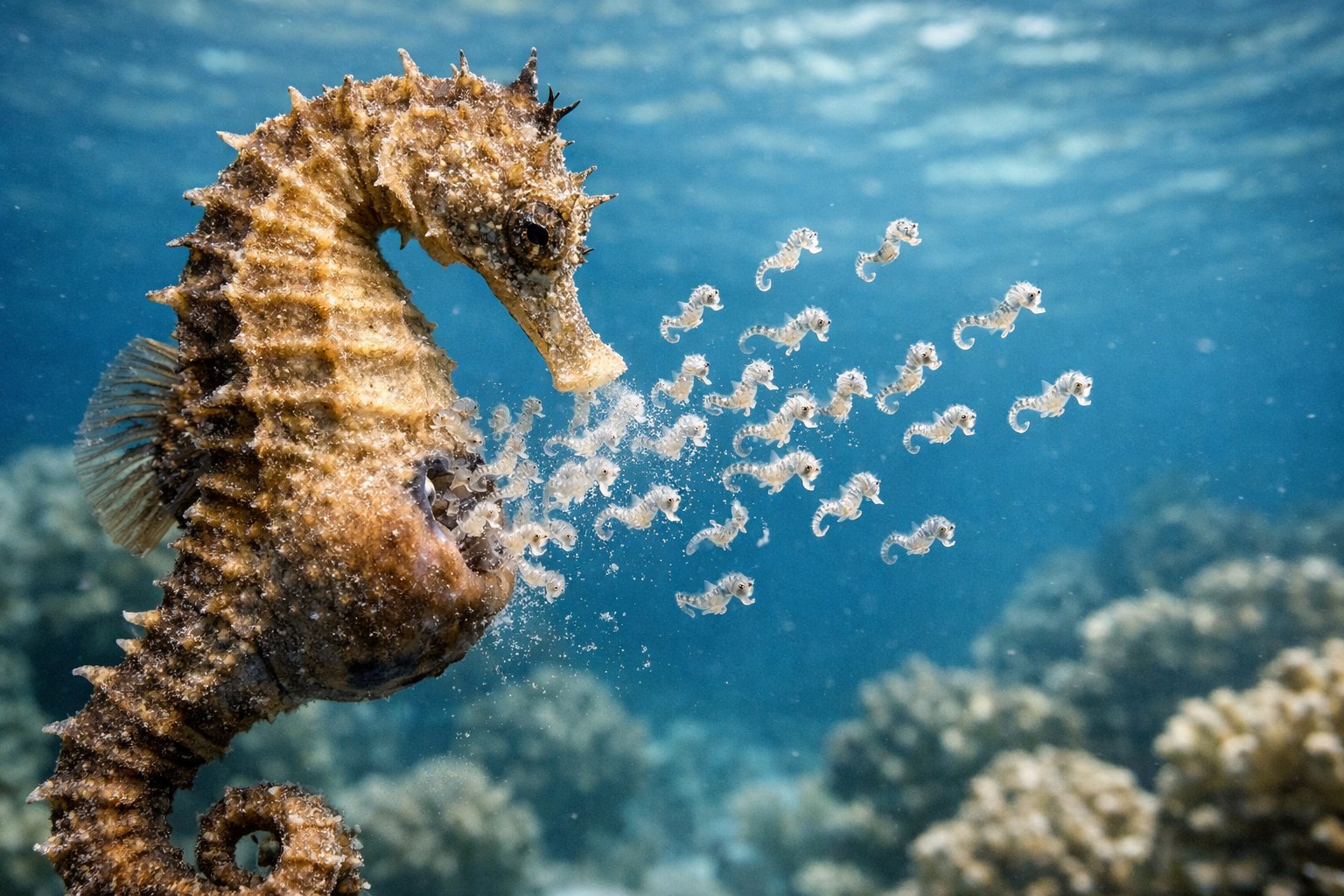
Let’s look at how the male’s pouch works, what baby seahorses look like when they’re born, and why so few make it to adulthood.
You’ll also get a sense of how each life stage affects their odds and what people are trying to do to help them hang on.
How Seahorses Are Born

Male seahorses carry eggs in a special pouch, then go through contractions and push out fully formed babies that have to fend for themselves.
Let’s break down how parents transfer eggs, how the male gives birth, and what those tiny babies face in their first days.
Male Pregnancy and the Brood Pouch
Male seahorses (family Syngnathidae) have a brood pouch on their belly that’s basically a nursery.
When they mate, the female uses her ovipositor to place eggs right inside the male’s pouch.
You can imagine the pouch as a safe chamber that shields eggs from predators and sudden changes in salt or temperature.
Inside, the male fertilizes the eggs and provides oxygen and some nutrients through tissue that acts kind of like a placenta.
Species in the genus Hippocampus, along with pipefish and seadragons, all show different pouch shapes and sizes.
Some just have skin folds; others have a fully sealed pouch.
Pair bonding and a sort of courtship dance help time the egg transfer so both parents are ready.
Seahorse Birth Process
When embryos finish developing, the male’s pouch muscles contract and push the juveniles out.
Labor can last anywhere from a few minutes to a few hours, depending on the species and how many babies are inside.
You might see dozens—or even hundreds—of tiny seahorses squirt out in a single birth.
The male’s contractions also shift the pouch’s chemistry, which helps the babies adjust from pouch life to seawater.
If you watch closely, you’ll see males arching and shaking a bit to help release the young.
After birth, the male doesn’t stick around or offer any more care.
That’s just how it goes for seahorses and their close relatives.
Baby Seahorses and Early Life
Newborn seahorses are tiny—just a few millimeters to a couple centimeters long—and they already look like mini adults.
They start swallowing plankton and tiny crustaceans with their long snouts almost right away.
Don’t expect any parental feeding after release.
Survival rates are rough: currents, predators, and the constant hunt for food mean most won’t make it.
Parents invest a lot before birth, but once the fry are swimming free, they’re on their own.
They have to anchor to seagrass or coral and hide if they want to survive.
If you’re curious about more birth details, check out how seahorses give birth at National Geographic.
Seahorse Growth, Survival, and Conservation

Seahorses grow quickly, but as babies, they face huge risks.
A lot of species need help from people just to survive.
Let’s talk about how young seahorses become independent, what threatens them in the wild, and what people are doing to protect them.
Growth Stages and Independence
Right after birth, seahorses are tiny but fully formed.
Within hours, they swim and hunt on their own, using their eyes to spot small prey like copepods and shrimp larvae.
Since there’s no parental care, most babies drift as plankton and get picked off; some species have survival rates as low as 1 in 200.
As they grow, young seahorses settle onto seagrass or coral.
Species size and water temperature affect how fast they grow.
Pygmy species like Hippocampus denise settle in just a few days, while bigger types like the Pacific seahorse take weeks.
Males and females usually reach maturity around 7 to 12 months, depending on the species—like Hippocampus erectus or Hippocampus zostera.
There’s a lot of variation.
Dwarf and pygmy seahorses grow up faster and don’t live as long.
White’s seahorse (Hippocampus whitei) has even been recorded living up to seven years in the wild, which is actually pretty long for a seahorse.
Life in the Wild and Survival Challenges
Adult seahorses usually stick close to a small home range and use camouflage to dodge predators.
Surveys show adults might occupy just a 5–50 m² patch of seagrass or coral.
Monogamous species stay close together during breeding; polygamous types tend to roam a bit more.
Predators? Crabs, octopus, big fish, birds, and turtles all eat seahorses.
They also deal with tough environments: strong currents can sweep babies away, and low light makes it hard for juveniles to hunt.
Habitat really matters—seagrass beds, mangroves, and branching coral give them places to grab onto and find food.
Lose those habitats, and local populations drop fast, whether it’s the short-snouted seahorse (Hippocampus hippocampus) in Europe or the lined seahorse elsewhere.
Humans make things harder too.
Coastal development and pollution threaten habitats.
Overfishing and bycatch remove adults from the wild.
And climate change? It shifts temperatures and acidifies water, which messes with their food and nurseries.
Threats and Conservation Efforts
Fishing pressure and the aquarium trade have really hurt a lot of seahorse species. People collect seahorses for traditional medicine, souvenirs, and, unfortunately, shrimp trawls often scoop up huge numbers by accident.
Some species, like the long-snouted seahorse (Hippocampus guttulatus) and the Pacific seahorse, get hit especially hard.
Conservationists use a bunch of different strategies. Protected marine areas and restoring habitats—like planting seagrass or protecting coral—can help local populations recover, at least a bit.
Trade rules under CITES now limit exports of wild-caught seahorses. Captive-bred seahorses have started to fill the demand for aquariums, which hopefully means fewer are taken from the wild.
Researchers keep an eye on population trends and look at what specific species need. For example, Hippocampus capensis or Hippocampus reidi each have their own quirks.
If you want to help, you can choose captive-bred seahorses for your aquarium. Avoid buying products made from seahorses, and maybe support projects that protect habitats like estuaries, mangroves, and seagrass beds.
Curious about their survival or how far they roam? Check out Project Seahorse’s page on survival and growth: https://projectseahorse.org/saving-seahorses/about-seahorses/survival/.


