
Ever wondered if chimpanzees might someday evolve into humans? Honestly, it’s a common question. We share a surprising amount with chimps—DNA, behaviors, even some facial expressions. But the idea that one species just turns into another over time? It’s not that simple.
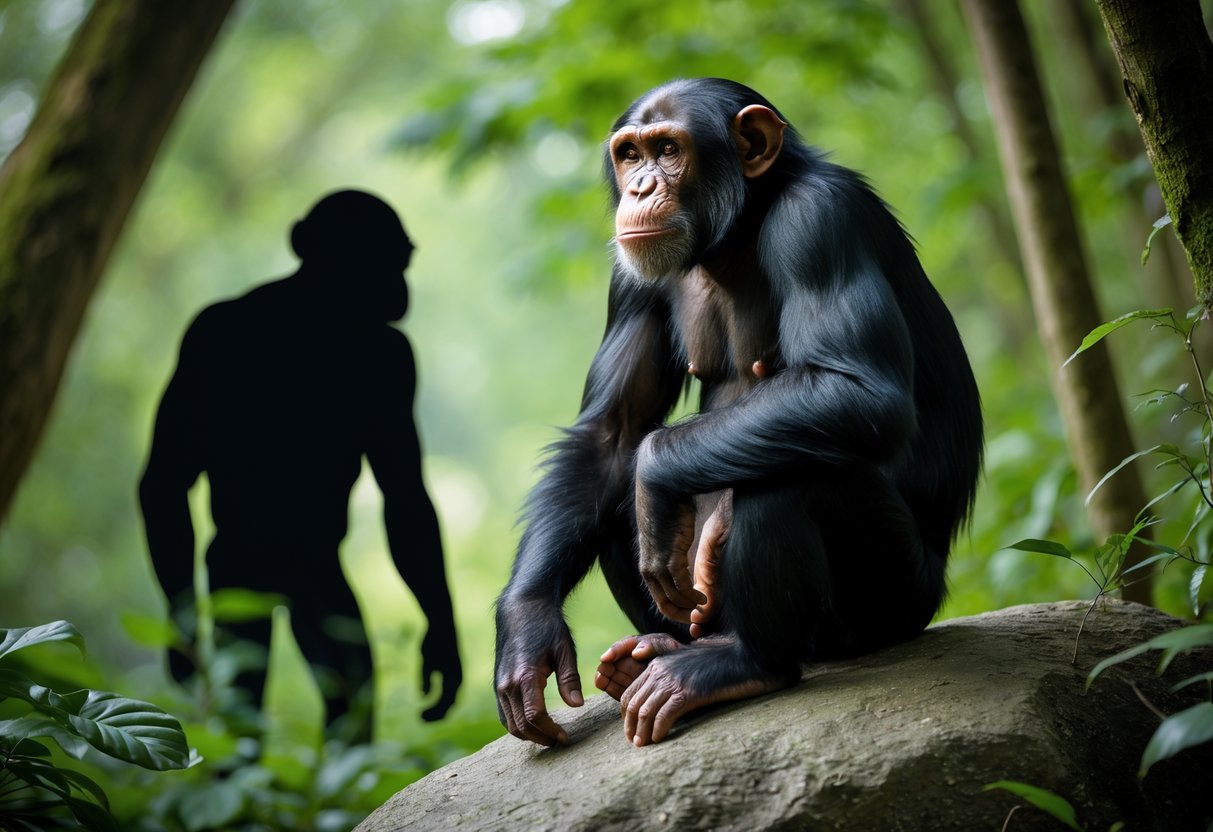
Chimpanzees won’t evolve into humans. Humans and chimps split off from a common ancestor millions of years ago. Since then, each has wandered down its own evolutionary path.
Instead of picturing evolution as a straight line, try to see it more like a tree’s branches. Every branch grows in its own direction.
Chimpanzees have adapted beautifully to their forest homes. Meanwhile, humans took a different turn. Realizing this makes it clear: chimps aren’t “almost humans.” They’ve got their own wild, fascinating story.
Can Chimpanzees Evolve Into Humans?

People sometimes ask if chimpanzees could eventually become humans. The way evolution works for each species is a bit more complicated. Species branch off, share ancient relatives, and carry DNA that’s both similar and different.
Misconceptions About Human and Ape Evolution
Maybe you’ve heard someone say chimps are “early humans” or that they’ll eventually turn into us. Nope. Chimps and humans have been walking separate evolutionary paths for a long, long time.
Evolution doesn’t turn one species directly into another. Both can change over time, but they keep their own identities. Chimps are evolving as chimps. Humans are evolving as humans. That’s just how it goes.
Branches of the Evolutionary Tree
Picture a big, messy family tree. Humans, chimpanzees, and bonobos all sit on different branches that split from a shared trunk.
About 6 to 8 million years ago, that trunk split. One branch led to modern humans. Another led to chimps and bonobos. Each group faced its own challenges and found its own way.
| Branch | Species | Time of Split |
|---|---|---|
| Human Line | Modern humans (Homo sapiens) | ~6 million years ago |
| Chimp Line | Chimpanzees and bonobos | ~6 million years ago |
The Role of the Common Ancestor
You and chimps share a distant relative from millions of years ago. This common ancestor wasn’t a human or a chimp, but something in between.
Traits like tool use and social behavior probably started with this ancestor. Both chimps and humans got some of those habits. Over time, though, each species picked up its own quirks and abilities.
Thinking about this ancestor helps you see humans and chimps as cousins. Not as a parent and child.
Genetic Similarities and Differences
You share about 98–99% of your DNA with chimpanzees. That’s pretty wild, right?
But even a small chunk of difference can mean a lot. Those differences shape things like brain size, walking upright, and language.
Chimps can use tools and communicate, sure. But humans developed language and more complex skills. That’s why chimps are still chimps, and humans are, well, us.
If you want to dig deeper, check out this look at chimpanzee evolution.
The Path of Human Evolution

So, how did humans get here? And where do all these other species fit in?
Big changes happened over millions of years. Early creatures slowly became modern humans, picking up unique traits along the way.
Key Stages From Ancestor to Modern Humans
Human ancestors started to change about 6 or 7 million years ago. Early species like Ardipithecus began walking upright. Later on, Homo erectus showed up with bigger brains and some tool skills.
Eventually, Homo sapiens appeared, bringing language and advanced tools into the mix. Neanderthals lived at the same time as early humans but looked and acted a bit differently.
Here’s a quick rundown:
- Walking upright
- Using tools and hunting
- Bigger brains
- Living in groups and developing language
Fossil Record and Early Human Species
Most of what you know about your deep past comes from fossils. Bones, teeth, and old tools tell stories about species like Ardipithecus, Homo erectus, and Neanderthals.
Scientists find these fossils mainly in Africa. They help trace the journey from ape-like ancestors to modern humans.
The fossil record isn’t perfect. But it shows your ancestors adapted to all kinds of environments. For example, Homo erectus had sturdy bodies for long walks. Neanderthals handled cold climates.
By studying fossils, you can piece together how humans fit into the bigger story of evolution.
Divergence of Great Apes and Humans
Your connection to chimpanzees and other great apes stretches back about 6 to 7 million years. Back then, your shared ancestor roamed the earth.
After that split, humans and chimpanzees each went their own way. Chimpanzees stuck with the forests, while your ancestors started walking upright.
Bipedalism changed everything. Suddenly, your ancestors could use tools and even hunt together—a big leap, honestly.
Gorillas, chimpanzees, and bonobos still count as your closest relatives. But none of them turned into humans; every species just carved out its own path, shaped by whatever the world threw at them.
If you want to dig deeper into how this separation shaped human evolution, check out chimpanzees and human evolution.


