
It’s wild, but in seahorses, dads actually carry the babies. Male seahorses give birth because evolution handed them a pouch that lets them protect, oxygenate, and nourish eggs until they hatch. That means both parents can end up with more surviving young.
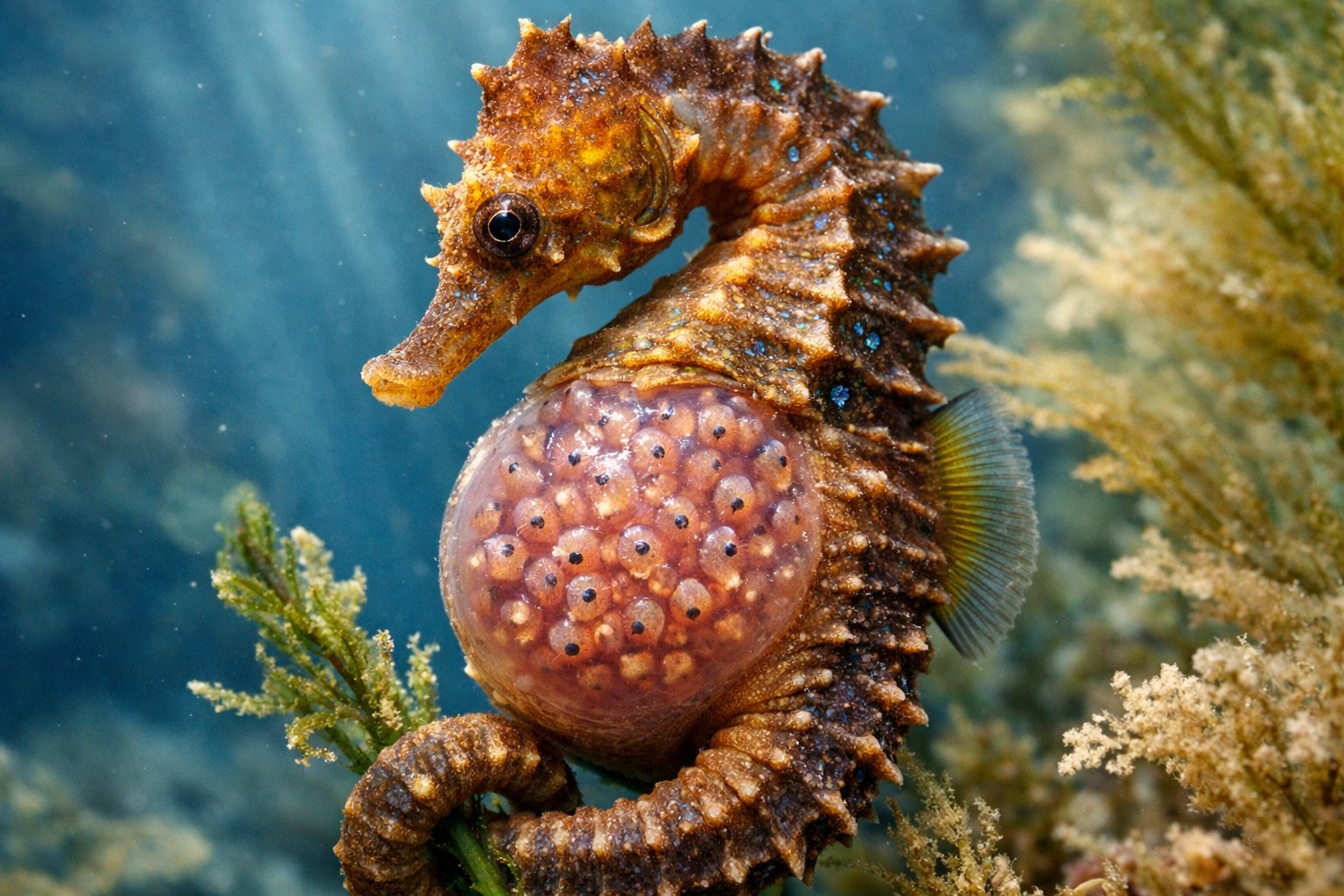
Let’s talk about how this whole role reversal plays out. From the courtship dance to the brood pouch and that surprisingly intense pregnancy—there’s a lot going on.
Up next, you’ll see how the pouch works, why this trade-off makes sense for seahorses, and how their relatives like pipefish and seadragons fit in.
Male Pregnancy in Seahorses: How and Why It Happens

Male seahorses carry embryos in a special pouch. They fertilize and incubate the eggs, then give birth to a bunch of tiny fry after a few weeks.
Want to know how the pouch works? Or how seahorses pull off their courtship and what this role reversal actually does for them? Let’s get into it.
The Brood Pouch and Its Unique Biology
The brood pouch sits right on the male seahorse’s belly, kind of like a built-in nursery. When a female is ready, she deposits her eggs and the male fertilizes them right there inside the pouch.
That pouch does more than just hold eggs. It supplies oxygen, regulates salt, and keeps the embryos safe from salty seawater.
Inside, the pouch grows a rich blood supply and secretes nutrients and antimicrobial stuff. Embryos get oxygen and some nutrients straight from dad, which is honestly closer to a true pregnancy than just carrying eggs around.
Pouch muscles and skin help control water flow and pressure while the babies develop. It’s a pretty sophisticated setup for a fish.
Different seahorse species have different pouches. Some are totally enclosed, others are more open.
Those differences change how much protection and care the male can give. Think of the pouch as both a shield and a living nursery—pretty clever, right?
The Seahorse Mating and Courtship Process
Seahorse courtship isn’t quick. Pairs usually go through these long, synchronized dances—color changes, swimming side by side, even holding tails.
All that bonding helps them time the egg transfer just right.
When the female is ready, she releases eggs into the male’s pouch through her ovipositor. The male fertilizes them as they enter. The whole thing is quick, but it takes perfect timing.
After the transfer, the male’s body starts changing. Blood flow to the pouch ramps up, and hormones shift to support the growing embryos.
Gestation lasts two to four weeks, depending on species and water temperature. When it’s time, the male uses strong muscle contractions to push the tiny fry out into the water.
Evolutionary Advantages of Male Pregnancy
Male pregnancy shifts the work of raising young and can help more babies survive, especially in places full of predators.
By carrying the eggs, males keep embryos safe in a controlled environment—way better than leaving them out in the open.
This switch also lets females make another batch of eggs sooner, since the male is busy with the current brood. That means a pair can have more young during a breeding season.
Males can even influence which embryos do best by tweaking pouch conditions, maybe giving healthier babies an edge.
In the Syngnathidae family, this trait seems to balance energy costs between males and females. Natural selection probably favors it in places where tiny fry wouldn’t make it without extra care.
Seahorse Family, Adaptations, and Relatives

What traits really help seahorses survive? And how do they fit into the bigger family picture?
Let’s look at their quirks, relatives, and the body parts that make male pregnancy possible.
Seahorse Species and Their Unique Traits
Seahorses belong to the genus Hippocampus. There are about 40 known species, all with their own shapes, colors, and sizes.
Some, like the common seahorse (Hippocampus kuda), hang out in warm, shallow water. Others prefer it cooler or deeper.
Most species use a prehensile tail to anchor to seagrass or coral. That tail’s handy for feeding or during their odd little courtship rituals.
Instead of scales, their bodies have bony plates—almost like armor—giving them that stiff, horse-like look. Color changes and skin filaments help them hide or sneak up on tiny prey.
Family Syngnathidae: Pipefish and Sea Dragons
Seahorses are in the Syngnathidae family, along with pipefish and sea dragons.
Pipefish look like skinny tubes with tiny mouths. They don’t have curled tails, so they swim differently and wrap around plants less often.
Sea dragons (like Phyllopteryx) have leafy appendages for camouflage. Some carry eggs on their tails instead of in a pouch.
Members of Syngnathidae all share fused jaws and long snouts for suction feeding. These features shape how they eat, mate, and even where they like to live.
Physical Adaptations and Reproductive Strategies
The brood pouch stands out as a key adaptation for male pregnancy. In a lot of Hippocampus species, the female actually deposits her eggs right into the male’s pouch. He then fertilizes and incubates them himself.
The pouch provides oxygen and some nutrients. It also regulates salinity, which really helps the embryos develop.
You’ll spot some other interesting traits, too. Armored bony plates protect seahorses from predators, though they make fast swimming pretty tough.
The long snout and small, toothless mouth let seahorses suck up plankton and tiny crustaceans. After birth, the fry are tiny and totally independent. Not many make it to adulthood, honestly.
These physical quirks and the male’s unusual role in gestation really shape their mating patterns. You might notice this in how many young appear in a single brood.
- Key terms to remember: syngnathidae, Hippocampus, pipefish, seadragons, bony plates, prehensile tail, brood pouch, seahorse fry.


