
So, who’s actually smarter—a chimpanzee or a gorilla? That question’s trickier than it sounds, since both of these apes show off some pretty impressive smarts in their own ways.
Chimpanzees usually get the reputation for being sharper because they solve problems fast and use tools in really clever ways. They pick up new skills quickly and seem to handle surprises with ease.
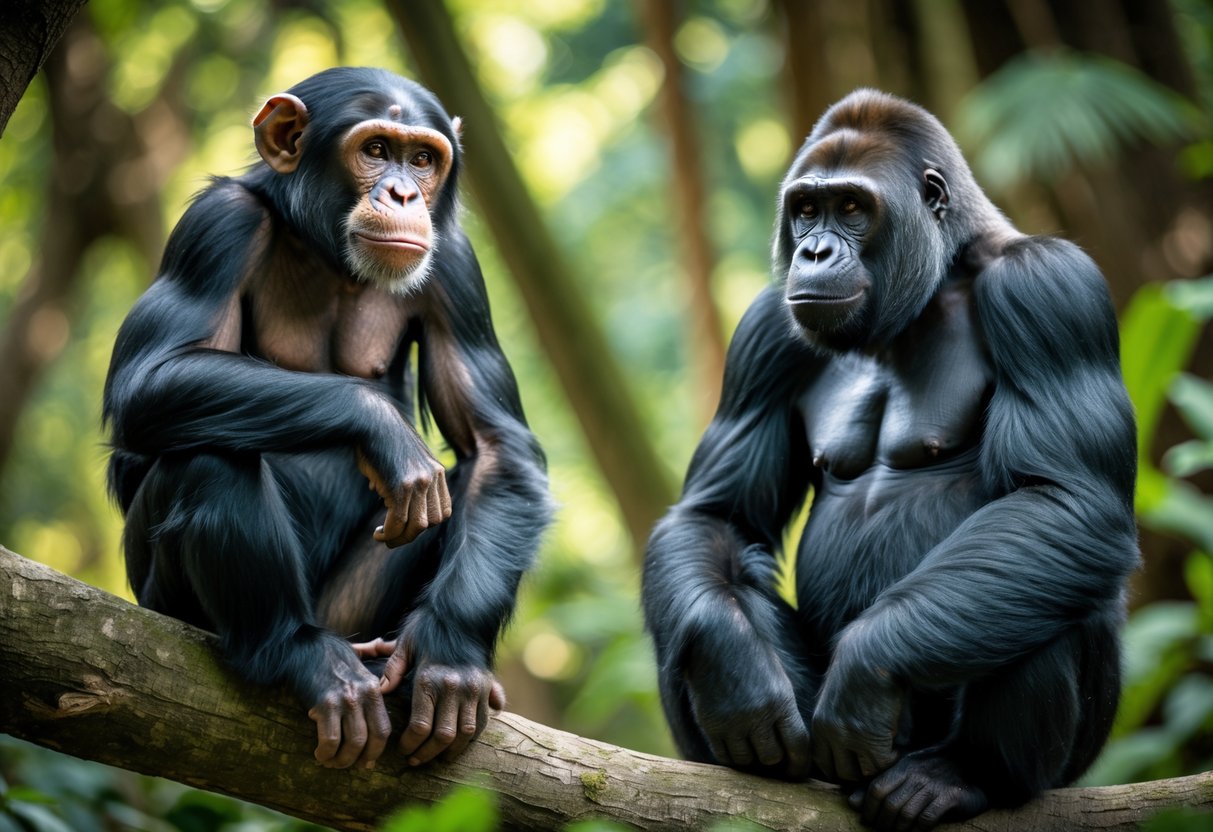
But don’t write gorillas off. Their emotional intelligence runs deep, and they communicate a lot through gestures and body language.
If you take a closer look at how each species thinks and acts, you’ll see just how different—and fascinating—their intelligence can be.
Comparing Chimpanzee and Gorilla Intelligence

Chimpanzees and gorillas both show off their smarts, but they do it in pretty different ways.
Their brains, tool use, and social lives all highlight what makes each species unique.
Cognitive Abilities and Brain Size
Chimpanzee brains are about 400 cubic centimeters in size.
Gorillas have slightly bigger brains—around 500 cubic centimeters.
But honestly, brain size alone doesn’t explain everything.
Chimpanzees use brain regions that help them remember things and solve puzzles fast.
This ability lets them deal with all kinds of wild challenges.
Gorillas, on the other hand, seem to focus more on reading emotions and picking up on social cues.
Their bigger brains help them form strong bonds and sense how others feel.
If you think about it, chimps come across as quick thinkers, while gorillas seem more tuned in to emotions.
Tool Use and Problem-Solving Skills
Chimpanzees really stand out when it comes to using tools.
You’ve probably seen videos of them fishing termites out of mounds with sticks or smashing nuts with rocks.
This kind of tool use shows they can plan ahead and understand how things work.
Chimps solve problems quickly and remember steps pretty well.
Gorillas don’t use tools as much, but they’ll use sticks to reach food or steady themselves.
Most of the time, their problem-solving is about dealing with the moment, not planning for the future.
So, if you’re comparing, chimps seem to shine with their creative use of objects, while gorillas handle things in a more practical, straightforward way.
Social Complexity and Communication
Chimpanzees live in pretty big groups—sometimes up to 100 individuals.
Their social world is busy and complicated, full of shifting friendships and rivalries.
You’ll notice chimps making all sorts of sounds and even teaching each other new tricks.
Gorillas usually stick to smaller groups, led by a dominant silverback male.
These groups are calmer and less aggressive overall.
Gorillas rely a lot on body language, facial expressions, and gestures to get their point across.
They’re great at picking up on subtle feelings and building close family ties.
If you spend time watching both species, you’ll notice two very different, but equally impressive, types of social smarts.
Want more details? Check out this article on chimpanzee and gorilla intelligence.
Habitat, Behavior, and Cultural Context

You’ll find chimpanzees and gorillas living in different areas of East Africa.
Their homes shape how they act and interact with each other.
In places like Uganda and Rwanda, their social lives look pretty different.
Habitats in East Africa
Chimpanzees mostly stick to forests and woodlands across East Africa, like Uganda’s Kibale National Park.
They like spots with lots of fruit trees and thick greenery for food and shelter.
Gorillas—especially mountain gorillas—live in Rwanda’s Volcanoes National Park and Uganda’s Bwindi Impenetrable Forest.
These areas have dense forests and higher elevations.
Gorillas eat mostly plants—think leaves and bamboo.
Both chimps and gorillas travel on the ground, but chimps climb trees more often to eat or rest.
You might spot chimps using branches as tools up in the trees, while gorillas usually stay on the ground because of their size.
Social Structure Differences in Uganda and Rwanda
Chimpanzees hang out in big, flexible groups called communities. They often split into smaller parties, meeting up and drifting apart all the time.
This way of living lets them share food and defend their territory, though it can get noisy and competitive.
Mountain gorillas stick together in smaller groups known as troops. A dominant male, the silverback, leads the troop.
He protects and guides everyone, and the group usually stays close. Their behavior feels calmer and less noisy than what you’d see with chimpanzees.
In Uganda and Rwanda, chimpanzee groups can range anywhere from 20 to 150 members. Gorilla troops, on the other hand, usually have just 5 to 30.
Gorillas seem to prefer a more peaceful group life. It’s interesting to see how these differences show each species adapting to their own environment and way of life.


