
If you’re curious about Scottish mythological birds, you’ll probably find the Boobrie one of the most fascinating creatures out there.
The Boobrie shape-shifts and appears as a gigantic bird, haunting the lochs of western Scotland with its black wings, human-like claws, and those haunting calls. People say it’s not just a bird—it can show up as a water horse or even a giant insect, which really adds to the weirdness.
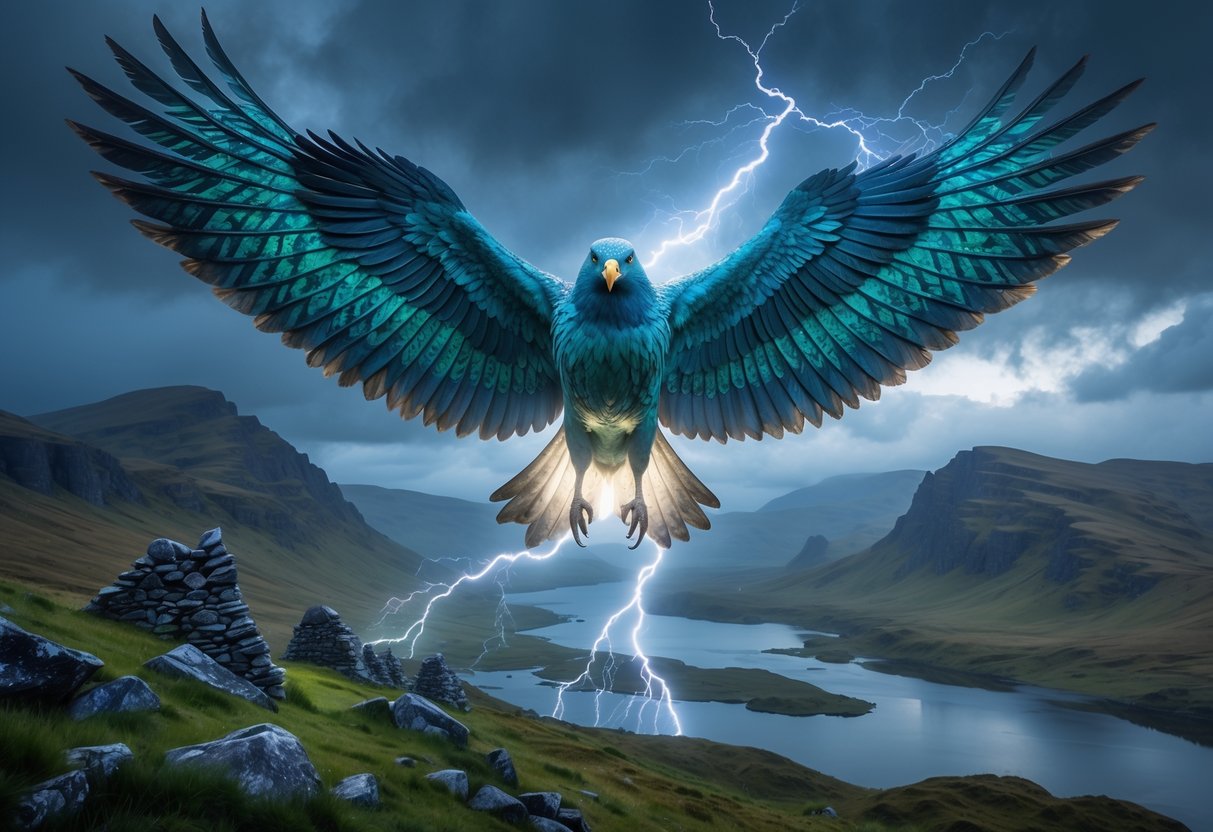
The Boobrie is said to hunt cattle and fishermen, using tricks like mimicking the sounds of lambs or calves to lure them in. It moves across water or land with surprising speed, and its strange stare unsettles just about anyone who sees it.
If you’re into stories about the supernatural, the Boobrie is a unique glimpse into Scottish folklore. Its mix of bird and other odd forms really shows how Scottish myths tie into nature and the unknown.
You might want to dig deeper into its story to see what it reveals about ancient Scottish beliefs.
The Boobrie: Scotland’s Monstrous Mythical Bird

Scottish folklore brings us a creature that takes on some pretty strange forms.
People know this mythological bird for its eerie calls and sudden attacks. It lives near lochs and shores, especially around Argyll and Lochaber.
It isn’t just a big bird, either—it can become other creatures, which makes it even stranger.
Origins and Folklore in Scottish Highlands
The Boobrie’s roots go deep into stories from the Scottish Highlands, especially in Argyll and Lochaber.
Locals say it lurks in deep lochs like Loch Leathan and nearby waters. People see it as mysterious and sometimes dangerous.
Folklore paints the Boobrie as a kind of guardian of the lochs but also a threat to animals near water. Farmers used to fear it, since it sometimes stole livestock from boats.
It’s tangled up with old myths about death and protection, warning folks to respect the power of the water.
Physical Appearance and Unique Abilities
The Boobrie usually shows up as a huge water bird, pretty much like a great northern diver or an auk. It has black wings and webbed feet, so it swims really well.
Its eyes have a piercing gaze that can scare or confuse anyone who meets them.
Its call? Oddly enough, it sounds more like a bull or a calf than a bird. That loud bellow scares animals or lures them closer.
The Boobrie hunts otters, sheep, and sometimes fish. It grabs prey with long talons and drags them underwater.
Shape-Shifting Forms: Aquatic Horse and Water Bull
One of the weirdest things about the Boobrie is its shape-shifting. It doesn’t always stick to being a giant bird.
Sometimes, it turns into a water horse—folks call it an each-uisge or kelpie—and runs over the water like it’s nothing.
It can also become a tarbh-uisg, or water bull. In these forms, it hunts differently but remains a threat to livestock and people near the lochs.
These shape-shifting powers make the Boobrie one of Scotland’s most mysterious and feared mythological creatures.
If you ever wander around the lochs of Argyll or Lochaber, maybe keep an ear out for its strange calls or watch for sudden movements on the water.
Symbolism and Role of Mythical Birds in Scottish and Celtic Mythology

Mythical birds in Scottish and Celtic stories carry deep meanings about life, death, and change.
They show up as powerful symbols linked to fate, war, and the spirit world. These birds remind us how life moves in cycles and how transformation leads to new beginnings.
Cycle of Life, Death, and Rebirth
In Celtic and Scottish tales, birds often stand for the natural cycle of life, death, and rebirth.
The Phoenix is a strong symbol—it dies in flames and rises again from its ashes. That’s a pretty clear sign that endings lead to fresh starts, mirroring the changing seasons and the sun’s daily journey from sunrise to sunset.
You’ll also see this idea in Celtic festivals like Samhain and Imbolc, which mark times for honoring the dead and welcoming new life.
Birds like the raven and the crow guide souls between the living and the spirit world, showing the close tie between life and death in these stories.
Transformation and Immortality in Folklore
Many Scottish myths connect birds to transformation and immortality.
Some stories tell of bird-like creatures that shape-shift, changing from human to bird and back. This shows how change is natural and sometimes magical.
The raven, for example, often gets linked to war and fate. In Scottish folklore, it acts as a messenger and a symbol of both death and protection.
These birds aren’t just animals—they’re spiritual beings tied to the idea that life goes on beyond what we can see, hinting at immortality through rebirth or spiritual presence.
Other Mythical Birds: Influences and Parallels
Scottish myths actually share a lot with stories from other cultures about magical birds. The Adarna bird from Filipino legends, the Phoenix from Greek mythology, and even the sun god Ra’s falcon in Egyptian tales—they all stand for ideas like renewal and power.
People everywhere seem to look at mythical birds as symbols of hope and transformation. Kinda fascinating, right? These connections really help you see how Scottish and Celtic tales fit into a bigger pattern of human storytelling.
If you want to dig deeper, check out The Phoenix in Celtic Mythology or read about the ravens in Celtic myths.


