
Ever found yourself wondering what would actually happen if human sperm ended up in a chimpanzee? You’re definitely not the only one. It’s a weirdly fascinating question, given how much DNA we share with chimps.
But honestly, fertilization doesn’t work the way you might expect.

Human sperm can’t fertilize a chimpanzee egg because their reproductive systems and genetic codes just don’t match up. No pregnancy, no hybrid baby—nature’s got some solid roadblocks in place to keep species apart, even if the idea sounds wild.
Understanding why this happens really shows how nature keeps each species unique. Even though some people tried to cross these lines in the past, fertilization between humans and chimps just gets blocked at every turn.
Can Human Sperm Fertilize a Chimpanzee Egg?

Human sperm can’t fertilize a chimpanzee egg. The main reasons? Biological differences in how their reproductive systems work, genetic mismatches, and what scientists have found in past experiments.
Let’s get into why these differences make fertilization basically impossible.
Reproductive Barriers Between Species
Your body and a chimp’s body are just built differently when it comes to reproduction.
These differences act as natural barriers.
For example, sperm needs to reach and attach to the egg, but chimpanzee eggs have special outer layers that human sperm can’t really get through. The timing and process of reproduction also don’t line up between humans and chimps.
Physical differences in reproductive organs make natural fertilization a non-starter. Even fancy lab methods like in vitro fertilization haven’t gotten past all these obstacles.
Genetic Compatibility and Chromosomal Differences
Human and chimpanzee DNA gets compared a lot, but it’s not similar enough for fertilization.
Humans have 23 pairs of chromosomes. Chimps have 24 pairs.
That difference means sperm and egg can’t combine the way they need to for an embryo to form.
The genes in the sperm and egg have to match up just right. When they don’t, fertilization fails or any early development stops almost immediately.
Results From Scientific Attempts
Scientists have tried mixing human sperm with chimpanzee eggs for quite a while.
Back in the early 1900s, some experiments used artificial insemination with human sperm and female chimps. None of these attempts led to pregnancy or birth.
Modern tests sometimes show human sperm can stick to or even enter chimpanzee eggs in a lab setting. But there’s never been successful fertilization or development.
All this evidence backs up the idea that hybrid offspring just aren’t possible between humans and chimps—naturally or artificially.
If you want to go deeper, check out the research on human sperm and chimpanzee fertilization experiments.
Hybrid and Chimera Myths Versus Scientific Reality
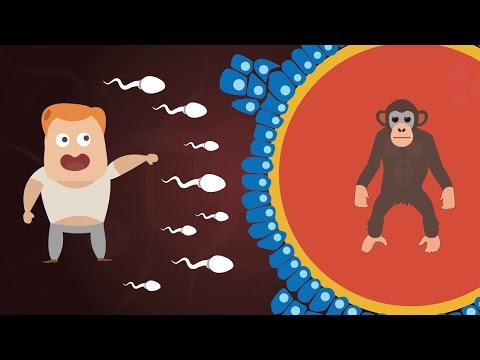
When human sperm gets anywhere near a chimpanzee egg, people start asking all kinds of questions. The difference between hybrids and chimeras can get confusing, and science has some pretty clear answers about these cross-species ideas.
It’s also worth thinking about the ethical dilemmas that come with this kind of research.
Formation of Chimeras in Scientific Research
Chimeras are creatures made by combining cells from two different species.
In labs, scientists inject human stem cells into animal embryos. This doesn’t make a full mixed-species animal—it just means the animal has some human cells.
Researchers usually create these chimeras to study diseases or try to grow human organs inside animals. None of these chimeras have ever been developed all the way to birth or full maturity.
The main goal is to study certain cells or organs, not to make a human-animal hybrid.
This whole process is very different from breeding two species. Chimeras get made by mixing cells early on, not by combining sperm and eggs from different species.
Differences Between Hybrids and Chimeras
A hybrid is what you get from the direct mating or fertilization of two species—a mule from a horse and donkey, for example. Hybrids have DNA from both parents in every cell.
Chimeras, though, have cells from two species mixed together, but each cell only has one species’ DNA. So, a chimera is like a patchwork, while a hybrid is a blend throughout.
Humans and chimpanzees have different numbers of chromosomes. That makes true hybrids almost impossible.
The mismatch means human sperm just can’t fertilize a chimpanzee egg in any meaningful way.
Ethical Implications of Cross-Species Experiments
It’s worth pausing to consider how blending human and animal cells or genes stirs up some tricky ethical questions. When researchers work on human-animal chimeras, they end up confronting issues around animal welfare and, honestly, what it really means to be human.
Scientists try to find a balance between the potential medical benefits—like maybe growing human organs for people who need transplants—and the risk of creating creatures with identities that aren’t clear at all.
Different countries set their own rules and draw lines in different places, so what’s allowed in one place might be banned in another.
People in this field need to stay transparent and work under strict oversight to make sure they don’t lose sight of both their scientific goals and the ethical boundaries. It’s a conversation that’s not going away, especially as technology keeps moving forward.
If you’re curious, you can check out more about human-animal hybrid experiments.


