
You notice small, dark pellets in your attic or maybe under a tree and want a quick answer. Squirrel droppings look like tiny, smooth, coffee-bean shaped pellets—dark when fresh, lighter as they dry.

Spotting these signs can help you tell squirrel mess apart from mouse or rat activity—and figure out if you need to do something about it. Up next, you’ll see the exact size, how the color changes, and what makes them different so you can ID droppings without second-guessing.
What Do Squirrel Droppings Look Like?

Most of the time, you’ll find small, uniform pellets that match the size, shape, and texture described here. Pay attention to length, color, how the surface feels, and where the pellets pile up—those details help you tell squirrel droppings from other critters’ scat.
Shape and Size of Squirrel Pellets
Squirrel pellets are small and cylindrical. They usually measure about 5–8 mm long—think 1/4 to 1/2 inch—and around 3–4 mm wide.
Each pellet has rounded ends and a steady thickness, so a pile looks like a bunch of tiny capsules. When you compare them to other droppings, squirrel feces look rounder than rat droppings and bigger than mouse pellets.
When you find several together, they stay pretty consistent in size. That uniformity really helps you spot squirrel poop fast.
Fresh vs. Old Squirrel Poop Colors
Fresh squirrel droppings come out dark brown or nearly black. The color comes from what they ate and the moisture.
Over days or weeks, pellets fade to lighter brown, grayish brown, or even a chalky gray as they dry out and break down. Sometimes you’ll spot greenish tones—usually means the squirrel ate a lot of green plants or unripe fruit.
Very pale, brittle pellets are usually old. You can use color and where you find them to guess how recent the activity is.
Texture, Odor, and Common Locations
Fresh pellets feel smooth and firm, maybe a bit tacky. Older ones turn brittle and crumbly.
They don’t smear like bird droppings or flake apart like dry bird guano. The smell is usually mild compared to bigger rodents.
You might catch a faint musty odor in a closed space like an attic. Squirrels tend to leave droppings in attics, along rafters, near entry holes, under bird feeders, at the base of trees, and up high on fence tops or roof ledges.
Notable Features in Squirrel Feces
Squirrel droppings usually show up in little clusters, not long scattered trails. Sometimes you’ll spot nesting material, chewed seed shells, or a bit of fur nearby.
Pellets don’t show segmentation like worm castings—they stay uniform. Check for bite marks on wood, chewed wires, or squirrel tracks near the droppings.
Those extra signs help you confirm it’s squirrel poop, not rat or mouse. For more photo comparisons, check out this How to Identify Squirrel Poop (With Pictures) guide.
Key Differences: Squirrel Droppings vs Other Animal Droppings
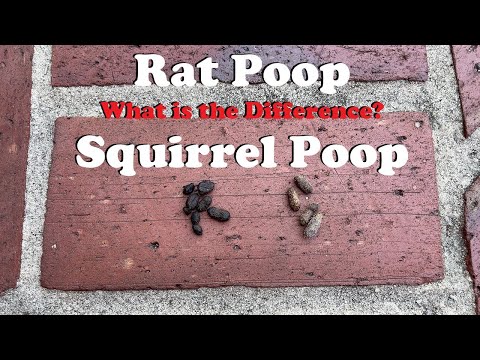
Squirrel droppings are small, brown, and pill-shaped. You can spot differences in shape, size, color, and where you find them—those clues help you tell them apart from rats, mice, and other rodents.
Distinguishing from Rat Droppings
Rat droppings are longer and more uniform than squirrel scat. A Norway rat’s pellet usually measures about 12–18 mm and has pointed ends.
Squirrel droppings are shorter (around 5–8 mm), rounder, and sometimes have a slight bulge in the middle. Where you find the droppings matters too.
Rats leave piles near food, along walls, and in dark corners. Squirrels scatter droppings on tree branches, in attics, or around bird feeders.
Color can clue you in: rat poop is usually dark brown to black when fresh, while squirrel pellets might be light brown, reddish, or greenish, depending on what they ate.
If you see a bunch of long, uniform pellets along baseboards, you probably have rats. If the pellets are rounder and scattered around trees or in a loft, chances are they belong to squirrels.
Squirrel vs Mouse and Other Rodents
Mouse droppings are much smaller than squirrel scat and there are usually more of them. A mouse pellet is about 2–4 mm long and sharply pointed at both ends.
Squirrel droppings are bigger and less uniform than mouse droppings. Sometimes, you’ll see bits of shell or plant matter from nuts and seeds.
Other rodents like voles or chipmunks leave droppings that look a bit like mice or small squirrels. Vole droppings are blunt and stubby, often found on lawns or near burrow entrances.
Chipmunk scat can be close in size to small squirrel pellets but shows up near ground burrows and often has more seed fragments. When you compare, grab a ruler or use a coin for scale and note the location.
Finding pellets in trees, nests, or up high in rafters points to tree squirrels or flying squirrels, not mice or ground rodents.
Species Variations: Tree, Ground, and Flying Squirrels
Tree squirrels, like gray squirrels and fox squirrels, drop pellets all over—sometimes in trees, on roofs, or under feeders. You’ll notice their droppings change color a bit, especially as their diet moves from nuts to fruits throughout the year.
Ground squirrels tend to leave their droppings right by their burrow entrances or just out on the ground. You might spot their pellets clumped together in certain spots, and honestly, they often look bigger and more cylindrical than what you’d find from tree squirrels.
Flying squirrels? Well, they’re nocturnal, so you’ll usually find their droppings in attics or tucked away in hollow trees. Their scat piles up in nests or sometimes just in one attic corner, which is kind of gross if you think about it. Baby squirrels make smaller, softer pellets—these look fresher and a bit darker.
Diet really messes with the color and consistency of squirrel droppings, regardless of the species. So, you’ll want to pay attention to where you find the scat and the pattern it forms, not just its shape.
For some side-by-side photos and extra ID tips, check out this guide on squirrel droppings.


