
Ever wondered what frogs mate with? The answer’s pretty straightforward: frogs mate with other frogs—specifically, males with females.
When it’s time to mate, the male frog climbs onto the female’s back and grabs her in a position called amplexus. While she lays eggs, he fertilizes them right there, outside her body. It might sound a bit odd, but honestly, it’s just how most frogs do things.
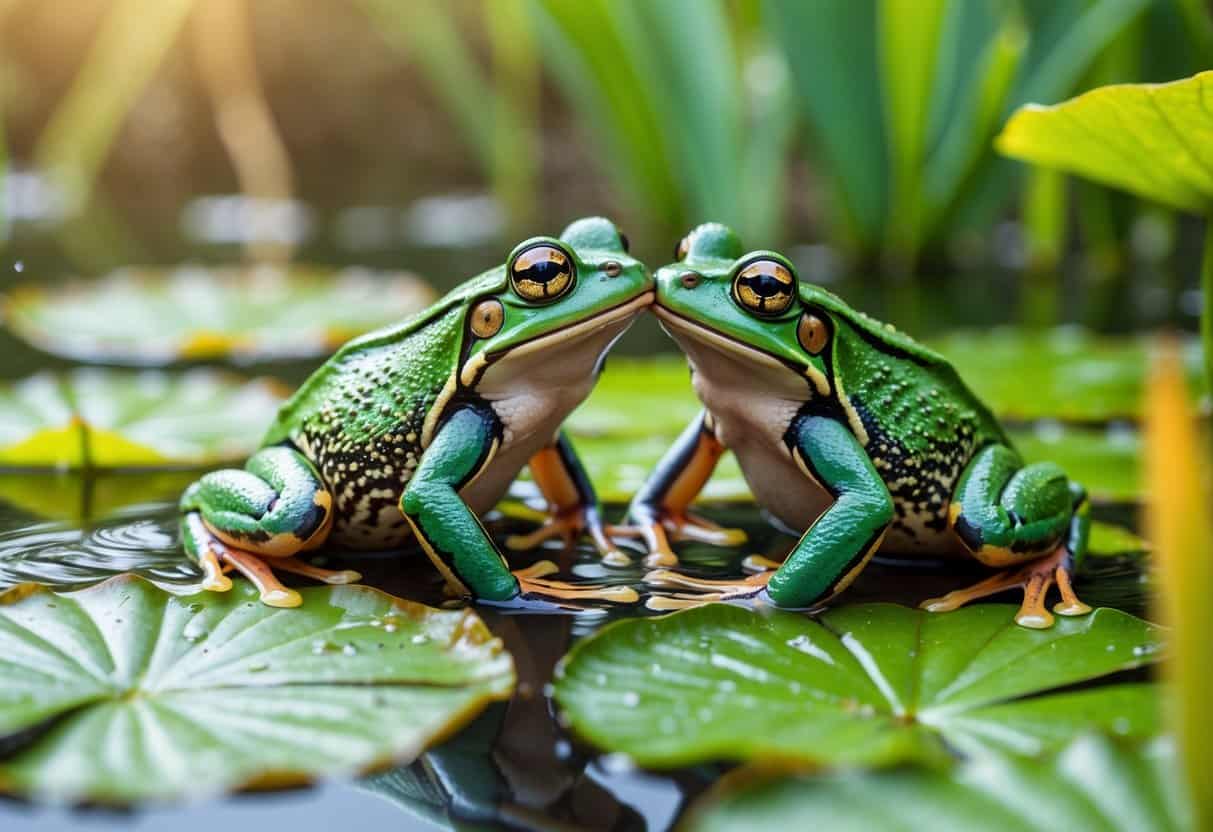
This mating embrace can last for hours—or even days, believe it or not. The male holds tight to make sure his sperm actually reaches the eggs as she drops them in the water or in damp spots.
It’s a quirky but effective way for frogs to keep their species going, especially in places where survival isn’t always easy.
If you’re curious about why frogs mate like this, you’re not alone. There’s a lot more to their breeding habits than you might guess. Check out frog breeding behavior if you want a deep dive.
Who Do Frogs Mate With?
Frogs usually mate with females of their own species, but things get messy during breeding season. Males sometimes grab anything that moves if it even slightly resembles a potential mate.
That eagerness leads to some funny and even awkward moments, depending on the species and what’s going on around them.
Role of Female Frogs in Mating
Female frogs are a bit picky, but they don’t always choose directly. Males call out to attract them, and if a female responds, a male hops on her back and hangs on.
Amplexus—the name for this grip—helps him fertilize her eggs as she lays them.
Females don’t linger at breeding spots. They show up, lay eggs, and move on.
Males stick around longer, hoping for more chances to mate. So, you’ll often see a bunch of males competing for just a handful of females.
Unlike males, females don’t make release calls. If a male grabs the wrong partner, she usually stays silent.
Differences Between Frogs and Toads in Mating Partners
Frogs and toads often share the same ponds, but they breed at different times. That timing cuts down on mix-ups between species.
Still, sometimes you might spot an American Toad clinging to a Green Frog. Their eyesight just isn’t perfect.
Toads call with short, high-pitched trills, while frogs have a range of calls. These sounds mostly help them find the right mates.
But when breeding season gets wild, males might latch onto almost anything—frogs, toads, or even floating objects like leaves or, weirdly, mice.
Species-Specific Mating Choices
Each frog species has its own way of finding a mate. Bombay Night Frogs, for example, use loud and distinctive calls to connect in the dark.
Some frogs rely on color or size to spot the right partner. Males usually go after females that fit these clues.
Mistakes still happen. Males sometimes try to mate with other males or even the wrong species.
Many frogs have a “release call” to let others know they’re not the right match. Without this call, mix-ups can drag on—especially if a male grabs an object or another animal.
If you want to dig deeper, you can check out frog breeding behaviors and see how different calls play into frog romance.
How Frogs Mate: Behaviors and Fertilization
Frog mating isn’t just a simple process. You’ll notice some unique behaviors and interesting ways frogs get the job done.
They use a strong grip, and you’ll find differences between external and internal fertilization. Some species have weird little tricks to help them out.
The journey from eggs to adult frogs changes a lot along the way.
What Is Amplexus?
Amplexus is the “hug” you’ll see during frog mating. The male grabs the female tightly around her waist or back with his front legs.
This hold can last a long time—sometimes hours, sometimes days.
While he’s hanging on, the male fertilizes the eggs as the female lays them in water. This grip keeps them together so the eggs get fertilized right away.
Other males might show up and try to push the first male off. It’s a bit of a scramble at times.
External vs Internal Fertilization
Most frogs go with external fertilization. The female lays her eggs, and the male releases sperm over them outside her body.
They need water for this, since the eggs and sperm meet there to make tadpoles.
Some rare species, like tailed frogs (genus Ascaphus), use internal fertilization. The male has a tail-like extension he uses to pass sperm inside the female.
This usually happens in fast streams, where eggs would otherwise get washed away.
Most frogs stick to external fertilization, which is why you’ll hear males calling loudly near ponds or streams with enough water.
Special Adaptations: Tailed Frogs, Nuptial Pads, and More
Some frogs have special features to help them mate. Male frogs often develop nuptial pads—thick, rough patches on their thumbs or forearms.
These pads help the male grip the female during amplexus, especially if she’s big or slippery.
Tailed frogs (Ascaphus species) live in cold, fast streams and use their “tail” for internal fertilization. That way, eggs stay fertilized even in rushing water.
Other frogs might use bright colors or loud croaks to catch a mate’s attention.
Sometimes, you’ll see several males grabbing onto the same female, forming a “frog ball” as they compete to fertilize her eggs.
Egg Laying to Froglets: The Reproductive Journey
Once fertilization happens, the female lays hundreds—sometimes even thousands—of eggs. You’ll usually spot these frog eggs in clusters or long strands floating in the water.
A jelly-like coating surrounds each egg, helping keep them from drying out and giving some protection from hungry predators.
Soon, the eggs hatch and tiny tadpoles wriggle out. Tadpoles stick to the water, breathing with their little gills.
Over the next several weeks or months, you’ll notice the tadpoles changing. They start growing legs, their tails shrink, and eventually, they develop lungs.
Once they’ve made that leap, they become froglets. These small frogs leave the water behind and venture onto land.
At this stage, they’re basically miniature adults, but still pretty vulnerable. The whole process is fascinating, isn’t it?
If you’re curious, you can dive deeper into this process at frog breeding behavior.


