
You might expect a straightforward answer, but honestly, evolution doesn’t work that way. It branches out—one animal doesn’t just turn into another overnight.
Cats and lions both come from a shared ancestor that lived millions of years ago. Neither one existed before the other in a direct line. That little twist changes how you think about your housecat and those big cats out on the savannah.

Let’s look at when the cat family first split apart. Early wild cats eventually led to lions, while others headed toward the cats curled up on your couch.
It’s wild to think about how tiny changes over ages made both the pets we know and those kings of the wild.
The Evolutionary Timeline: Cat and Lion Origins

This timeline shows the key steps from the earliest true cats to the big cats in the Panthera genus. It also follows the wildcats that eventually brought us the modern house cat.
You’ll see fossil ancestors, when big cats branched off, and how the wildcat lineage led to Felis silvestris lybica.
Proailurus: The First True Cat
Proailurus lived about 25 million years ago in Europe and Asia. People often call it the first true cat.
Picture a small, nimble predator, maybe the size of a modern marten. It could climb trees and had sharp, retractable claws—traits you still see in cats today.
Those features helped Proailurus sneak up on prey and escape danger. Fossils of Proailurus help scientists mark the start of the Felidae family.
Its skull and teeth show a clear move toward the meat-eating habits cats are famous for. Proailurus stands as the common starting point for both small cats and the ancestors of big cats.
Big Cats and Panthera Genus Emergence
Around 6 to 7 million years ago, a branch of felids evolved into the big cats. That’s lions, tigers, leopards, and jaguars.
These cats developed stronger jaws, bigger teeth, and a larynx that (in most Panthera species) lets them roar. Fossils like Panthera palaeosinensis, found in northern China and dated to about 2 million years ago, show a mix of lion and leopard traits.
That fossil helps mark when the Panthera group spread across Asia, Africa, and the Americas. Big cat traits didn’t show up all at once.
Size, social behavior, and roaring came at different times. Lions slowly gained the features we recognize today, not all in one leap.
The Role of Felis silvestris lybica in Cat Ancestry
Felis silvestris lybica, the African wildcat, started the line that led to domestic cats. It split from other Felis cats about 3 to 4 million years ago.
These wildcats adapted to open, dry habitats in the Near East and Africa. When humans started farming, wildcats moved into grain stores and got closer to people.
Genetic studies show our house cats mostly come from F. s. lybica populations in the Fertile Crescent. This wildcat kept the small-cat body plan—agile, solitary, and good at hunting small prey.
Its survival and closeness to humans explain why we have domestic cats instead of tiny lions in our homes.
Branching of Modern Cats and Lions
After Proailurus, the cat family tree split into several branches. Small-cat lines led to genera like Felis—this includes your house cat and wildcats.
The big-cat line led to Panthera, which produced lions that later spread across Africa, Europe, and Asia. Populations adapted to different climates and prey, leading to new species.
For example, cave lions and American lions appeared in the Pleistocene. That shows just how far lion relatives once roamed.
Genetic clocks and fossils together reveal that cats first branched into many species about 10 to 25 million years ago. Your cat traces its roots to wildcats like F. s. lybica.
Lions trace their lineage back to the Panthera branch that split off millions of years earlier.
Modern Domestic Cats and Lions: Relationships and Differences
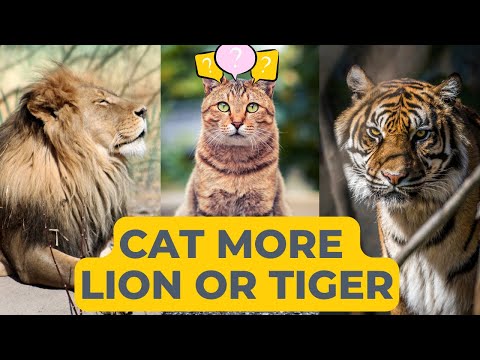
Domestic cats and lions share deep ancestry. Still, they differ in size, behavior, and their stories with humans.
Let’s look at their shared roots, how cats became our companions, and where lions fit among the big cats.
Common Ancestors and the Feline Family Tree
You share the Felidae family with both house cats and lions. That’s thanks to ancient relatives like Proailurus and Pseudaelurus.
Genetic studies show the Felidae split into two main groups: small cats (Felis) and big cats (Panthera). Domestic cats belong to the genus Felis, while lions are Panthera leo.
Small cats keep fully retractable claws and a flexible spine for sneaking up on prey. Big cats in Panthera evolved a different hyoid bone and throat anatomy, which lets most of them roar.
Fossils and DNA place the Panthera lineage a few million years after early felids. You can spot distant kinship in shared teeth patterns, whisker pads, and hunting instincts, but not in recent ancestry.
Domestication of Cats: From Wildcats to Pets
Your pet cat’s story begins with wildcats, especially Felis silvestris in the Near East. Domestication started about 9,000 years ago.
Humans stored grain, which attracted rodents. Wildcats that didn’t mind people stuck around for easy food and shelter.
Over time, those wildcats became the first pet cats. Domestication changed some behaviors and traits, but most wild features stayed.
Most cat breeds still have retractable claws, sharp night vision, and a strong hunting drive. Selective breeding brought us the variety in coat, size, and temperament we see today.
Genetic differences between domestic cats and lions are still huge. Crossing them isn’t possible—reproductive barriers and DNA differences are just too big.
Lions in the Animal Kingdom
You’ll spot lions as big, social predators built for open spaces. They don’t act like your typical house cat—lions stick together in prides and hunt as a team.
Their bodies really show it. Those powerful shoulders and thick forelimbs? Perfect for wrestling big prey. Their claws don’t retract much, which makes them better at grabbing hold of things.
Lions fall under the Panthera group, along with tigers like the Amur tiger and a few other heavyweights. Fossils, like the American lion, hint that big, social cats used to roam a lot more places.
The hyoid bone in Panthera cats lets them roar in a way that’s honestly hard to miss. You might hear a lion’s roar from miles away—it’s kind of wild when you think about it.
Lions need huge territories and wild prey, which sets them apart from your average pet cat. Their survival depends on space and the right kind of habitat.


