
You step outside and see fresh prints in the snow—now what? Do you follow them or just keep walking? Spotting the difference isn’t rocket science, but you’ll want to look at the shape, toe marks, and whether the trail leads to a tree.
Squirrel tracks land in tight, boxy sets with long, fingerlike toes and often head straight to a trunk. Rabbit tracks, though, stretch out more, with the hind feet landing ahead of the front feet in a longer pattern.

This post will help you figure out what to look for in both clear and messy snow. You’ll get tips for telling similar small-animal trails apart, plus some simple clues to find where the animal went.
You’ll pick up quick checks you can use right on the trail. Before you know it, you’ll identify prints in seconds and start reading the story the snow’s been telling.
Detecting Squirrel vs Rabbit Tracks in Snow

You’ll learn some clear, visual clues for telling squirrel and rabbit tracks apart. Focus on shape, size, how they bound, toe and claw marks, and which way the trails go.
Key Differences in Shape and Size
Squirrel track sets look boxy and about as wide as they are long. The hind feet usually land together at the front of each set, while the front feet land behind, making a compact four-print cluster about 1–3 inches across for most tree squirrels.
Rabbit track sets are longer and narrower. The big hind feet land ahead of two smaller front prints, creating an elongated rectangle that can measure 3–6 inches wide, depending on the species.
If you can, measure the prints. Size gives you quick clues: mouse-size marks are tiny, rabbits usually leave bigger tracks than squirrels, and snowshoe hares make really big, widely spaced bounds.
Check how clear the edges are. Squirrel toes and nails often leave sharp detail in good snow.
Interpreting Bounding Patterns
Squirrels and rabbits both move by bounding, but the patterns aren’t the same. Squirrels make short hops over and over, so you’ll see boxy clusters spaced about 1–3 feet apart.
If you follow a squirrel trail, you’ll often end up at a tree base or a food cache. Squirrels love vertical cover.
Rabbits show a “one-one-two” rhythm: the two front prints land behind the two hind prints that land together. This creates a stretched series of rectangles.
Their bounds are usually longer and more evenly spaced than a squirrel’s. Rabbits like to circle trees or move through open cover, not head straight for a trunk.
Toes, Paw Prints, and Claw Imprints
Look closely at toe count and nail marks. Squirrel front prints usually show four toes, and hind prints show five. Those hind toes are long and fingerlike, sometimes with clear nail tips for climbing.
You might spot two small heel pads at the back of a squirrel’s front print.
Rabbit prints usually show five toes on every foot, but the prints are rounder and fuzzier because of all the hair on the pads. Nail marks don’t show up as clearly in rabbit tracks unless the snow is wet or firm.
If you can clearly count long claw imprints and fingerlike toes, you’re probably looking at a squirrel track.
Directional Clues and Trail Signs
Check where the trail leads. Squirrel trails often head to trees, low branches, or the base of a stump. If the prints keep going toward vertical cover or you spot scuffs where a squirrel jumped onto a trunk, it’s a good bet you’re on a squirrel’s path.
Rabbit trails usually skirt around trees and move through brush or open spots. You might spot small, round droppings along a rabbit’s path.
Also, watch for tail-drag marks. Small rodents often leave them, but rabbits and squirrels rarely do.
Use the spacing to judge speed. Longer gaps mean faster running, which helps you tell a hurried rabbit from a cautious squirrel.
For more examples and images, check out this guide on squirrel tracks in snow.
Comparing Other Animal Tracks in Snow
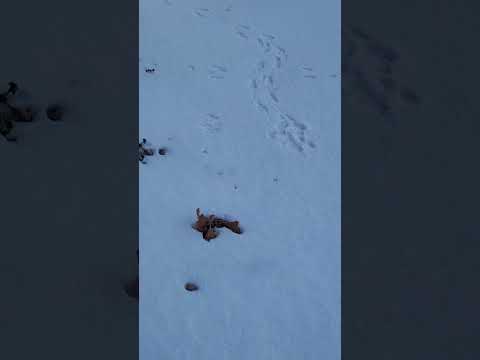
You’ll see how scat and track shape can separate squirrels and rabbits. You’ll also get tips for telling pets from wild ungulates, and spot the basic signs that point to recent movement.
Focus on toe count, size, gait, and nearby signs like chew marks or droppings to make quick IDs.
Distinguishing Squirrel and Rabbit Scat
Squirrel scat usually looks like small, elongated pellets or tiny cigar-shaped droppings. You’ll often find them in clusters near feeding spots, on logs, or under cone-bearing trees where squirrels snack.
Look for shell fragments or chewed cone bits nearby.
Rabbit scat is round, pea-sized pellets scattered along a run or piled at a feeding site. If you see lots of round pellets in a line or at the edge of a hedgerow, you’re probably looking at rabbit sign. Rabbits don’t usually leave scat in trees.
When you track, pair scat shape with prints. Squirrel toe prints and tail drag marks plus clustered scat point to squirrels. Rabbit pellets plus an extended bounding print pattern point to rabbits.
If you spot fur tufts or small gnaw marks on bark, those clues help confirm your ID.
Spotting Dog, House Cat, and Deer Tracks
Dog tracks show four toes and a big pad, often with claw marks. Their stride can be long and kind of unpredictable. In snow, dogs can smudge prints; you’ll often see them crossing trails or following human paths.
House cat tracks are smaller, rounder, and usually don’t show claw marks since cats retract their claws. You’ll notice a neat, direct-walk pattern—prints in a straight line—often near houses or yards.
Look for small toe pads and a distinct central pad shape.
Deer tracks look like heart- or teardrop-shaped cloven hooves in pairs. They often make a steady, single-file trail with even spacing between steps.
You might spot browse lines on low twigs, hair on branches, or shallow scrape marks in softer snow.
Use the setting: tracks near trails, yards, or fences usually belong to dogs or cats. Tracks through fields with nearby browse likely match deer.
Compare print size and pattern to be sure.
Understanding Wildlife Tracking Basics
Start by measuring the track’s length and width, either with your eye or a ruler.
Look at the toes. If you see four toes with claws, you’re probably looking at a dog’s track. Four toes without claws? That usually means cat. Two hooves? Think deer. If you spot four small toes on the front and five on the hind, kind of scattered, it’s likely a squirrel. Four small front toes and longer hind prints lined up in a bounding pattern? That’s probably a rabbit.
Pay attention to how the animal moves. When one foot lands exactly where another did, like a direct register, you’re probably tracking a cat or deer. A bounding pattern points to a rabbit. If you notice tracks ricocheting and scattering, that’s a squirrel.
Don’t forget to look for other clues nearby—droppings, chewed cones, bits of hair, maybe a tail drag or a spot where something bedded down.
Take a photo or make a quick sketch. Jot down the compass direction, too. That info makes it easier to follow fresh signs and figure out whether you want to keep going or just hang back for a while.


