
You can actually hear a lion’s roar from up to five miles away. At close range, it can hit about 114 decibels. That’s louder than a rock concert and strong enough to echo across the savanna.

Let’s dig into how lions make that sound, why it travels so far, and what it means for other lions nearby. You’ll get some straightforward facts about decibels, how their throats work, and when and why lions use their roar.
How Loud Is a Lion’s Roar?

Let’s talk about just how loud lions get, how they stack up against other big cats, and how far their calls can really go if conditions are just right.
Decibel Levels of a Lion Roar
A lion’s roar lands at about 114 decibels if you’re standing nearby. That’s above the noise at a typical rock concert and way beyond what you’d hear in a normal conversation.
If you’re just a few meters away, the sound feels sharp and honestly, almost physical—it’s that powerful.
Decibels work on a logarithmic scale. Every 10 dB jump means the sound energy is about ten times greater. So, 114 dB is roughly 1,000 times more intense than 74 dB. Wild, right?
The lion’s thick, square-shaped vocal folds make this possible by vibrating at low frequencies.
If you ever find yourself close to a roaring lion, you really should protect your ears. Sounds over 120 dB can actually damage hearing.
Field measurements can change depending on distance, wind, or terrain, so that 114 dB number is more of a typical close-up reading—not a hard rule for every roar.
Comparison to Other Big Cats and Animals
Lions sit near the top when it comes to loud roars. People often call it the “loudest roar” among big cats, and honestly, that’s not far off.
Tigers can roar too, but they usually don’t hit the same peak levels as lions. Leopards and jaguars make different sounds, and theirs just aren’t as loud.
Compared to us, a lion at 114 dB is way louder than a human scream, which sits around 70 dB. It’s also a bit louder than your average loud concert, which is about 110 dB.
Elephants can make deep, powerful rumbles that travel long distances, but those don’t get as loud up close as a lion’s roar. The low frequencies in a lion’s roar help it travel so well.
If you check out recordings, you’ll notice the volume changes between individuals, prides, and situations. Male African lions usually make the deepest, loudest roars, which helps them claim territory and shout across the plains.
Range and Distance of the Lion Roar
A lion’s roar really travels in open country. On a cool, calm morning or evening, with flat land, people have heard lions from up to 5 miles (about 8 kilometers) away.
That range drops fast in thick bush or noisy spots.
Low notes carry best. The deep parts of the roar travel farther than the higher bits. Weather matters too—humidity and temperature can help or hurt how far the sound goes.
Sound loses strength as it moves, so a roar that blasts out at 114 dB right next to the lion fades a lot a few miles away.
Lions tend to roar at dawn or dusk, probably because sound carries farther then. They use these calls to warn other prides and to keep in touch with their own group across the savanna.
If you’re out listening, you’ll hear them clearly within a few hundred meters, and maybe catch a faint roar at several kilometers if it’s quiet enough.
What Makes a Lion’s Roar So Powerful?
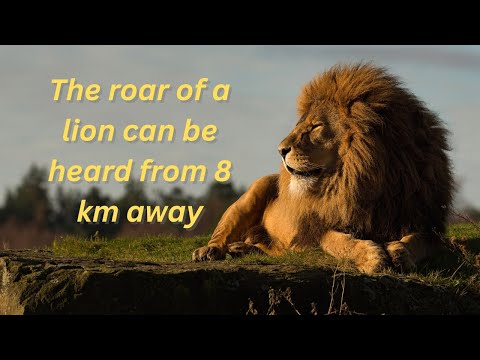
Lions roar so loudly because of their body design and how roaring fits into their lives. Their throat structure, behavior, and even the way researchers study them all play a part.
Unique Anatomy Behind the Roar
You hear a lion’s roar thanks to its oversized larynx and unique vocal folds. The folds are kind of flat and square, giving a bigger surface for vibration.
This shape lets lions make those deep, booming sounds without needing to push out tons of air.
A lion’s throat and chest work like a big resonating chamber. Large air sacs and a wide windpipe help boost the sound even more.
When a lion roars—male or female—it can hit those low, rumbling notes that seem to roll across the grasslands.
Honestly, it’s a bit like a drumbeat you feel in your chest. The mix of body size, vocal fold shape, and resonance gives lions one of the loudest calls in the cat family.
Purpose and Communication of Lion Roars
Lions use their roar to send messages—territory claims, group locations, warnings, you name it. They often roar at dusk as they get ready to hunt, letting rivals know to keep their distance.
Roaring also helps pride members find each other. If the group splits up while hunting, a roar can bring everyone back together.
Males roar to show dominance and attract mates. Usually, the louder and deeper the roar, the stronger the lion.
Roars travel for kilometers, which works perfectly in open savannas. Roaring lets lions avoid a lot of fighting by warning off competitors without having to get physical.
Lions Tigers & Bears: Conservation and Monitoring
At sanctuaries like Lions Tigers & Bears, you might hear roars echoing through the grounds. Staff pay close attention to these vocal patterns—they help them check on the animals’ health and stress levels.
If a roar sounds off or changes, it could mean an animal feels sick or is having social issues. It’s a bit like listening for a cough or a sigh in a friend.
Conservation teams actually use recordings out in the wild, too. With passive acoustic surveys, researchers can pick up on animals’ presence over huge areas without ever needing to catch or disturb them.
This method helps them spot population declines, especially in places hit hard by habitat loss or human activity. It’s a clever workaround for a tough problem.
Sanctuaries and scientists often swap recordings and findings to boost animal care and protection. If you’re interested, you can support their work by learning more about habitat loss and the shrinking spaces where these mighty roars used to travel for miles.


