
You might assume only female animals give birth, but seahorses throw that idea out the window. Male seahorses actually carry the eggs and give birth to live, fully formed babies.

Here’s the wild part—males take eggs from females, tuck them into a pouch, and then use their tails to pump out a shower of tiny seahorses. Why did this role-reversal even evolve? Let’s dig in and see how it shapes seahorse life.
How Do Seahorses Give Birth?

Seahorse dads carry embryos in a pouch, decide when labor starts, and use their bodies to push babies out. Here’s how the males get pregnant, what the pouch actually does, and what happens to the babies after birth.
Unique Role of Male Seahorses
Male seahorses, unlike most animals, get pregnant and give birth. During mating, the female deposits eggs into the male’s brood pouch at the base of his tail.
The male fertilizes the eggs and seals the pouch shut. Inside, he manages temperature, salt levels, and gives oxygen and nutrients to the growing embryos.
This level of parental care runs through the whole Syngnathidae family—so pipefish and seadragons do it too. Depending on the species, males might carry just a few dozen or several thousand embryos at once.
Males also show off with courtship dances before the egg transfer. These dances help the pair sync up and time things just right, making it more likely the babies survive.
Brood Pouch and Birthing Process
The brood pouch works a bit like a womb. Its lining forms a placenta-like tissue, swapping gases and nutrients with each embryo.
Think of it as a cozy, controlled nursery that keeps the young safe as they develop. Pregnancy usually lasts about 2–3 weeks, but this depends on species and water temperature.
When it’s time, the male uses his muscles and bends his body to squeeze the pouch. Water moves in and out, helping flush out the babies.
Labor comes in bursts. With each contraction and pouch opening, small groups of fry shoot out.
The male controls when the pouch opens and the movements that push the young out. It’s a pretty wild sight.
Birth Outcomes and Baby Survival
When the babies arrive, they already look like tiny adult seahorses and immediately swim away. Honestly, survival rates in the wild are low—fish and birds often eat many fry right after birth.
Females lay lots of eggs because only a few young make it to adulthood. Things like habitat, water temperature, and predators make a big difference in how many survive.
If you’re raising seahorses in a tank, adding hideouts and keeping the water flow gentle really helps fry survive. In the wild, the male’s care gives them a head start, but most still face tough odds early on.
- Key terms: brood pouch, male seahorses, Syngnathidae, seahorse birth, seahorse reproduction.
Want to see more? Check out National Geographic’s video on seahorse birth for a closer look at male pregnancy and pouch action: https://www.youtube.com/watch?v=b_nEA3dtOZs.
Seahorse Reproduction in Context
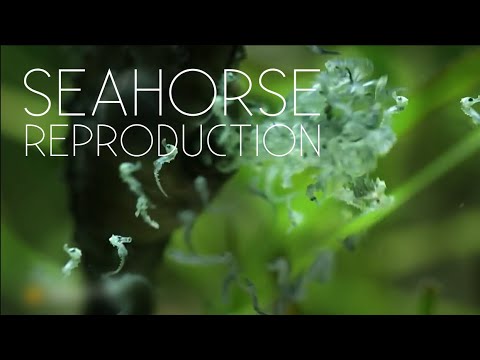
Seahorse dads carry and protect eggs inside a pouch. They control the pouch’s chemistry and use their tails to grip during mating and birth.
Their close relatives do some of this too, but each group has its own anatomy and courtship quirks.
Courtship and Egg Transfer
You’ll see seahorse pairs perform a dance before the eggs get transferred. Males and females face each other, change color, and spiral together for hours.
This ritual strengthens their bond and helps time the female’s egg release so the male is ready. When eggs are set, the female uses a short tube (sort of like an ovipositor) to deposit them into the male’s pouch.
The male opens a slit on his belly and flexes his tail to steady himself. He fertilizes the eggs inside the pouch and seals them up.
Sometimes, courtship repeats over several days so the male can get more eggs.
Family Members: Pipefish and Sea Dragons
Seahorses belong to Syngnathidae, which includes pipefish and seadragons. Pipefish look like straight-bodied seahorses and usually have a narrower brood area along their belly instead of a full pouch.
Their mating is less flashy but still involves the female handing off eggs to the male. Seadragons (sea dragons) have leafy appendages, and in many species, the male carries eggs on a brood patch under or along the tail.
Pipefish, seadragons, and seahorses all share this unusual male brooding, but the details of the pouch or patch differ. Those differences change how many eggs they carry and how parents protect the young as they grow.
Anatomy of Seahorses
You’ll spot a seahorse by its horse-like head, those long snouts, and a tail that curls up almost like it’s holding onto something. Most true seahorse species fall under the genus Hippocampus.
Their prehensile tails help them grip onto seagrass or coral, especially during mating or when it’s time for birth. It’s a clever trick, honestly.
When it comes to the males, they’ve got a brood pouch where a placenta-like lining actually forms. This lining supplies oxygen and nutrients to the developing embryos.
The muscles and blood vessels in the pouch also play a big role. They control the chemistry of the fluid, slowly changing it from something like body fluids to salt water as the embryos get close to hatching.
Unlike what you see in most animals, male seahorses use skeletal muscles near the base of their anal fin to help push out the young. That’s pretty wild, right?
This setup is nothing like a female uterus. It really shows how Syngnathidae have come up with all sorts of ways to make male brooding work.


