
You probably know seahorses as those quirky, upright fish, but their parenting style? Totally unexpected. Male seahorses actually carry and protect eggs in a pouch until they hatch. They manage things like salt balance and oxygen for the babies—pretty wild, right?
So yes, male seahorses really do care for the young before birth by incubating and regulating conditions inside their brood pouch.
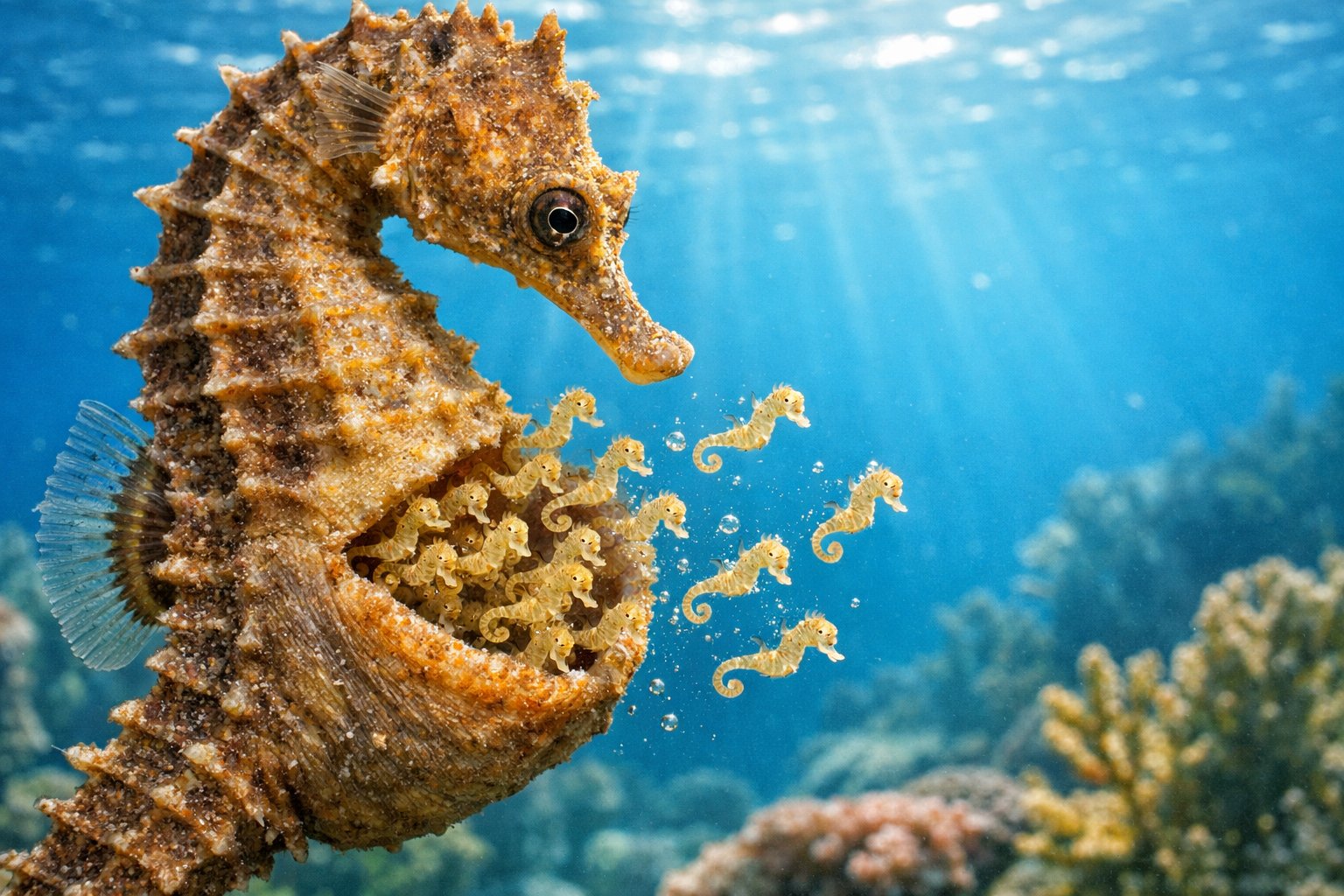
Picture a parent prepping a nursery, but underwater, and it’s literally attached to their body. This post explores how males support the developing young, what birth looks like, and what happens to the tiny seahorses once they leave the pouch.
How Male Seahorses Care for Babies Before Birth

Male seahorses carry eggs in a special pouch, and they control the pouch’s environment. When it’s time, they use strong muscle contractions to give birth.
Their role changes a bit depending on the species. The pouch acts like a tiny womb, keeping eggs safe until the fry are ready.
The Unique Brood Pouch and Male Pregnancy
Male seahorses in the genus Hippocampus have a brood pouch right on the front of their body. The pouch lining is packed with blood vessels, which lets the male send oxygen and nutrients to the developing embryos.
It’s a little like a mammal placenta, just simpler.
Pouch shape and depth differ by species. Pot-bellied seahorses have deep, closed pouches, while dwarf seahorses get by with shallower folds.
The pouch keeps eggs protected from predators and currents as the babies grow.
You can actually see the pouch swell during pregnancy. Its chemistry shifts to match seawater as birth approaches.
That change helps the fry survive when they finally leave the pouch and hit open water.
Pregnancy and Embryo Development
After a bit of courtship, the female deposits her eggs straight into the male’s pouch. He fertilizes them inside and starts incubation.
Incubation can last anywhere from 10 to 25 days, depending on the species and water temperature.
Inside, embryos turn into tiny versions of adults. The male keeps the salinity just right and supplies oxygen through the pouch wall.
He might even provide some immune factors and nutrients for growth.
Survival rates for embryos are pretty low in the wild, so males usually carry a lot of eggs. Some broods reach hundreds or even thousands in bigger species.
His care before birth gives more fry a shot at making it out into the world.
The Role of Male Contractions During Birth
When fry are ready, the male’s skeletal muscles around the pouch contract and push them out. These contractions are quick and forceful, not much like human labor.
Birth can last from a few minutes to several hours, depending on how many babies he’s carrying.
He increases pressure in the pouch, rhythmically pushing fry out through the opening. The contractions also help flush out pouch fluid, easing the fry’s transition to saltwater.
Once the fry are out, the male doesn’t stick around to protect them. The tiny seahorses have to swim off and find food immediately.
But those contractions are the final, crucial step that releases viable baby seahorses into the sea.
Seahorse Reproduction and Courtship Rituals
Courtship in the Syngnathidae family gets pretty elaborate. You’ll see pair dances, color changes, and tail entwining that sync up egg transfer.
These displays help time the female’s egg release with the male’s readiness. Some pairs actually perform their ritual every morning for several days.
It keeps mates bonded and boosts the odds of a successful transfer.
Afterward, some species mate again quickly. In certain Hippocampus species, the female prepares new eggs while the male still carries the current brood.
That means rapid, back-to-back broods when conditions are right.
What Happens to Baby Seahorses After Birth?

Baby seahorses leave their father’s pouch ready to handle life solo. They’re tiny, can swim a bit, and need to find food and shelter fast if they want to survive.
Life of Baby Seahorses in the Wild
Newborn seahorses look like miniature adults, often less than 1 cm long, depending on the species. They use their dorsal fin to swim and snatch up tiny crustaceans—copepods and larval shrimp are favorites.
Most drift in the plankton for days or weeks. Currents carry them between seagrass beds, mangroves, and coral rubble, where they can find food and hiding spots.
Their see-through bodies and early color-changing skills help them dodge predators. They can’t grip with their tails until they’re stronger, though.
If you’ve ever studied seahorses, you might notice that their relatives—pipefish and seadragons—have similar planktonic stages.
Why Parental Care Ends After Birth
Male seahorses put in a lot of effort before birth by carrying eggs in that brood pouch. The pouch provides oxygen, balances salt, and delivers some nutrients during incubation.
But once the young exit, the male’s job is done—he doesn’t stick around to guard or feed them.
This strategy means seahorses can produce huge broods—sometimes hundreds or thousands—so at least a few survive.
Wild parents return to mating and can have multiple broods each season. That trade-off—tons of care before birth, none after—shapes how we think about seahorse conservation and breeding in captivity.
Survival Rates and Dangers Baby Seahorses Face
Honestly, survival rates for baby seahorses are shockingly low. For some species, only about 1 in 100—or sometimes even just 1 in 200—make it to adulthood.
Predators like small fish, crabs, and plankton-eating invertebrates gobble up a lot of the hatchlings. Starvation hits hard too, since newborns have to find microscopic food right away and eat almost nonstop to survive.
Losing habitats makes it even tougher. When seagrass, coral, or mangroves disappear, safe spots for settling vanish with them.
Pollution creeps in and hurts their chances. People collecting seahorses for traditional medicine or aquarium hobbies also puts a dent in the population.
If you care about these tiny creatures, maybe think about supporting habitat protection or responsible trade. Groups like Project Seahorse push for those changes—maybe that’s the best shot for more juveniles to survive.


