
You’ve probably heard that seahorses can change gender. That idea sounds wild, right? But honestly, the reality is a bit less dramatic: seahorses are born male or female and stick with that sex for life.
This is important because their surprising habits—like males carrying eggs—come from fixed sexes, not switching back and forth.
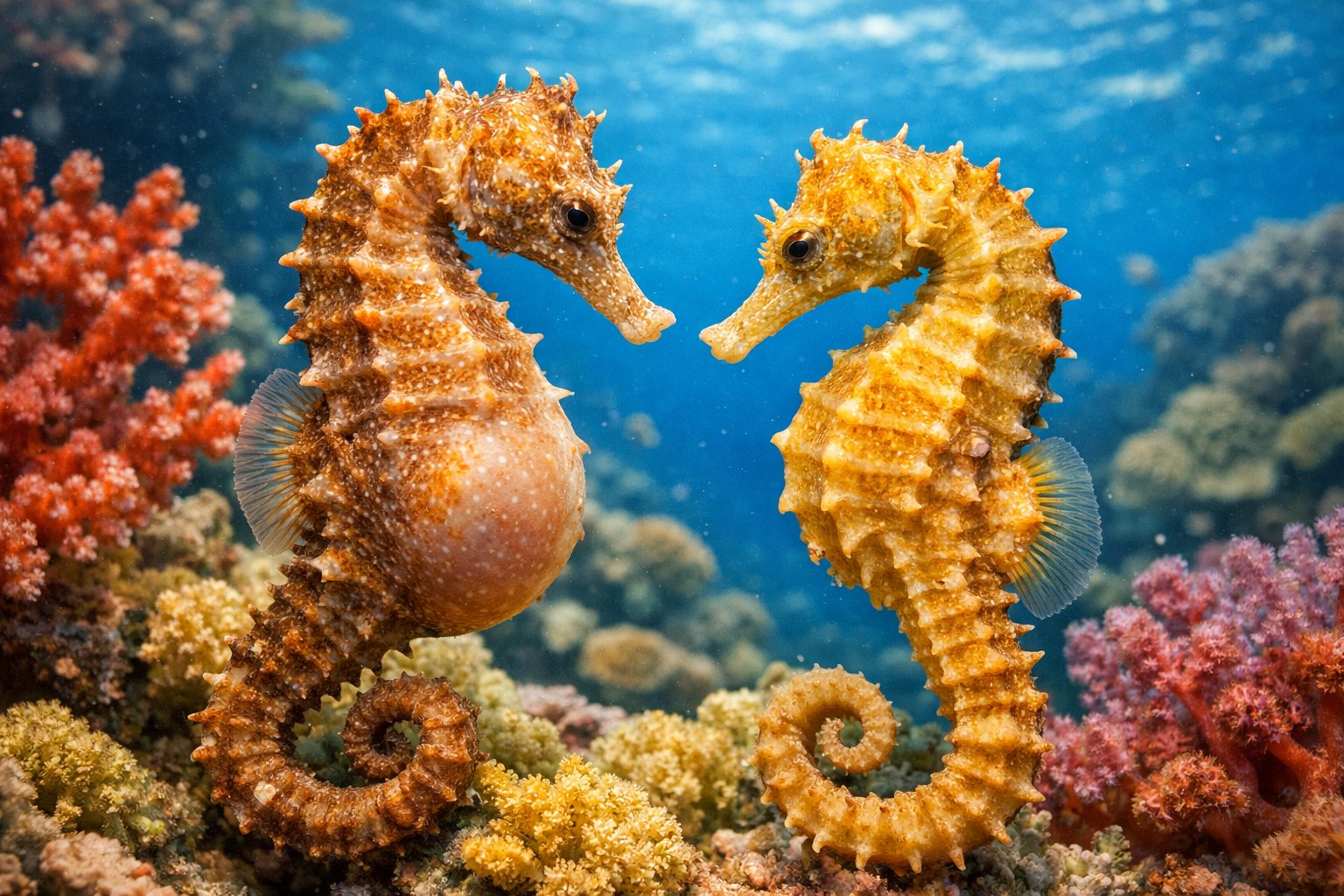
Let’s get into why male pregnancy matters and what’s actually going on inside the male’s brood pouch.
You’ll see how seahorse mating and baby care look totally different from most fish, and maybe you’ll start to get why scientists find them so fascinating.
Do Seahorses Change Gender?

Let’s clear this up: do seahorses actually change sex? And how does that compare to other fish?
What do males and females actually do when it comes to reproduction? Here’s a quick look at the basics.
Sequential Hermaphroditism Explained
Sequential hermaphroditism means an animal can shift from one sex to another during its life.
Plenty of reef fish pull this off. Clownfish, for example, start out as males and become females if the dominant female disappears. That way, the group can always have a breeding pair.
But seahorses? They don’t really do this. Scientists have found that most Hippocampus species keep their sex from birth.
Their genetics and bodies lock in their sex early on. If you’ve heard that seahorses change sex, it’s probably a mix-up with other fish that actually do.
So, while lots of fish change sex, there’s just no strong evidence that seahorses normally do it.
Common Misconceptions About Seahorse Gender
People often assume seahorses change sex because the males get pregnant. That’s a pretty wild role reversal, but it’s not a gender swap.
The female passes her eggs into the male’s brood pouch, and he fertilizes and carries them. This unique setup makes people confuse “role” with “sex.”
There’s another myth that stress or a lack of mates makes seahorses switch sexes. But studies and fieldwork haven’t turned up any solid, repeatable examples of this in Hippocampus.
If you see claims about regular seahorse sex change, it’s smart to be skeptical and look for real evidence—peer-reviewed research, for example.
Seahorse Gender Roles in Nature
In seahorse pairs, each sex has its own job, but they work together.
Females make big, nutrient-rich eggs. Males develop a brood pouch with blood vessels that manage oxygen and salt for the embryos.
During courtship, you’ll spot color changes, synchronized swimming, and the male showing off his pouch before the egg transfer.
Different seahorse species have their own ways of doing things. Some stick with one partner for a while, others switch more often.
Brood sizes can go from just a few dozen to over a thousand babies, depending on the species and how big the parents are.
So, there’s plenty of variety in their roles, but not actual sex reversal.
Unique Reproduction and Male Pregnancy

Seahorses flip the script: here, the males carry and protect the developing young.
Let’s look at how mating works, what the brood pouch does, and how different species handle things like clutch size and timing.
How Male Seahorses Get Pregnant
It all starts with a courtship dance. The pair syncs up their timing and hormones.
The female transfers her eggs straight into the male’s pouch—sometimes it’s over in seconds.
Inside the pouch, the male fertilizes the eggs.
After that, the pouch seals up and the male supplies oxygen and a bit of nutrition.
How long the babies develop depends on water temperature and species—warmer water usually speeds things up.
Males can carry anywhere from a few dozen to thousands of embryos, all depending on species and pouch size.
A male might mate several times in a season. Once he releases one brood, he’s often ready to accept more eggs—sometimes from the same female, sometimes a new one.
This really boosts how many babies a pair can have each year.
The Role of the Brood Pouch
Think of the brood pouch as a traveling nursery.
It shields the embryos from predators and the outside world, while the male manages the environment inside.
The pouch controls things like salt levels, gives oxygen, and gets rid of waste, so the embryos can grow in steady conditions.
Hormones and immune changes in the pouch help the male’s body accept the embryos, even though they’re genetically different.
In some species, the pouch lining gives extra nutrients and fluids—almost like a mammal’s placenta.
That extra support means more embryos survive compared to laying eggs out in the open.
The pouch even shapes how seahorses reproduce. Bigger pouches mean bigger broods and sometimes different mating habits.
Males with larger pouches can put more into each clutch, which is pretty impressive for a fish.
Differences Among Seahorse Species
Seahorse species show a surprising amount of variety in pouch location, pouch type, and how many young they can carry. Some have a fully enclosed pouch right on their abdomen. Others just make do with a simple skin fold or a ventral flap.
These structures shape how embryos get protection and resources. You can really see the difference when you look at clutch size.
Smaller species might only carry a handful—maybe under a hundred embryos. The bigger ones? They can end up with several thousand at once.
Gestation length isn’t fixed either. Some species wrap things up in about two weeks, while others take over a month. Species traits and water temperature push these timelines around.
Behavior and timing? Also all over the place. Certain species form long-term monogamous pairs and mate daily.
Others remate more often, which changes things for conservation. These life-history quirks really shape how we need to protect different populations.
Related reading: learn about the cellular basis of this trait in the Nature study on seahorse male pregnancy (cellular and molecular mechanisms of seahorse male pregnancy).


