
Ever wondered if chimps sleep like we do? Chimps actually share a bunch of sleep habits with humans, but there are some pretty interesting differences too.
Chimps usually get about 9.5 hours of sleep each night, mostly in one long stretch. They spend time building cozy nests high up in trees so they can rest safely.
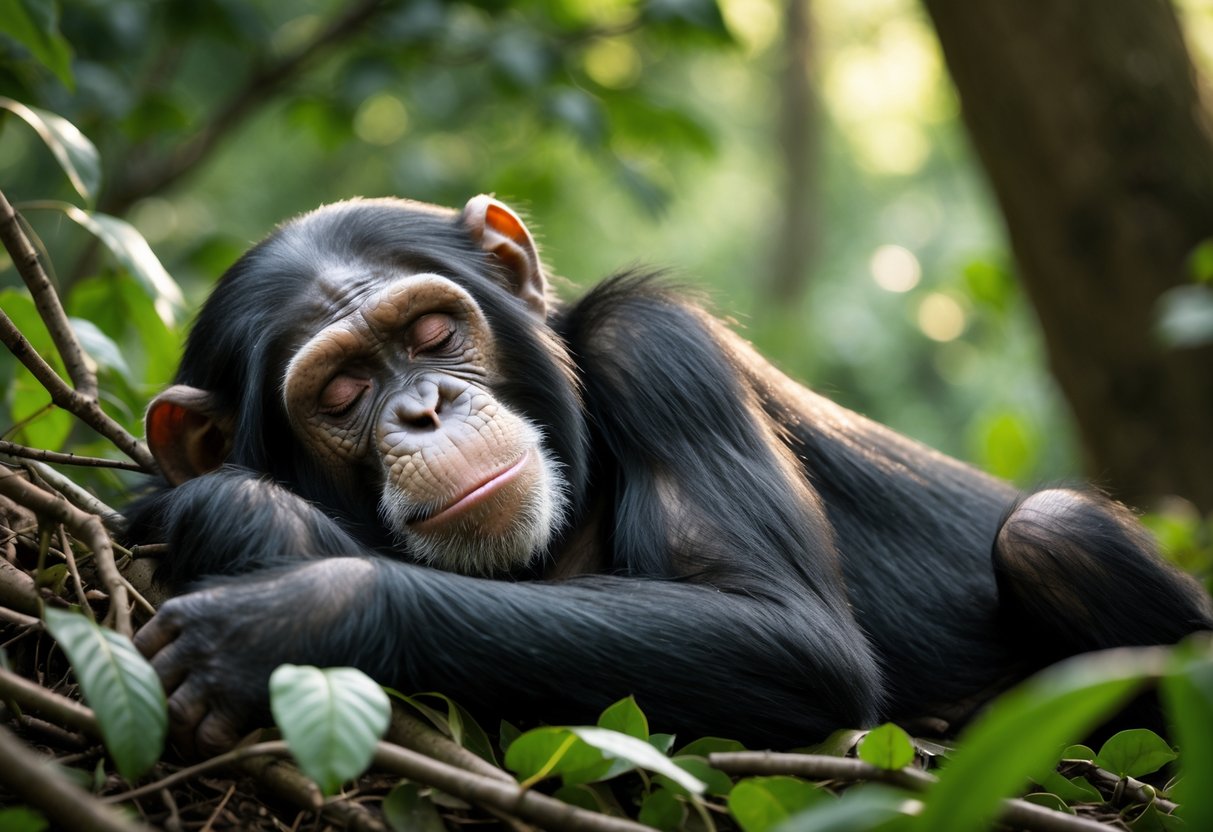
Chimps don’t just plop down anywhere—they work to find the best branches for their nests, making sure their beds feel comfortable and secure.
Their sleep keeps them sharp and healthy, much like how your own sleep boosts your memory and mood.
Learning about how chimps sleep might give you a new perspective on human rest, and why sleep habits matter for everyone. It’s kind of surprising how close chimps and humans are when it comes to bedtime, isn’t it?
Curious about their nighttime routines? Let’s keep going.
How Chimpanzee Sleep Compares to Humans
Chimpanzee sleep has a lot in common with human sleep, but there are some clear differences in how long they sleep and the quality of their rest.
Both chimps and humans go through important sleep stages like REM and deep sleep, which help with memory and brain function.
Similarities Between Chimpanzee and Human Sleep
Chimps and humans both tend to sleep in one main block during the night. Just like us, chimps build comfy nests out of leaves and branches to rest safely.
Their sleep structure has similar stages to ours, including periods of deep sleep and REM sleep.
Researchers from the American Journal of Physical Anthropology found that they can score chimpanzee sleep patterns using the same methods as with humans.
Both species show brain activity that changes during sleep, which points to shared sleep processes that matter for thinking and memory.
Chimps sometimes wake up a few times during the night, just like we do. This pattern goes against the old idea that they sleep in one long, unbroken stretch.
Differences in Sleep Duration and Stages
Chimps usually sleep a bit longer than most people. On average, they get about 8.8 to 9.5 hours of sleep each night, while humans often sleep around 7 to 8 hours.
Of course, this depends on the individual and their environment.
Older chimps usually sleep longer and get better quality rest than younger adults. Your own sleep changes with age too, following a pattern shaped by both biology and lifestyle.
In the wild, chimps sometimes clock up to 12 hours in their nests, but this number includes time spent just resting—not always actual sleep.
Humans, on the other hand, usually have more consistent sleep lengths, though things like social habits and artificial light can mess with that.
The Role of REM and Deep Sleep
You need REM sleep and deep sleep for memory and brain repair. Chimps do too.
Studies show that chimps experience REM sleep with eye and body movements a lot like ours.
David Samson and other researchers point out that this shared REM sleep hints at a strong evolutionary connection.
Deep sleep phases, which help with body recovery, show up in both chimps and humans.
These stages help us and chimps process the day’s information and get ready for what’s next. Chimpanzee sleep isn’t just downtime—it’s vital for their brains, just like it is for us.
Unique Sleeping Habits of Chimpanzees in the Primate Family

Chimpanzees have some sleep habits that really set them apart, even from other great apes.
Their way of making nests, choosing safe spots, and how they stack up against other primates like gorillas and orangutans, shows just how unique their routines are.
Nest Building Among Great Apes
Every night, chimps build fresh nests in the trees, usually picking sturdy branches from tough trees like Ugandan ironwood.
They weave branches and leaves together tightly to make a flat, firm bed. It’s not just about comfort—being up high keeps them safe and steady.
Chimps put real time and effort into their nests, unlike some other primates.
Orangutans also build tree nests but usually sleep alone. Gorillas might make nests on the ground or in trees, but often without as much effort.
The way chimps carefully build their nests shows how much they value a good sleep spot. It keeps predators away and shields them from the weather, helping them get better rest.
Influence of Sleep Environment and Safety
A chimp’s sleep environment matters as much to them as yours does to you.
They pick spots high in the trees, sometimes 30 feet off the ground, to steer clear of predators like snakes and big cats.
Safety and comfort go together. Chimps choose the most stable branches so they won’t fall while sleeping.
A solid nest can also cut down on bugs and dampness, which makes a big difference in how well they rest.
Sleeping close to others in the group often brings warmth and protection. Social sleeping, which happens with some chimps and among gorillas, offers extra eyes for danger and helps strengthen social ties.
This mix of safety and comfort in where they sleep really shows how important a secure place to rest is—whether you’re a chimp or a person.
Comparisons With Orangutans, Gorillas, and Baboons
Chimpanzees build their nests high up, and they make a fresh one every night. Orangutans do something pretty similar, but they usually sleep alone in tree nests they craft themselves.
Gorillas, though, mix it up. They often sleep together in groups, and sometimes they just settle on the ground. Their nests or bedding tend to be a lot simpler.
Baboons? They don’t really bother with nests at all. Instead, they sleep on the ground or just rest in tree branches, counting on their group for safety.
For baboons, sleep seems less about comfort and more about sticking together to stay safe.
You can really see how each species adapts to its own challenges and environment. Chimpanzees focus on cozy, secure nests, while others juggle social bonds and whatever their surroundings throw at them.
Curious about the science behind these habits? Researchers like David Samson talk about it in places like the American Journal of Physical Anthropology.


