
Ever wondered if a person could actually raise a chimpanzee like their own child? It sounds wild, right? Sure, chimps are smart and can pick up on a lot, but their development just isn’t the same as ours.
Trying to raise a chimp as a human doesn’t really work out. Their brains and bodies develop in ways that just don’t let them become truly human-like.

Some researchers got curious and ran experiments where they raised chimps alongside their own children. These studies showed that chimps can copy a lot of what humans do, but they just can’t speak or think exactly like us.
Honestly, raising a chimp this way is tough on everyone involved—both the animal and the family.
If you’re curious about just how close a chimp can get to acting human, or what kinds of challenges pop up, this story should give you a pretty honest look. There’s a lot to learn about what chimps can do, and where their limits really are.
Can a Human Raise a Chimpanzee: Science and Real-Life Experiments
When people try to raise a chimpanzee as if it’s human, they run into tons of challenges. Biology, behavior, and growth all play a part in how chimps turn out.
Real-life experiments actually show what a human caretaker is in for when they treat a chimp like a child.
Key Differences Between Humans and Chimpanzees
Humans and chimps have a bunch of similarities, but the differences really matter. Chimps grow up faster physically, but their minds mature differently.
Their brains are smaller and shaped differently, which changes how they learn and solve problems.
When it comes to communication, chimps rely on gestures and sounds instead of words. Their social needs and instincts don’t really match up with ours either.
You’ll see these differences pop up in how they react to care and training.
| Characteristic | Humans | Chimpanzees |
|---|---|---|
| Brain Size | Larger, more complex | Smaller, less complex |
| Maturation Speed | Slower | Faster |
| Communication | Spoken language | Gestures, sounds |
| Social Structure | More varied | Strong hierarchical |
If you’re thinking about raising a chimp, it’s important to keep these differences in mind.
Notable Case Study: Gua and the Kellogg Experiment
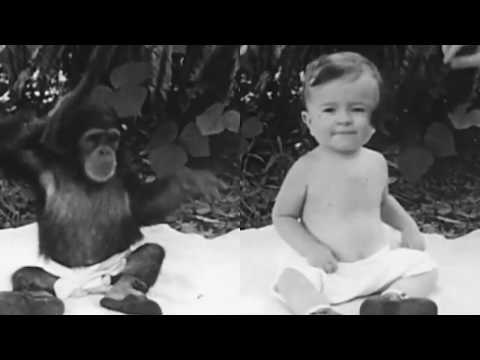
Back in 1931, Dr. Winthrop Kellogg and his wife decided to raise a chimp named Gua alongside their baby son, Donald. They treated Gua like a human child to see how much environment could shape her development.
For nine months, Gua and Donald grew up together. The Kelloggs tested them on memory, reflexes, and even language.
At first, Gua actually beat Donald in some tasks. She had impressive strength and coordination.
But after a while, it became obvious that Gua’s genetics were holding her back. She just couldn’t pick up human language or fully act like a human kid.
The experiment ended after nine months. Gua was getting tougher to handle, and there were worries that Donald was starting to copy her chimp sounds.
This story really shows both what’s possible and where the limits are when you try to raise a chimp in a human home. If you want more details, check out This Guy Simultaneously Raised a Chimp and a Baby in Exactly the Same Way.
Limitations of Chimpanzee Development and Behavior
Even with all the human care in the world, chimps like Gua hit some hard limits. Their brains just aren’t built for abstract thinking or real language.
You won’t see a chimp truly speaking or understanding language the way people do.
Chimps have strong instincts that you can’t really train out of them. Their social behaviors and emotions just don’t line up with ours.
As they grow, chimps get physically strong and can be tough to control.
Their health needs and lifespan also differ from ours. If you want to raise a chimp for years, you need special knowledge and resources.
It’s important to recognize when their behavior might turn risky or just too much to handle.
If raising a chimp sounds interesting, you’ve got to remember that biology shapes their development just as much as their environment.
Genetics, Evolution, and Implications for Raising Chimps

Thinking about raising a chimp like a human? You really have to consider genetics and evolution.
Chimps and humans share a lot of biology, but those differences are huge. They shape how chimps grow and act, no matter how much care you give them.
Genetic Barriers and Species Differences
Chimps and humans share about 98-99% of their DNA, but that tiny gap makes a big difference. Genes control how brains work, how bodies grow, and even how we pick up language.
Chimps just don’t have some of the brain developments that let people use words or understand complex ideas.
Physical differences matter too. Chimps walk differently and rely more on their sense of smell than sight.
These genetic barriers mean chimps can’t truly think or live like humans, even if you raise them in your home. If you want to dive deeper, check out this article on chimpanzee biology and human origins.
The Role of a Common Ancestor
Humans and chimps both came from a common ancestor millions of years ago. That’s why we share some social behaviors and cognitive skills.
But evolution sent us down different roads, especially when it comes to brain size and language.
This shared ancestry explains why chimps can pick up a few human-like tasks if they grow up around people. But their brains just don’t develop the same way.
Humans evolved to use complex speech, while chimps stayed tuned for survival in the wild. If you’re curious about this, there’s more in the discussion on differences between humans and chimpanzees genomes.
Ethical Considerations and Modern Perspectives
Raising a chimp like a human brings up all sorts of ethical questions you really have to consider. The Kellogg family, for example, tried this experiment and discovered chimps can bond with people and pick up basic tasks.
But honestly, those experiments put a lot of strain on both the animals and the humans involved. Most people today agree—it’s just not right to keep chimps in human homes.
Chimps need their own social groups, and they thrive in natural environments with other chimps. Modern science recognizes their intelligence, but doesn’t try to force them to act like humans anymore.
If you want a deeper look into these ethical debates, you might want to check out the Kellogg experiment story at IFLScience.


